

CTOP |
Catalog No.GC16888
 One-Click Copy Product Info
|

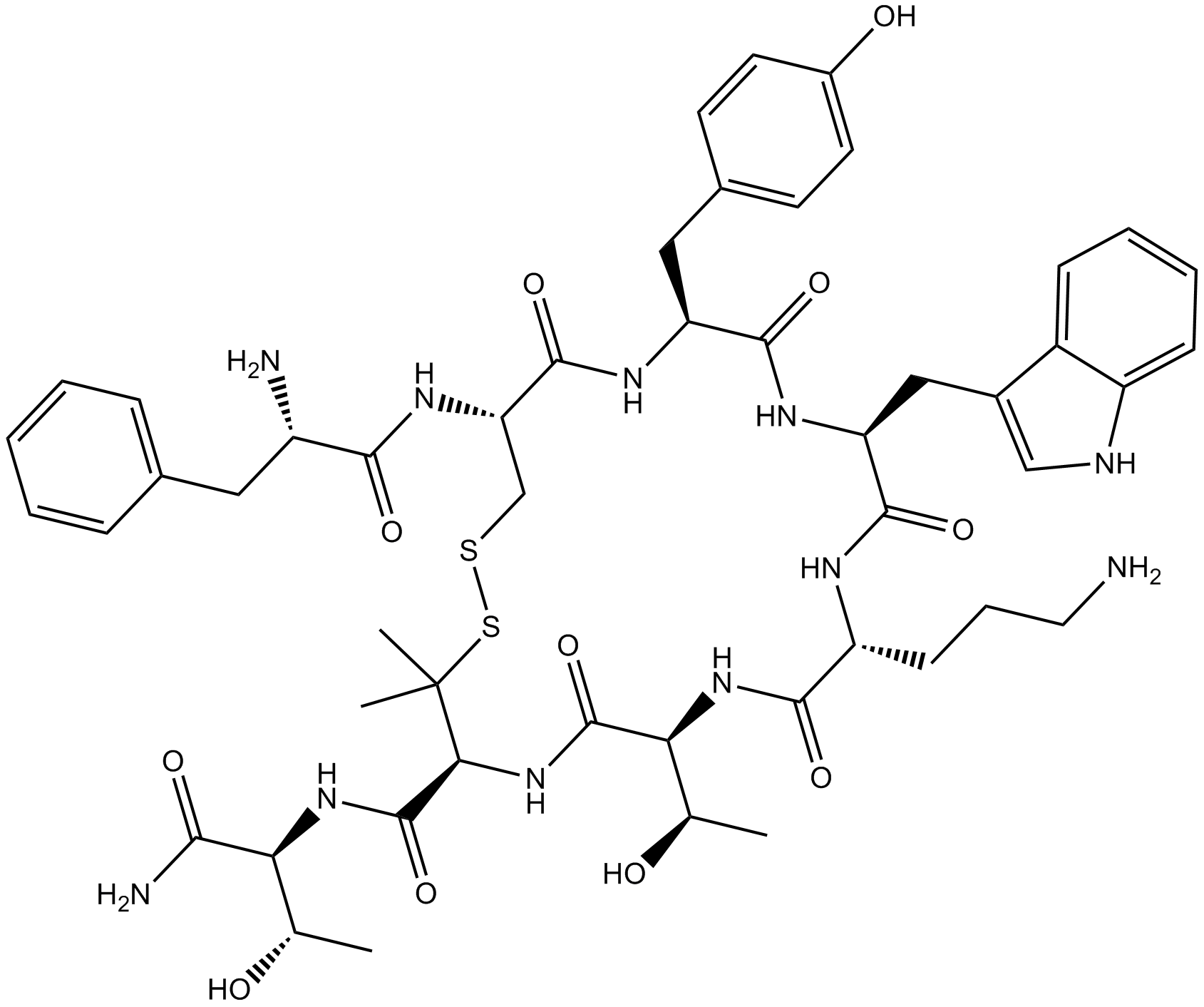
CTOP는 IC50 값 2.80nM의 강력하고 고도로 선택적인 μ-오피오이드 수용체 길항제이다.
Products are for research use only. Not for human use. We do not sell to patients.
Cas No.: 103429-31-8
Sample solution is provided at 25 µL, 10mM.
_1-3.$$$39978408@51.jpg');)
_1-9.$$$38538795@65.jpg');)
_1-9.$$$39112701@51.jpg');)
_1-7.$$$37316672@70.jpg');)
_366-372.$$$36198801@70.jpg');)
.$$$38565142@65.jpg');)
_1867-1883.$$$33248023@67.jpg');)
_eads6055.$$$39977546@45.jpg');)
_eadm9805.$$$40080571@45.jpg');)
_eadj3020.$$$39666821@45.jpg');)
_1-20.$$$39757301@28.jpg');)
_1-24.$$$38898113@28.jpg');)
_273-287.$$$36806353@46.jpg');)
_1-16.$$$37156877@44.jpg');)
_1-19.$$$37460805@44.jpg');)
_1291-1307.$$$34518654@46.jpg');)
CTOP는 IC50 값 2.80nM의 강력하고 고도로 선택적인 μ-오피오이드 수용체 길항제이다. CTOP는 μ-오피오이드 수용체를 표적으로 하고 Ca²⁺ 유입 억제를 차단해서 쥐의 신경 뇌하수체 말단에서 펩타이드 방출을 조절할 수 있다[2]. CTOP는 쥐 모델의 체온과 체중을 조절하고 모르핀에 의한 진통 효과를 차단하기 위해 일반적으로 사용되고 있다[3].
체외 실험에서 10nM CTOP 처리 48시간이 델타 오피오이드 펩타이드 [D-Ala2, D-Leu5]엔케팔린(DADLE)의 PC12 세포에 대한 세포 독성을 현저하게 억제하고 세포 생존을 촉진하였다[4]. 1µM CTOP로 15분 처리하면 고립된 허약한 쥐 심장에서 상승한 젖산 탈수소효소(LDH) 활성에 대한 모르핀과 레미펜타닐의 억제 효과를 완전히 차단하였다[5].
체내 실험에서 음주 15분 전 복강 내 주사를 통해 CTOP (1mg/kg) 처리가 알코올 선호 C57BL/6 쥐의 알코올 섭취량을 현저하게 감소시켰다[6]. 열판 검사 30분 전에 단일 용량의 CTOP (6µg/쥐)를 쥐의 로스트럴 전대상피질(rACC)에 주사하였고 위약 진통 쥐의 통증 역치를 감소시킬 수 있었다[7].
References:
[1] Gulya K, Lui G K, Pelton J T, et al. HD-Phe-Cys-Tyr-D-Trp-Orn-Thr-Pen-Thr-NH2: A potent and selective antagonist for mu opioid receptors[J]. Progress in Opioid Research, 1986: 209.
[2] Ortiz‐Miranda S I, Dayanithi G, Coccia V, et al. µ‐Opioid Receptor Modulates Peptide Release From Rat Neurohypophysial Terminals By Inhibiting Ca2+ Influx[J]. Journal of neuroendocrinology, 2003, 15(9): 888-894.
[3] Gulya K, Kriván M, Nyolczas N, et al. Central effects of the potent and highly selective μ opioid antagonist (CTOP) in mice[J]. European journal of pharmacology, 1988, 150(3): 355-360.
[4] Hayashi T, Tsao L I, Su T P. Antiapoptotic and cytotoxic properties of delta opioid peptide [D‐Ala2, D‐Leu5] enkephalin in PC12 cells[J]. Synapse, 2002, 43(1): 86-94.
[5] He S F, Jin S Y, Yang W, et al. Cardiac μ-opioid receptor contributes to opioid-induced cardioprotection in chronic heart failure[J]. British journal of anaesthesia, 2018, 121(1): 26-37.
[6] Kim S G, Stromberg M F, Kim M J, et al. The effect of antagonists selective for μ-and δ-opioid receptor subtypes on alcohol consumption in C57BL/6 mice[J]. Alcohol, 2000, 22(2): 85-90.
[7] Zhang R R, Zhang W C, Wang J Y, et al. The opioid placebo analgesia is mediated exclusively through µ-opioid receptor in rat[J]. International Journal of Neuropsychopharmacology, 2013, 16(4): 849-856.
| 세포 실험 [1]: | |
세포 라인 | PC12 세포 |
제조 방법 | PC12 세포는 37°C, 5% CO₂에서 콜라겐 코팅 플라스크에 5% 태아 소 혈청, 10% 마 혈청, 글루타민(4mM), 페니실린(50U/ml) 및 스트렙토마이신(50mg/ml)이 포함된 RPMI1640 배양지로 배양하였습니다. 세포를 무혈청 배양지로 4회 세척한 후 DADLE (100pM)과 CTOP (10nM) 유무에 관계없이 무혈청 조건에서 48시간 배양하였습니다. 그런 다음 세포 생존율을 분석하였습니다. |
반응 조건 | 10nM; 48 시간 동안 |
응용 분야 | DADLE 처리 후에 CTOP 처리가 PC12 세포의 세포 생존율을 현저하게 향상시켰습니다. |
| 동물 실험 [2]: | |
동물 모형 | 수컷 C57BL/6 쥐 |
제조 방법 | 수컷 C57BL/6 쥐(3주령)는 한 케이지당 5마리씩 사육되었고 도착 후 5일간 적응 기간을 가졌습니다. 물과 음식은 자유롭게 섭취할 수 있었습니다. 7일 동안 쥐는 알코올 용액(10% v/v)을 강제로 마시게 하였고 음식은 계속 자유롭게 섭취할 수 있었습니다. 8일부터 35일까지 각 쥐는 음식을 자유롭게 섭취할 수 있고 물은 22시간 동안 제공되는 개별 케이지에 사육되었고 나머지 2시간 동안 알코올 용액(10% v/v)이 제공되었습니다. 매일 알코올 병 제공 전에 음식과 물 병을 0.01g까지 정밀하게 저울에 달아 일일 음식 (24시간) 및 물 (22시간) 섭취량을 기록하였습니다.마찬가지로 알코올 병은 2시간 접근 기간의 시작과 종료할 때 모두 저울에 달았습니다. 이 시점에 쥐의 체중도 측정하였습니다. 33일째 종료할 때 알코올 소비량에 따라 쥐를 매칭해서 다섯 개 그룹 중 하나에 무작위로 배정하였습니다. 매칭 절차는 평균 기준선 알코올 소비량에 따라 쥐를 순위로 매기는 것을 포함하였습니다. 소비량이 가장 높은 다섯 마리 쥐는 다섯 개 실험 그룹에 분배되었고 이와 같은 방식으로 진행되었습니다. 이는 그룹 간 알코올 소비량이 비교 가능하도록 보장하였습니다. CTOP 그룹(n=7)의 쥐는 CTOP 1mg/kg을 복강 내 주사하였습니다. 모든 생리식염수 또는 CTOP 주사는 35일째 알코올 접근 15분 전에 투여되었습니다. CTOP 투여 후 2시간 이내의 알코올 섭취량을 분석하였습니다. |
제형 | 1mg/kg 한 번; i.p. |
응용 분야 | CTOP 처리가 알코올 선호 C57BL/6 쥐의 알코올 소비를 현저하게 억제하였습니다. |
References: | |
| Cas No. | 103429-31-8 | SDF | |
| Formula | C50H67N11O11S2 | M.Wt | 1062.28 |
| Solubility | Soluble to 1 mg/ml in Water | Storage | Desiccate at -20°C |
| General tips | Please select the appropriate solvent to prepare the stock solution according to the
solubility of the product in different solvents; once the solution is prepared, please store it in
separate packages to avoid product failure caused by repeated freezing and thawing.Storage method
and period of the stock solution: When stored at -80°C, please use it within 6 months; when stored
at -20°C, please use it within 1 month. To increase solubility, heat the tube to 37°C and then oscillate in an ultrasonic bath for some time. |
||
| Shipping Condition | Evaluation sample solution: shipped with blue ice. All other sizes available: with RT, or with Blue Ice upon request. | ||
| Prepare stock solution | |||

|
1 mg | 5 mg | 10 mg |
| 1 mM | 941.4 μL | 4.7069 mL | 9.4137 mL |
| 5 mM | 188.3 μL | 941.4 μL | 1.8827 mL |
| 10 mM | 94.1 μL | 470.7 μL | 941.4 μL |
Step 1: Enter information below (Recommended: An additional animal making an allowance for loss during the experiment)
 g
μL
g
μL
Step 2: Enter the in vivo formulation (This is only the calculator, not formulation. Please contact us first if there is no in vivo formulation at the solubility Section.)
Calculation results:
Working concentration: mg/ml;
Method for preparing DMSO master liquid: mg drug pre-dissolved in μL DMSO ( Master liquid concentration mg/mL, Please contact us first if the concentration exceeds the DMSO solubility of the batch of drug. )
Method for preparing in vivo formulation: Take μL DMSO master liquid, next addμL PEG300, mix and clarify, next addμL Tween 80, mix and clarify, next add μL saline, mix and clarify.
Method for preparing in vivo formulation: Take μL DMSO master liquid, next add μL Corn oil, mix and clarify.
Note: 1. Please make sure the liquid is clear before adding the next solvent.
2. Be sure to add the solvent(s) in order. You must ensure that the solution obtained, in the previous addition, is a clear solution before proceeding to add the next solvent. Physical methods such as vortex, ultrasound or hot water bath can be used to aid dissolving.
3. All of the above co-solvents are available for purchase on the GlpBio website.
Quality Control & SDS
- View current batch:
- Purity: >98.00% Appearance: A solid
- COA (Certificate of Analysis)
- SDS (Safety Data Sheet)
- Datasheet
Average Rating: 5 (Based on Reviews and 20 reference(s) in Google Scholar.)