

NGI-1 (Synonyms: N-linked Glycosylation Inhibitor 1; ML414) |
Catalog No.GC33055
 One-Click Copy Product Info
|

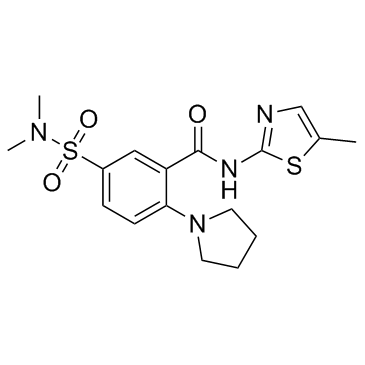
NGI-1 (ML414)은 효과적인 올리고당 전이효소(OST) 억제제이다.
Products are for research use only. Not for human use. We do not sell to patients.
Cas No.: 790702-57-7
Sample solution is provided at 25 µL, 10mM.
_1-3.$$$39978408@51.jpg');)
_1-9.$$$38538795@65.jpg');)
_1-9.$$$39112701@51.jpg');)
_1-7.$$$37316672@70.jpg');)
_366-372.$$$36198801@70.jpg');)
.$$$38565142@65.jpg');)
_1867-1883.$$$33248023@67.jpg');)
_eads6055.$$$39977546@45.jpg');)
_eadm9805.$$$40080571@45.jpg');)
_eadj3020.$$$39666821@45.jpg');)
_1-20.$$$39757301@28.jpg');)
_1-24.$$$38898113@28.jpg');)
_273-287.$$$36806353@46.jpg');)
_1-16.$$$37156877@44.jpg');)
_1-19.$$$37460805@44.jpg');)
_1291-1307.$$$34518654@46.jpg');)
NGI-1 (ML414)은 효과적인 올리고당 전이효소(OST) 억제제이다. NGI-1은 올리고사카리릴 트랜스퍼레이즈(OST) 복합체의 STT3A와 STT3B 아단위를 선택적으로 억제해서 단백질의 N-링크당화 과정을 차단한다[2-3]. NGI-1은 종양 세포에서 EGFR과 같은 당화에 의존적인 단백질의 조절을 연구할 때 자주 사용되고 일정한 항종양 잠재력이 있다[4].
PC9 세포에서 NGI-1(10㎛; 48시간)은 부모 및 T790M 발현 PC9 세포 라인 모두의 증식을 약 90% 줄였다. HEK293 세포에서 NGI-1(5㎛; 60분) 처리는 HSV-1의 세포 유형에 따른 기능 장애를 유발한다. Caco2 세포에서 NGI-1(1㎛, 5㎛; 3일)은 SARS-CoV-2에 대한 유의한 억제 효과가 있다. SKMG3 세포에서 NGI-1(10㎛; 48시간)은 교모세포종세포에서 RTK 신호전달을 방해한다[7].
구강 편평상피세포암 이종이식 모델에서 NGI-1(10mg/kg; ip; 14일)을 대상으로 EREG 당화를 결합해서 억제하면 항PD-L1 억제제의 체내 효능을 현저하게 향상시킨다[8]. 폐선암 이종이식 모델에서 NGI-1(20mg/kg; ip; 24일)으로 처리된 쥐의 종양 부피와 젖은 무게는 종점에서 DMSO 대조 그룹보다 현저하게 작았다[9]. CD24-WT 누드 쥐에서 NGI-1(20mg/kg; ip; 24일) 처리는 종양 성장을 현저하게 억제했다[10].
References:
[1]. Rinis N, Golden JE, Marceau CD, et al. Editing N-glycan site occupancy with small-molecule oligosaccharyltransferase inhibitors. Cell chemical biology. 2018 Oct 18; 25(10): 1231-1241.
[2]. Lu H, Cherepanova NA, Gilmore R, et al. Targeting STT3A-oligosaccharyltransferase with NGI-1 causes herpes simplex virus 1 dysfunction. The FASEB Journal. 2019 Feb 27;33(6):6801.
[3]. Harada Y, Ohkawa Y, Kizuka Y, et al. Oligosaccharyltransferase: a gatekeeper of health and tumor progression. International journal of molecular sciences. 2019 Dec 2; 20(23): 6074.
[4]. Cao Y, Yi W, Zhu Q. Glycosylation in the tumor immune response: the bitter side of sweetness: Glycosylation in the tumor immune response. Acta Biochimica et Biophysica Sinica. 2024 Jun 28; 56(8): 1184.
[5]. Lopez Sambrooks C, Baro M, Quijano A, et al. Oligosaccharyltransferase inhibition overcomes therapeutic resistance to EGFR tyrosine kinase inhibitors. Cancer research. 2018 Sep 1; 78(17): 5094-5106.
[6]. Huang YJ, Zhao H, Huang X, et al. Identification of oligosaccharyltransferase as a host target for inhibition of SARS-CoV-2 and its variants. Cell Discovery. 2021 Nov 30; 7(1): 116.
[7]. Baro M, Lopez Sambrooks C, Quijano A, et al. Oligosaccharyltransferase inhibition reduces receptor tyrosine kinase activation and enhances glioma radiosensitivity. Clinical Cancer Research. 2019 Jan 15; 25(2): 784-795.
[8]. Xu S, Wang H, Zhu Y, et al. Stabilization of EREG via STT3B-mediated N-glycosylation is critical for PDL1 upregulation and immune evasion in head and neck squamous cell carcinoma. International Journal of Oral Science. 2024 Jul 1; 16(1): 47.
[9]. Cheng J, Xia L, Hao X, et al, Tavolari S. Targeting STT3A produces an anti-tumor effect in lung adenocarcinoma by blocking the MAPK and PI3K/AKT signaling pathway. Translational Lung Cancer Research. 2022 Jun; 11(6): 1089.
[10]. Wang J, Zhang HM, Zhu GH, et al. STT3-mediated aberrant N-glycosylation of CD24 inhibits paclitaxel sensitivity in triple-negative breast cancer. Acta Pharmacologica Sinica. 2025 Apr; 46(4): 1097-1110.
| 세포 실험 [1]: | |
세포 라인 | PC9 세포 |
제조 방법 | 제조업체의 지시 의존적으로 CellTiter 96 비방사성 세포증식검사 (Promega)를 사용해서 성장률을 결정하였습니다. 간단하게 비소세포폐암세포(2×10³)를 처리하지 않거나 10㎛ NGI-1, 100㎛ gefitinib 또는 1㎛ osimertinib로 처리해서 96웰 판에 3겹으로 씨를 뿌리고 10% 혈청을 포함한 배양액에서 성장시켰습니다. 매 48시간마다 새로운 억제제가 있는 또는 없는 배지를 교환하였습니다. |
반응 조건 | 10μM; 48시간 동안 |
응용 분야 | NGI-1은 부모 세포라인과 T790M 발현 PC9 세포주의 증식을 약 90% 줄였습니다. |
| 동물 실험 [2]: | |
동물 모형 | 구강 편평 세포암 이종 이식 모델 |
제조 방법 | NGI-1은 10% DMSO + 40% PEG300 + 5% Tween 80 + 45% 식염수로 희석해서 최종 농도를 1 mg/mL로 만들었고 PD-L1 억제제는 PBS로 희석해서 최종 농도를 0.5 mg/mL로 만들었습니다. 동물 실험에서는 6주령 SPF 등급의 C57BL/6 수컷 쥐를 사용하였습니다. MTCQ1 세포를 사용해서 종양 이종 이식 모델을 설정하였고 세포(5×10⁶ cells/100μL PBS)를 쥐의 측면에 피하 주사하였고 종양 크기는 주 3회 관찰하였습니다. NGI-1과 PD-L1 억제제는 각각 10mg/kg과 5mg/kg의 용량으로 매주 4회 복강 주사하였습니다. |
제형 | 10mg/kg; ip; 14 동안 |
응용 분야 | NGI-1을 표적으로 EREG 당화를 결합해서 억제하면 항PD-L1 억제제의 체내 효능을 현저하게 향상시킵니다. |
References: | |
| Cas No. | 790702-57-7 | SDF | |
| Synonyms | N-linked Glycosylation Inhibitor 1; ML414 | ||
| Canonical SMILES | O=C(NC1=NC=C(C)S1)C2=CC(S(=O)(N(C)C)=O)=CC=C2N3CCCC3 | ||
| Formula | C17H22N4O3S2 | M.Wt | 394.51 |
| Solubility | DMSO : 160 mg/mL (405.57 mM) | Storage | Store at -20°C |
| General tips | Please select the appropriate solvent to prepare the stock solution according to the
solubility of the product in different solvents; once the solution is prepared, please store it in
separate packages to avoid product failure caused by repeated freezing and thawing.Storage method
and period of the stock solution: When stored at -80°C, please use it within 6 months; when stored
at -20°C, please use it within 1 month. To increase solubility, heat the tube to 37°C and then oscillate in an ultrasonic bath for some time. |
||
| Shipping Condition | Evaluation sample solution: shipped with blue ice. All other sizes available: with RT, or with Blue Ice upon request. | ||
| Prepare stock solution | |||

|
1 mg | 5 mg | 10 mg |
| 1 mM | 2.5348 mL | 12.6739 mL | 25.3479 mL |
| 5 mM | 507 μL | 2.5348 mL | 5.0696 mL |
| 10 mM | 253.5 μL | 1.2674 mL | 2.5348 mL |
Step 1: Enter information below (Recommended: An additional animal making an allowance for loss during the experiment)
 g
μL
g
μL
Step 2: Enter the in vivo formulation (This is only the calculator, not formulation. Please contact us first if there is no in vivo formulation at the solubility Section.)
Calculation results:
Working concentration: mg/ml;
Method for preparing DMSO master liquid: mg drug pre-dissolved in μL DMSO ( Master liquid concentration mg/mL, Please contact us first if the concentration exceeds the DMSO solubility of the batch of drug. )
Method for preparing in vivo formulation: Take μL DMSO master liquid, next addμL PEG300, mix and clarify, next addμL Tween 80, mix and clarify, next add μL saline, mix and clarify.
Method for preparing in vivo formulation: Take μL DMSO master liquid, next add μL Corn oil, mix and clarify.
Note: 1. Please make sure the liquid is clear before adding the next solvent.
2. Be sure to add the solvent(s) in order. You must ensure that the solution obtained, in the previous addition, is a clear solution before proceeding to add the next solvent. Physical methods such as vortex, ultrasound or hot water bath can be used to aid dissolving.
3. All of the above co-solvents are available for purchase on the GlpBio website.
Quality Control & SDS
- View current batch:
- Purity: >98.00% Appearance: A solid
- COA (Certificate of Analysis)
- SDS (Safety Data Sheet)
- Datasheet
Average Rating: 5 (Based on Reviews and 7 reference(s) in Google Scholar.)