

NPPB (Synonyms: HOE 144, Hoechst 144) |
Catalog No.GC14268
 One-Click Copy Product Info
|

NPPB는 단로 전류에 대해 IC50이 80nM인 강력한 염화물 채널 억제제이다.
Products are for research use only. Not for human use. We do not sell to patients.
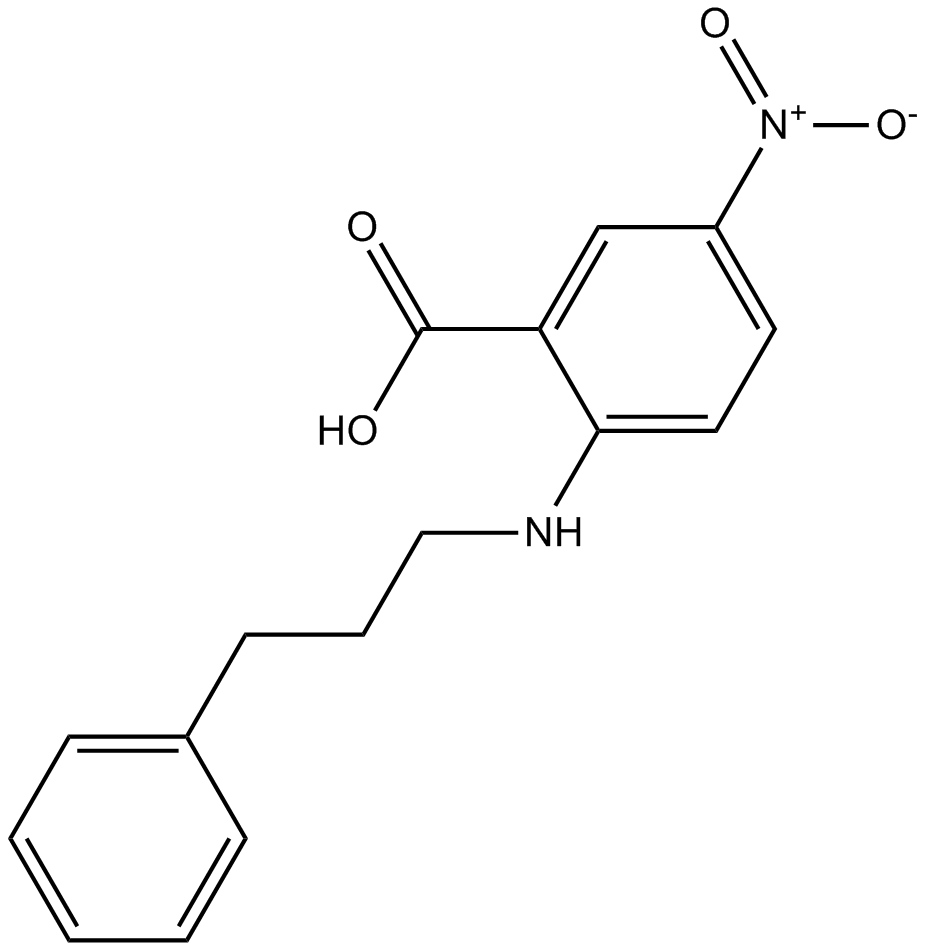
Cas No.: 107254-86-4
Sample solution is provided at 25 µL, 10mM.
NPPB는 단로 전류에 대해 IC50이 80nM인 강력한 염화물 채널 억제제이다. NPPB는 상피 이온 수송 기전(낭포성 섬유증 및 분비성 설사 등) 및 심혈관 생리 조절 연구에 일반적으로 사용된다[2][3].
체외 실험에서 인간 결막 섬유아세포(HConFs)를 NPPB(100μM; 48시간)로 처리하면 세포 증식, 이동, 세포 주기 진행을 억제하고 세포 사멸을 증가시키고 콜라겐 I와 섬유접합 단백질의 발현을 줄였다[4]. NPPB(30-120μM; 72시간)는 부착 섬유아세포(AFB)의 이동을 IC50이 56.75μM인 정도로 억제하고 세포 증식을 농도와 시간 의존적으로 줄여서 부피 활성 염화물 전류(ICl, vol)를 차단하고 부피 조절 감소(RVD)를 억제하였다[5].
체내 실험에서 NPPB(20과 40mg/kg; 복강주사; 1-7시간)은 쥐에서 압박 손상 유도 신경병성 통증에서 기계적 및 열적 과민증을 증가시켰다[6]. NPPB(0.1㎖; 20 mM; 동맥내 주사)은 토끼의 연수에서 ET-1 유도 혈관수축을 예방하고 ET-1 유도 조직학적 변화를 역전시켰다[7].
References:
[1] Wangemann P, Wittner M, Di Stefano A, et al. Cl(-)-channel blockers in the thick ascending limb of the loop of Henle. Structure activity relationship. Pflugers Arch. 1986;407 Suppl 2:S128-S141.
[2] Lin WY, Sohma Y, Hwang TC. Synergistic Potentiation of Cystic Fibrosis Transmembrane Conductance Regulator Gating by Two Chemically Distinct Potentiators, Ivacaftor (VX-770) and 5-Nitro-2-(3-Phenylpropylamino) Benzoate. Mol Pharmacol. 2016;90(3):275-285.
[3] Diaz RJ, Losito VA, Mao GD, Ford MK, Backx PH, Wilson GJ. Chloride channel inhibition blocks the protection of ischemic preconditioning and hypo-osmotic stress in rabbit ventricular myocardium. Circ Res. 1999;84(7):763-775.
[4] Sun L, Dong Y, Zhao J, et al. NPPB modulates apoptosis, proliferation, migration and extracellular matrix synthesis of conjunctival fibroblasts by inhibiting PI3K/AKT signaling. Int J Mol Med. 2018;41(3):1331-1338.
[5] Zhong J, Qin Z, Yu H, et al. NPPB prevents postoperative peritoneal adhesion formation by blocking volume-activated Cl- current. Naunyn Schmiedebergs Arch Pharmacol. 2020;393(3):501-510.
[6] Ramteke VD, Tandan SK, Kumar D, Aruna Devi R, Shukla MK, Ravi Prakash V. Increased hyperalgesia by 5-nitro-2, 3-(phenylpropylamino)-benzoic acid (NPPB), a chloride channel blocker in crush injury-induced neuropathic pain in rats. Pharmacol Biochem Behav. 2009;91(3):417-422.
[7] Dogulu F, Barun S, Emmez H, et al. Effect of a chloride channel inhibitor, 5-nitro-2- (3-phenylpropylamino)-benzoate, on endothelin-1 induced vasoconstriction in rabbit basilar artery. Turk Neurosurg. 2009;19(4):380-386.
| 세포 실험 [1]: | |
세포 라인 | 원대 점착성 섬유모세포 (AFB) |
제조 방법 | 원대 복막 AFB 세포를 12웰 판에 1.9×10⁵/웰의 밀도로 파종하고 80에서 90%의 접합도까지 성장하도록 하였습니다. 접합 단일층을 10μL 파이펫 팁으로 긁고 세포 파편을 제거하기 위해 여러 번 PBS로 세척하였습니다. 배양액은 1% BSA, 1% FBS를 포함하고 있어 NPPB의 농도는 0, 30, 60, 90, 120μM로 증가하였습니다. 상처 치유는 상처가 닫히는 속도를 평가하기 위해 역전형 형광 현미경으로 촬영하였습니다. 이동률은 [(0시간의 상처 면적−72시간의 상처 면적)/0시간의 상처 면적]×100%라는 공식을 사용해서 계산하였습니다. 72시간의 실험 데이터는 비선형 회귀 분석을 사용해서 시그모이드형 용량 반응 곡선으로 변환해서 해당 IC50 값을 계산하였습니다. |
반응 조건 | 30–120μM; 72 시간 동안 |
응용 분야 | NPPB는 부착 섬유아세포(AFB)의 이동을 IC50이 56.75μM인 정도로 억제하였습니다. |
| 동물 실험 [2]: | |
동물 모형 | 알비노 토끼 |
제조 방법 | 2.7-3.6kg의 체중을 가진 30마리의 알비노 토끼를 5개 그룹으로 나누었습니다. 모든 동물은 30mg/kg 펜토바르비탈 나트륨(정맥주사)으로 마취되고 호흡기를 사용해서 인공호흡을 하였습니다. 각 동물의 대퇴동맥을 통해 5 프랑스 고유량 다목적 카테터를 척추동맥에 삽입하였습니다. 각 그룹에서 기저동맥의 대조 혈관조영술을 실시하였습니다. 대조 혈관조영술 후 15분에 1그룹의 척추동맥에 0.6㎖의 동위원소 생리식염수를 2그룹의 척추동맥에 0.6㎖의 1nM ET-1을 천천하게 주사하였습니다. 주사 후 30분에 ET-1과 동위원소 생리식염수의 효과를 평가하기 위해 대조 혈관조영술을 실시하였다. ET-1과 NPPB를 동시 처리한 그룹(3그룹)에서는 대조 혈관조영술 후 0.1㎖의 20 mM NPPB를 천천하게 주사하였습니다.NPPB 투여 후 10분에 0.6㎖, 1nM ET-1을 천천히 주사하였습니다. 마지막 혈관조영술은 ET-1 주사 후 30분에 실시해서 NPPB 처리 토끼에서 ET-1의 효과를 평가하였습니다. 4그룹에서 NPPB가 DMS에 녹아 있었기 때문에 0.1㎖ DMS 주사 후 30분에 대조 혈관조영술을 실시해서 DMS의 효과를 테스트하였습니다. 4그룹에서 정상 기저동맥에서 NPPB의 효과를 테스트하기 위해 0.1㎖ 20 mM NPPB 주사 후 30분에 대조 혈관조영술을 실시하였습니다. 감산 영상에서 각 그룹에서 주사 전후 기저동맥의 직경을 측정하고 정량 분석 소프트웨어로 비교하였습니다. 모든 동물은 반복 혈관조영술 후 즉시 출혈로 희생되었습니다. 기저동맥은 신속하게 제거되었고 이전에 설명된 방법 의존적으로 초미세 구조 조사를 위해 처리되었습니다. |
제형 | 0.1ml; 20mM; 동맥 내 주사 |
응용 분야 | NPPB는 토끼의 연수에서 ET-1 유도 혈관 수축을 예방하고 ET-1 유도 조직학적 변화를 역전시켰습니다. |
References: | |
| Cas No. | 107254-86-4 | SDF | |
| Synonyms | HOE 144, Hoechst 144 | ||
| Chemical Name | 5-nitro-2-((3-phenylpropyl)amino)benzoic acid | ||
| Canonical SMILES | OC(C1=CC([N+]([O-])=O)=CC=C1NCCCC2=CC=CC=C2)=O | ||
| Formula | C16H16N2O4 | M.Wt | 300.31 |
| Solubility | ≥ 11.05mg/mL in DMSO | Storage | Store at -20°C |
| General tips | Please select the appropriate solvent to prepare the stock solution according to the
solubility of the product in different solvents; once the solution is prepared, please store it in
separate packages to avoid product failure caused by repeated freezing and thawing.Storage method
and period of the stock solution: When stored at -80°C, please use it within 6 months; when stored
at -20°C, please use it within 1 month. To increase solubility, heat the tube to 37°C and then oscillate in an ultrasonic bath for some time. |
||
| Shipping Condition | Evaluation sample solution: shipped with blue ice. All other sizes available: with RT, or with Blue Ice upon request. | ||
| Prepare stock solution | |||

|
1 mg | 5 mg | 10 mg |
| 1 mM | 3.3299 mL | 16.6495 mL | 33.2989 mL |
| 5 mM | 666 μL | 3.3299 mL | 6.6598 mL |
| 10 mM | 333 μL | 1.6649 mL | 3.3299 mL |
Step 1: Enter information below (Recommended: An additional animal making an allowance for loss during the experiment)
 g
μL
g
μL
Step 2: Enter the in vivo formulation (This is only the calculator, not formulation. Please contact us first if there is no in vivo formulation at the solubility Section.)
Calculation results:
Working concentration: mg/ml;
Method for preparing DMSO master liquid: mg drug pre-dissolved in μL DMSO ( Master liquid concentration mg/mL, Please contact us first if the concentration exceeds the DMSO solubility of the batch of drug. )
Method for preparing in vivo formulation: Take μL DMSO master liquid, next addμL PEG300, mix and clarify, next addμL Tween 80, mix and clarify, next add μL saline, mix and clarify.
Method for preparing in vivo formulation: Take μL DMSO master liquid, next add μL Corn oil, mix and clarify.
Note: 1. Please make sure the liquid is clear before adding the next solvent.
2. Be sure to add the solvent(s) in order. You must ensure that the solution obtained, in the previous addition, is a clear solution before proceeding to add the next solvent. Physical methods such as vortex, ultrasound or hot water bath can be used to aid dissolving.
3. All of the above co-solvents are available for purchase on the GlpBio website.
Quality Control & SDS
- View current batch:
- Purity: >98.00% Appearance: A solid
- COA (Certificate of Analysis)
- SDS (Safety Data Sheet)
- Datasheet
Average Rating: 5 (Based on Reviews and 13 reference(s) in Google Scholar.)