

p2Ca |
Catalog No.GC31861
 One-Click Copy Product Info
|

8-mer 펩타이드인 p2Ca는 자연적으로 처리되어 Ld-동종반응성 T 세포 클론인 2C에 제공되는 리간드입니다.
Products are for research use only. Not for human use. We do not sell to patients.
Cas No.: 142606-55-1
Sample solution is provided at 25 µL, 10mM.
_1-3.$$$39978408@51.jpg');)
_1-9.$$$38538795@65.jpg');)
_1-9.$$$39112701@51.jpg');)
_1-7.$$$37316672@70.jpg');)
_366-372.$$$36198801@70.jpg');)
.$$$38565142@65.jpg');)
_1867-1883.$$$33248023@67.jpg');)
_eads6055.$$$39977546@45.jpg');)
_eadm9805.$$$40080571@45.jpg');)
_eadj3020.$$$39666821@45.jpg');)
_1-20.$$$39757301@28.jpg');)
_1-24.$$$38898113@28.jpg');)
_273-287.$$$36806353@46.jpg');)
_1-16.$$$37156877@44.jpg');)
_1-19.$$$37460805@44.jpg');)
_1291-1307.$$$34518654@46.jpg');)
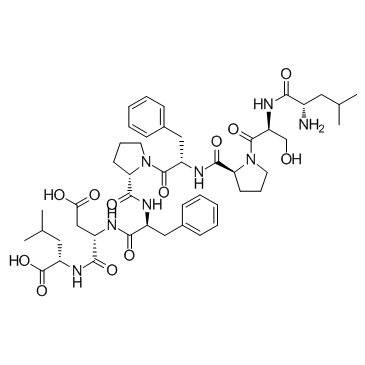
p2Ca, an 8-mer peptide, is a ligand that is naturally processed and presented to the Ld-alloreactive T cell clone, 2C.
p2Ca and QL9 peptides assume distinct conformations when bind to Ld and, furthermore, demonstrate that there is flexibility in peptide binding within the MHC class I cleft. Ld antigenic peptide p2Ca (LSPFPFDL) is 8-mer that lack the proline at position 2 and thus use alternative amino-terminal anchors. The p2Ca octamer is identified as the ligand that is naturally processed and presented to the Ld-alloreactive T cell clone, 2C[1]. p2Ca, is immunodominant in allorecognition of the murine MHC class I molecule H-2Ld. The majority of Ld-alloreactive T-cell clones are specific for Ld-p2Ca and this immunodominance is not due to peptide cross-reactivity[2]. p2Ca is a ubiquitously expressed self-peptide. p2Ca is derived from the mouse mitochondrial enzyme α-ketoglutarate dehydrogenase. p2Ca is present in every tissue of BALB/c mice that has been examined, including the spleen and thymus. It is also expressed by mouse tumor cell lines such as the mastocytoma P815. CTL derived in vitro recognize specifically the p2Ca/L d complex and use Vβ8 regions predominantly. The cultured cells lyse target cells with lower levels of p2Ca than the levels used for induction. This result suggests that it may be possible to use peptides at high concentrations to elicit CTL that react with endogenous levels of a peptide/class I complex[3].
BALB/c mice, coinjected with a syngeneic BALB/c myeloma and exogenous p2Ca, are able to reject the tumor. The p2Ca/L d system may thus provide a model for evaluating the parameters for effective immunotherapy with tumor-associated peptides[3].
[1]. Hornell TM, et al. Peptide length variants p2Ca and QL9 present distinct conformations to L(d)-specific T cells. J Immunol. 2001 Oct 15;167(8):4207-14. [2]. Connolly JM, et al. The peptide p2Ca is immunodominant in allorecognition of Ld by beta chain variable region V beta 8+ but not V beta 8- strains. Proc Natl Acad Sci U S A. 1994 Nov 22;91(24):11482-6. [3]. Tjoa BA, et al. Generation of cytotoxic T-lymphocytes to a self-peptide/class I complex: a model for peptide-mediated tumor rejection. Cancer Res. 1994 Jan 1;54(1):204-8.
Animal experiment: | Mice: The effectiveness of self-peptide treatment is evaluated using a syngeneic system with the BALB/c derived myeloma Sp2/0. B2 [an Ld transfectant of Sp2/0 (19)] is incubated for the indicated times with 3 or 30 μM p2Ca or without p2Ca. A binding assay with 125I-labeled anti-Ld antibody 28-14-8 is performed[3]. |
References: [1]. Hornell TM, et al. Peptide length variants p2Ca and QL9 present distinct conformations to L(d)-specific T cells. J Immunol. 2001 Oct 15;167(8):4207-14. | |
| Cas No. | 142606-55-1 | SDF | |
| Canonical SMILES | Leu-Ser-Pro-Phe-Pro-Phe-Asp-Leu | ||
| Formula | C47H66N8O12 | M.Wt | 935.07 |
| Solubility | Soluble in Water | Storage | Store at -20°C |
| General tips | Please select the appropriate solvent to prepare the stock solution according to the
solubility of the product in different solvents; once the solution is prepared, please store it in
separate packages to avoid product failure caused by repeated freezing and thawing.Storage method
and period of the stock solution: When stored at -80°C, please use it within 6 months; when stored
at -20°C, please use it within 1 month. To increase solubility, heat the tube to 37°C and then oscillate in an ultrasonic bath for some time. |
||
| Shipping Condition | Evaluation sample solution: shipped with blue ice. All other sizes available: with RT, or with Blue Ice upon request. | ||
| Prepare stock solution | |||

|
1 mg | 5 mg | 10 mg |
| 1 mM | 1.0694 mL | 5.3472 mL | 10.6944 mL |
| 5 mM | 213.9 μL | 1.0694 mL | 2.1389 mL |
| 10 mM | 106.9 μL | 534.7 μL | 1.0694 mL |
Step 1: Enter information below (Recommended: An additional animal making an allowance for loss during the experiment)
 g
μL
g
μL
Step 2: Enter the in vivo formulation (This is only the calculator, not formulation. Please contact us first if there is no in vivo formulation at the solubility Section.)
Calculation results:
Working concentration: mg/ml;
Method for preparing DMSO master liquid: mg drug pre-dissolved in μL DMSO ( Master liquid concentration mg/mL, Please contact us first if the concentration exceeds the DMSO solubility of the batch of drug. )
Method for preparing in vivo formulation: Take μL DMSO master liquid, next addμL PEG300, mix and clarify, next addμL Tween 80, mix and clarify, next add μL saline, mix and clarify.
Method for preparing in vivo formulation: Take μL DMSO master liquid, next add μL Corn oil, mix and clarify.
Note: 1. Please make sure the liquid is clear before adding the next solvent.
2. Be sure to add the solvent(s) in order. You must ensure that the solution obtained, in the previous addition, is a clear solution before proceeding to add the next solvent. Physical methods such as vortex, ultrasound or hot water bath can be used to aid dissolving.
3. All of the above co-solvents are available for purchase on the GlpBio website.
Quality Control & SDS
- View current batch:
- Purity: >98.00% Appearance: A solid
- COA (Certificate of Analysis)
- SDS (Safety Data Sheet)
- Datasheet
Average Rating: 5 (Based on Reviews and 4 reference(s) in Google Scholar.)