

Pioglitazone HCl |
Catalog No.GC11152
 One-Click Copy Product Info
|

A PPARγ agonist
Products are for research use only. Not for human use. We do not sell to patients.
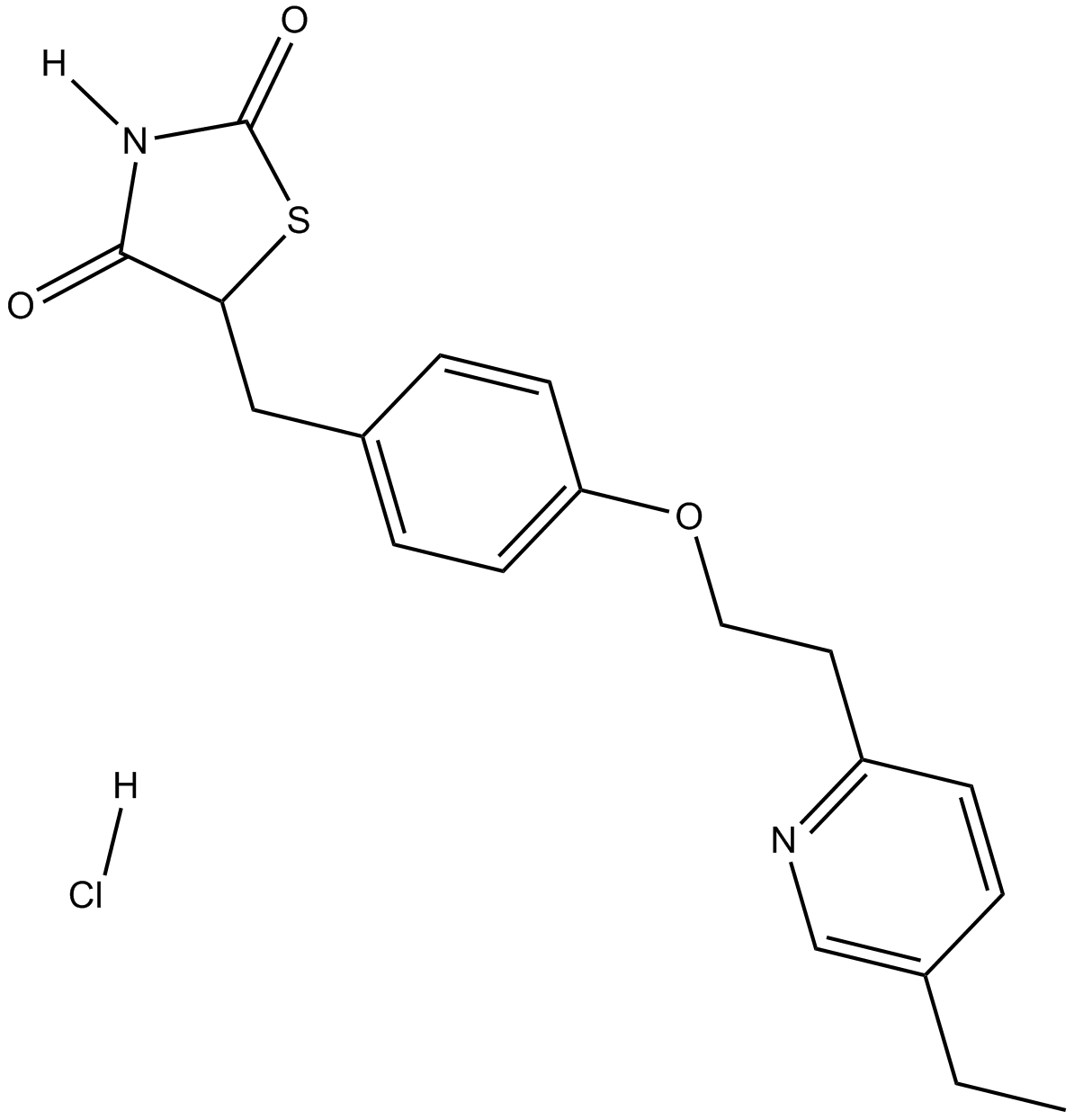
Cas No.: 112529-15-4
Sample solution is provided at 25 µL, 10mM.
_1-3.$$$39978408@51.jpg');)
_1-9.$$$38538795@65.jpg');)
_1-9.$$$39112701@51.jpg');)
_1-7.$$$37316672@70.jpg');)
_366-372.$$$36198801@70.jpg');)
.$$$38565142@65.jpg');)
_1867-1883.$$$33248023@67.jpg');)
_eads6055.$$$39977546@45.jpg');)
_eadm9805.$$$40080571@45.jpg');)
_eadj3020.$$$39666821@45.jpg');)
_1-20.$$$39757301@28.jpg');)
_1-24.$$$38898113@28.jpg');)
_273-287.$$$36806353@46.jpg');)
_1-16.$$$37156877@44.jpg');)
_1-19.$$$37460805@44.jpg');)
_1291-1307.$$$34518654@46.jpg');)
Pioglitazone HCl is a potent and highly selective agonist of PPARγ with IC50 value of 3μM[1].
Pioglitazone HCl can increase both insulin-stimulated glucose uptake in peripheral tissues and insulin sensitivity in hepatic and adipose tissue. It is treated for hyperglycemia and Type 2 diabetes (T2D). Pioglitazone needs insulin as a co-factor for PPAR agonism so it is not effect when being treated to late stages of T2D with developed insulinopenia. In clinical trials, 15mg pioglitazone produces significant improvements in HbA1c and fasting plasma glucose (FPG) [2].
Pioglitazone is also reported to have multiple beneficial effects on lipid metabolism. It produces significant decreases in TG and significant increases in high density lipoprotein (HDL) in clinical studies [2].
References:
[1] Saad S, Agapiou DJ, Chen XM, Stevens V, Pollock CA. The role of Sgk-1 in the upregulation of transport proteins by PPAR-{gamma} agonists in human proximal tubule cells. Nephrol Dial Transplant. 2009 Apr;24(4):1130-41.
[2] Dorkhan M, Frid A. A review of pioglitazone HCL and glimepiride in the treatment of type 2 diabetes. Vasc Health Risk Manag. 2007;3(5):721-31.
Cell experiment: | In order to evaluate cell proliferation, HIT-T15 cells are seeded on 96-well plates (3×10⁴ cells/well) and cultured for 5 days as described. Viable cells are determined using the Cell Titer 96 Aqueous One Solution Cell Proliferation Assay. To evaluate cell apoptosis and cell necrosis, HIT-T15 cells are plated on 6-well dishes (7×10⁵ cells/well) for 5 days in standard conditions (CTR) or in the presence of AGEs (AGEs) with or without Pioglitazone (0.5 or 1 μM) or AG (1 mM). They are then processed to measure both the activity of caspase-3 and the activity of lactate dehydrogenase (LDH) (a stable cytosolic enzyme that is a marker of cell membrane damage and cell death due to necrosis) using Cytotox 96 Non Radioactive Cytotoxicity Assay[2]. |
Animal experiment: | Mice[3] 10 mg/kg Pioglitazone HCl or vehicle (0.25% carboxymethylcellulose) is adnimistered to ob/ob and adipo-/- ob/ob mice by oral gavage once daily for 14 consecutive days. 30 mg/kg Pioglitazone or vehicle is also adnimistered to ob/ob and adipo-/- ob/ob mice by oral gavage once daily for 14 consecutive days. Rats[4] Male Wistar albino rats (weighing 250±20 g) are ued.Rats that achieved serum glucose level ≥250 mg/dL and serum creatinine level ≥1.5 mg/dL are divided into 2 groups (n=10 per each group): diabetic nephropathic (DN) group in which rats received an equal amount of vehicle (0.5% carboxy methyl cellulose) and Pioglitazone-treated (DN+Pio) group in which rats treated with Pioglitazone. Pioglitazone (10 mg/kg BW) is given orally by gastric gavage, once daily, for 4 weeks. |
References: [1]. Kuwabara K, et al. A novel selective peroxisome proliferator-activated receptor alpha agonist, 2-methyl-c-5-[4-[5-methyl-2-(4-methylphenyl)-4-oxazolyl]butyl]-1,3-dioxane-r-2-carboxylic acid (NS-220), potently decreases plasma triglyceride and glucose leve | |
| Cas No. | 112529-15-4 | SDF | |
| Chemical Name | 5-[[4-[2-(5-ethylpyridin-2-yl)ethoxy]phenyl]methyl]-1,3-thiazolidine-2,4-dione;hydrochloride | ||
| Canonical SMILES | CCC1=CN=C(C=C1)CCOC2=CC=C(C=C2)CC3C(=O)NC(=O)S3.Cl | ||
| Formula | C19H20N2O3S.HCl | M.Wt | 392.9 |
| Solubility | ≥ 19.65 mg/mL in DMSO, ≥ 7.52 mg/mL in EtOH with ultrasonic and warming | Storage | Store at -20°C |
| General tips | Please select the appropriate solvent to prepare the stock solution according to the
solubility of the product in different solvents; once the solution is prepared, please store it in
separate packages to avoid product failure caused by repeated freezing and thawing.Storage method
and period of the stock solution: When stored at -80°C, please use it within 6 months; when stored
at -20°C, please use it within 1 month. To increase solubility, heat the tube to 37°C and then oscillate in an ultrasonic bath for some time. |
||
| Shipping Condition | Evaluation sample solution: shipped with blue ice. All other sizes available: with RT, or with Blue Ice upon request. | ||
| Prepare stock solution | |||

|
1 mg | 5 mg | 10 mg |
| 1 mM | 2.5452 mL | 12.7259 mL | 25.4518 mL |
| 5 mM | 509 μL | 2.5452 mL | 5.0904 mL |
| 10 mM | 254.5 μL | 1.2726 mL | 2.5452 mL |
Step 1: Enter information below (Recommended: An additional animal making an allowance for loss during the experiment)
 g
μL
g
μL
Step 2: Enter the in vivo formulation (This is only the calculator, not formulation. Please contact us first if there is no in vivo formulation at the solubility Section.)
Calculation results:
Working concentration: mg/ml;
Method for preparing DMSO master liquid: mg drug pre-dissolved in μL DMSO ( Master liquid concentration mg/mL, Please contact us first if the concentration exceeds the DMSO solubility of the batch of drug. )
Method for preparing in vivo formulation: Take μL DMSO master liquid, next addμL PEG300, mix and clarify, next addμL Tween 80, mix and clarify, next add μL saline, mix and clarify.
Method for preparing in vivo formulation: Take μL DMSO master liquid, next add μL Corn oil, mix and clarify.
Note: 1. Please make sure the liquid is clear before adding the next solvent.
2. Be sure to add the solvent(s) in order. You must ensure that the solution obtained, in the previous addition, is a clear solution before proceeding to add the next solvent. Physical methods such as vortex, ultrasound or hot water bath can be used to aid dissolving.
3. All of the above co-solvents are available for purchase on the GlpBio website.
Quality Control & SDS
- View current batch:
- Purity: >99.50% Appearance: A solid
- COA (Certificate of Analysis)
- SDS (Safety Data Sheet)
- Datasheet
Average Rating: 5 (Based on Reviews and 30 reference(s) in Google Scholar.)