

RG2833 (Synonyms: RG-2833) |
Catalog No.GC10423
 One-Click Copy Product Info
|

An HDAC inhibitor
Products are for research use only. Not for human use. We do not sell to patients.
Cas No.: 1215493-56-3
Sample solution is provided at 25 µL, 10mM.
_1-3.$$$39978408@51.jpg');)
_1-9.$$$38538795@65.jpg');)
_1-9.$$$39112701@51.jpg');)
_1-7.$$$37316672@70.jpg');)
_366-372.$$$36198801@70.jpg');)
.$$$38565142@65.jpg');)
_1867-1883.$$$33248023@67.jpg');)
_eads6055.$$$39977546@45.jpg');)
_eadm9805.$$$40080571@45.jpg');)
_eadj3020.$$$39666821@45.jpg');)
_1-20.$$$39757301@28.jpg');)
_1-24.$$$38898113@28.jpg');)
_273-287.$$$36806353@46.jpg');)
_1-16.$$$37156877@44.jpg');)
_1-19.$$$37460805@44.jpg');)
_1291-1307.$$$34518654@46.jpg');)
RG2833 is a brain-penetrant HDAC inhibitor with IC50 of 60 nM and 50 nM for HDAC1 and HDAC3, respectively.
The Ki values of RG2833 for HDAC1 and HDAC3 are 32 nM and 5 nM, respectively. RG2833 is highly active in the whole tested concentration range from 1 to 10 µM. Continuous incubation with RG2833 slows the increase in frataxin protein, and when the compound is removed, frataxin protein levels rapidly increased in the cells from patient P13[1]. RG2833 produces significant increases in brain aconitase enzyme activity, together with reduction of neuronal pathology of the dorsal root ganglia (DRG)[2].
RG2833 (150 mg/kg) is able to correct frataxin deficiency in the brain and heart of KIKI mice 24 hours after a single injection, but not when lower doses are used. When followed in time, the frataxin mRNA increase induced by RG2833 in the KIKI mouse can be first detected at 12 hours and reach a maximum at 24 hours in both brain and heart[1]. RG2833 (100 mg/kg, s.c.) is well tolerated in chronic dosing of mice without toxicity. RG2833 improves motor coordination of YG8R FRDA mice. RG2833 increases frataxin protein expression in the brain of YG8R FRDA mice[2]. RGFP109 (30 mg/kg, p.o. once daily for 6 days) has no acute effects on dyskinesia after single or 6 days once-daily treatment. One week following cessation of RGFP109, dyskinesia and duration of ON-time with disabling dyskinesia are reduced by 37% and 50%, respectively[3].
References:
[1]. Rai M, et al. Two new pimelic diphenylamide HDAC inhibitors induce sustained frataxin upregulation in cells from Friedreich's ataxia patients and in a mouse model. PLoS One. 2010, 5(1), e8825.
[2]. Sandi C, et al. Prolonged treatment with pimelic o-aminobenzamide HDAC inhibitors ameliorates the disease phenotype of a Friedreich ataxia mouse model. Neurobiol Dis. 2011, 42(3), 496-505.
[3]. Johnston TH, et al. RGFP109, a histone deacetylase inhibitor attenuates L-DOPA-induced dyskinesia in the MPTP-lesioned marmoset: a proof-of-concept study. Parkinsonism Relat Disord. 2013, 19(2), 260-264.
| Cell experiment [1]: | |
|
Cell lines |
Unstimulated peripheral blood mononuclear cells (PBMC) from FRDA Patients. |
|
Preparation method |
The solubility of this compound in DMSO is >17mg/mL. General tips for obtaining a higher concentration: Please warm the tube at 37℃ for 10 minutes and/or shake it in the ultrasonic bath for a while. Stock solution can be stored below -20℃ for several months. |
|
Reacting condition |
1, 2.5, 5 or 10 μM for 48 hours |
|
Applications |
RG2833 dose-dependently upregulates frataxin mRNA and protein levels in cultures of unstimulated peripheral blood mononuclear cells (PBMC) from FRDA patients. |
| Animal experiment [2]: | |
|
Animal models |
GAA knock-in mice |
|
Dosage form |
150 mg/kg, subcutaneous injection |
|
Application |
RG2833 corrected frataxin deficiency and increases histone acetylation in the brain and heart of KIKI mice (a GAA repeat based FRDA mouse model) without acute toxicity signs. |
|
Other notes |
Please test the solubility of all compounds indoor, and the actual solubility may slightly differ with the theoretical value. This is caused by an experimental system error and it is normal. |
|
References: [1]. Rai M, et al. Two new pimelic diphenylamide HDAC inhibitors induce sustained frataxin upregulation in cells from Friedreich's ataxia patients and in a mouse model. PLoS One. 2010, 5(1), e8825. |
|
| Cas No. | 1215493-56-3 | SDF | |
| Synonyms | RG-2833 | ||
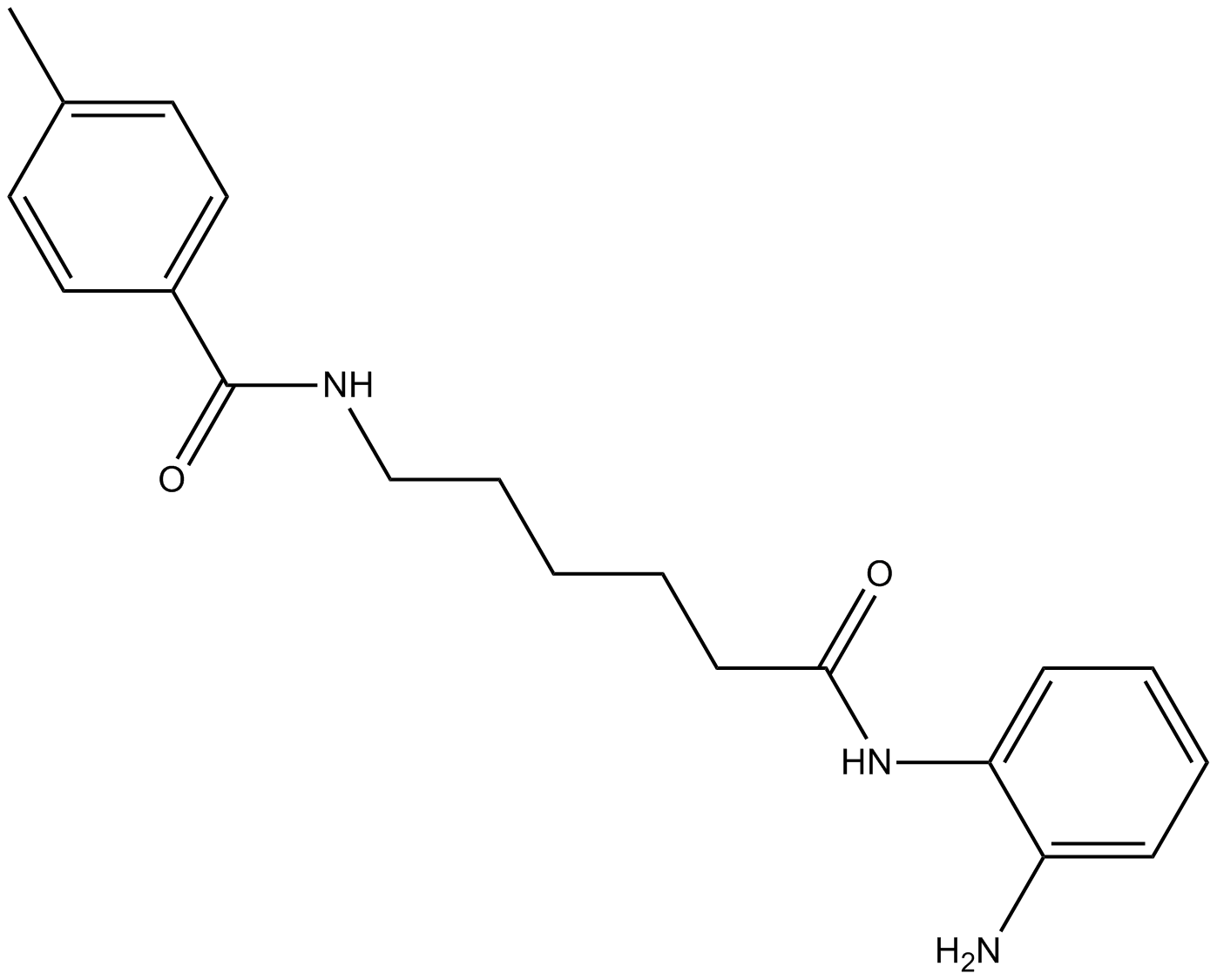
| Chemical Name | N-[6-(2-aminoanilino)-6-oxohexyl]-4-methylbenzamide | ||
| Canonical SMILES | CC1=CC=C(C=C1)C(=O)NCCCCCC(=O)NC2=CC=CC=C2N | ||
| Formula | C20H25N3O2 | M.Wt | 339.43 |
| Solubility | ≥ 16.95 mg/mL in DMSO, ≥ 8.05 mg/mL in EtOH with ultrasonic and warming | Storage | Store at -20°C |
| General tips | Please select the appropriate solvent to prepare the stock solution according to the
solubility of the product in different solvents; once the solution is prepared, please store it in
separate packages to avoid product failure caused by repeated freezing and thawing.Storage method
and period of the stock solution: When stored at -80°C, please use it within 6 months; when stored
at -20°C, please use it within 1 month. To increase solubility, heat the tube to 37°C and then oscillate in an ultrasonic bath for some time. |
||
| Shipping Condition | Evaluation sample solution: shipped with blue ice. All other sizes available: with RT, or with Blue Ice upon request. | ||
| Prepare stock solution | |||

|
1 mg | 5 mg | 10 mg |
| 1 mM | 2.9461 mL | 14.7306 mL | 29.4612 mL |
| 5 mM | 589.2 μL | 2.9461 mL | 5.8922 mL |
| 10 mM | 294.6 μL | 1.4731 mL | 2.9461 mL |
Step 1: Enter information below (Recommended: An additional animal making an allowance for loss during the experiment)
 g
μL
g
μL
Step 2: Enter the in vivo formulation (This is only the calculator, not formulation. Please contact us first if there is no in vivo formulation at the solubility Section.)
Calculation results:
Working concentration: mg/ml;
Method for preparing DMSO master liquid: mg drug pre-dissolved in μL DMSO ( Master liquid concentration mg/mL, Please contact us first if the concentration exceeds the DMSO solubility of the batch of drug. )
Method for preparing in vivo formulation: Take μL DMSO master liquid, next addμL PEG300, mix and clarify, next addμL Tween 80, mix and clarify, next add μL saline, mix and clarify.
Method for preparing in vivo formulation: Take μL DMSO master liquid, next add μL Corn oil, mix and clarify.
Note: 1. Please make sure the liquid is clear before adding the next solvent.
2. Be sure to add the solvent(s) in order. You must ensure that the solution obtained, in the previous addition, is a clear solution before proceeding to add the next solvent. Physical methods such as vortex, ultrasound or hot water bath can be used to aid dissolving.
3. All of the above co-solvents are available for purchase on the GlpBio website.
Quality Control & SDS
- View current batch:
- Purity: >98.00% Appearance: A solid
- COA (Certificate of Analysis)
- SDS (Safety Data Sheet)
- Datasheet
Average Rating: 5 (Based on Reviews and 30 reference(s) in Google Scholar.)