

Succinobucol (AGI-1067) (Synonyms: AGI-1067, Probucol Monosuccinate) |
Catalog No.GC31709
 One-Click Copy Product Info
|

숙시노부콜(AGI-1067)은 항염증 및 항혈소판 효과가 있는 페놀계 항산화제입니다.
Products are for research use only. Not for human use. We do not sell to patients.
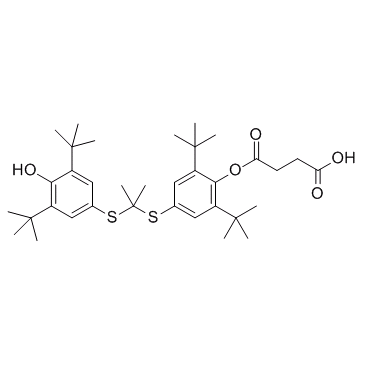
Cas No.: 216167-82-7
Sample solution is provided at 25 µL, 10mM.
_1-3.$$$39978408@51.jpg');)
_1-9.$$$38538795@65.jpg');)
_1-9.$$$39112701@51.jpg');)
_1-7.$$$37316672@70.jpg');)
_366-372.$$$36198801@70.jpg');)
.$$$38565142@65.jpg');)
_1867-1883.$$$33248023@67.jpg');)
_eads6055.$$$39977546@45.jpg');)
_eadm9805.$$$40080571@45.jpg');)
_eadj3020.$$$39666821@45.jpg');)
_1-20.$$$39757301@28.jpg');)
_1-24.$$$38898113@28.jpg');)
_273-287.$$$36806353@46.jpg');)
_1-16.$$$37156877@44.jpg');)
_1-19.$$$37460805@44.jpg');)
_1291-1307.$$$34518654@46.jpg');)
Succinobucol (AGI-1067) is a vasoprotective agent and phenolic antioxidant. Succinobucol exerts anti-inflammatory effects by selectively inhibiting the expression of redox-sensitive genes in endothelial cells and monocytes through the suppression of ASK1 and the subsequent activation of downstream p38 and JNK MAP kinases. Succinobucol can be used in research related to atherosclerosis, coronary heart disease, type 2 diabetes, and restenosis after percutaneous coronary intervention[1-4].
In vitro, SH-SY5Y cells were pretreated with succinobucol (3μM) for 6 days, followed by stimulation with 3-nitropropionic acid (3-NP; 1mM) for 6 or 24 hours. Succinobucol significantly prevented 3-NP-induced loss of cellular viability, increased generation of reactive oxygen species, and decrease of mitochondrial membrane potential (ΔΨm), and increased glutathione levels and glutamate cysteine ligase activity[5]. Metastatic 4T1 breast cancer cells were treated with Succinobucol (400ng/mL) for 24 hours. Succinobucol significantly inhibited cell migration and invasion, reduced the expression of vascular cell adhesion molecule-1 (VCAM-1), and decreased the binding of RAW 264.7 monocytes to 4T1 cancer cells[6].
In vivo, Swiss mice received daily intraperitoneal injections of Succinobucol (10mg/kg/day) for 15 days following a single intracerebroventricular infusion of 6-OHDA (40μg/site). Succinobucol partially protected against 6-OHDA-induced forelimb inability[7]. C57BL/6 mice received daily oral gavage of Succinobucol (10mg/kg/day) for 45 days following intranasal MPTP infusion (1mg/nostril). Succinobucol significantly alleviated MPTP-induced behavioral impairments and prevented the reduction of tyrosine hydroxylase (TH) and dopamine transporter (DAT) immunoreactivity in the substantia nigra and striatum[8].
References:
[1] Auten RL, Richardson RM, White JR, et al. Nonpeptide CXCR2 antagonist prevents neutrophil accumulation in hyperoxia-exposed newborn rats. J Pharmacol Exp Ther. 2001 Oct;299(1):90-5.
[2] Muldrew KM, Franks AM. Succinobucol: review of the metabolic, antiplatelet and cardiovascular effects. Expert Opin Investig Drugs. 2009 Apr;18(4):531-9.
[3] Dan Z, Cao H, He X, et al. A pH-Responsive Host-guest Nanosystem Loading Succinobucol Suppresses Lung Metastasis of Breast Cancer. Theranostics. 2016 Jan 25;6(3):435-45.
[4] Tardif JC. Clinical results with AGI-1067: a novel antioxidant vascular protectant. Am J Cardiol. 2003 Feb 6;91(3A):41A-49A.
[5] Colle D, Santos DB, Hartwig JM, et al. Succinobucol, a Lipid-Lowering Drug, Protects Against 3-Nitropropionic Acid-Induced Mitochondrial Dysfunction and Oxidative Stress in SH-SY5Y Cells via Upregulation of Glutathione Levels and Glutamate Cysteine Ligase Activity. Mol Neurobiol. 2016 Mar;53(2):1280-1295.
[6] He X, Yu H, Bao X, et al. pH-Responsive Wormlike Micelles with Sequential Metastasis Targeting Inhibit Lung Metastasis of Breast Cancer. Adv Healthc Mater. 2016 Feb 18;5(4):439-48.
[7] Ribeiro RP, Santos DB, Colle D, et al. Decreased forelimb ability in mice intracerebroventricularly injected with low dose 6-hydroxidopamine: A model on the dissociation of bradykinesia from hypokinesia. Behav Brain Res. 2016 May 15;305:30-6.
[8] Santos DB, Colle D, Moreira EL, et al. Succinobucol, a Non-Statin Hypocholesterolemic Drug, Prevents Premotor Symptoms and Nigrostriatal Neurodegeneration in an Experimental Model of Parkinson's Disease. Mol Neurobiol. 2017 Mar;54(2):1513-1530.
| Cell experiment [1]: | |
Cell lines | SH-SY5Y human neuroblastoma cells |
Preparation Method | SH-SY5Y cells were cultured in DMEM-F-12 supplemented with 2mM glutamine, 100units/mL penicillin, 100μg/mL streptomycin, and 10% of FBS at 37°C in a humidified atmosphere of 5% CO₂. Cells were pretreated with Succinobucol (3μM) or vehicle for 6 days, replacing medium cell culture each 3 days, followed by exposure to 3-nitropropionic acid (3-NP; 1mM) for 6h or 24h. |
Reaction Conditions | 3μM; pretreatment for 6 days |
Applications | Succinobucol pretreatment significantly prevented 3-NP-induced loss of cellular viability, generation of reactive oxygen species, and decrease of mitochondrial membrane potential (ΔΨm). Succinobucol pretreatment did not protect against 3-NP-induced inhibition of mitochondrial complex II activity. Succinobucol pretreatment significantly increased (50%) the levels of glutathione (GSH) in SH-SY5Y cells, and this event was paralleled by significant increases in glutamate cysteine ligase (GCL) messenger RNA (mRNA) expression and activity. |
| Animal experiment [2]: | |
Animal models | Swiss mice (male, 3 months old) |
Preparation Method | Mice received daily intraperitoneal (i.p.) injections of Succinobucol (10mg/kg/day) or vehicle for 15 days (from day -6 to day 8). Seven days after the beginning of Succinobucol treatment (day 0), mice received a single intracerebroventricular (i.c.v.) infusion of 6-OHDA (40μg/site) or vehicle. Behavioral tests (single pellet reaching task, grid test, open field) were performed on days 7 and 8. |
Dosage form | 10mg/kg/day; i.p.; for 15 days |
Applications | Succinobucol partially protected against 6-OHDA-induced forelimb inability (bradykinesia) as measured by the single pellet reaching task. 6-OHDA infusion caused a significant reduction (around 50%) in forelimb ability, and Succinobucol pretreatment partially prevented this deficit. |
References: | |
| Cas No. | 216167-82-7 | SDF | |
| Synonyms | AGI-1067, Probucol Monosuccinate | ||
| Canonical SMILES | CC(C)(C)C1=CC(SC(C)(C)SC2=CC(C(C)(C)C)=C(OC(CCC(O)=O)=O)C(C(C)(C)C)=C2)=CC(C(C)(C)C)=C1O | ||
| Formula | C35H52O5S2 | M.Wt | 616.91 |
| Solubility | DMSO : ≥ 100 mg/mL (162.10 mM);Water : < 0.1 mg/mL (insoluble) | Storage | Store at -20°C |
| General tips | Please select the appropriate solvent to prepare the stock solution according to the
solubility of the product in different solvents; once the solution is prepared, please store it in
separate packages to avoid product failure caused by repeated freezing and thawing.Storage method
and period of the stock solution: When stored at -80°C, please use it within 6 months; when stored
at -20°C, please use it within 1 month. To increase solubility, heat the tube to 37°C and then oscillate in an ultrasonic bath for some time. |
||
| Shipping Condition | Evaluation sample solution: shipped with blue ice. All other sizes available: with RT, or with Blue Ice upon request. | ||
| Prepare stock solution | |||

|
1 mg | 5 mg | 10 mg |
| 1 mM | 1.621 mL | 8.1049 mL | 16.2098 mL |
| 5 mM | 324.2 μL | 1.621 mL | 3.242 mL |
| 10 mM | 162.1 μL | 810.5 μL | 1.621 mL |
Step 1: Enter information below (Recommended: An additional animal making an allowance for loss during the experiment)
 g
μL
g
μL
Step 2: Enter the in vivo formulation (This is only the calculator, not formulation. Please contact us first if there is no in vivo formulation at the solubility Section.)
Calculation results:
Working concentration: mg/ml;
Method for preparing DMSO master liquid: mg drug pre-dissolved in μL DMSO ( Master liquid concentration mg/mL, Please contact us first if the concentration exceeds the DMSO solubility of the batch of drug. )
Method for preparing in vivo formulation: Take μL DMSO master liquid, next addμL PEG300, mix and clarify, next addμL Tween 80, mix and clarify, next add μL saline, mix and clarify.
Method for preparing in vivo formulation: Take μL DMSO master liquid, next add μL Corn oil, mix and clarify.
Note: 1. Please make sure the liquid is clear before adding the next solvent.
2. Be sure to add the solvent(s) in order. You must ensure that the solution obtained, in the previous addition, is a clear solution before proceeding to add the next solvent. Physical methods such as vortex, ultrasound or hot water bath can be used to aid dissolving.
3. All of the above co-solvents are available for purchase on the GlpBio website.
Quality Control & SDS
- View current batch:
- Purity: >98.00% Appearance: A solid
- COA (Certificate of Analysis)
- SDS (Safety Data Sheet)
- Datasheet
Average Rating: 5 (Based on Reviews and 23 reference(s) in Google Scholar.)