

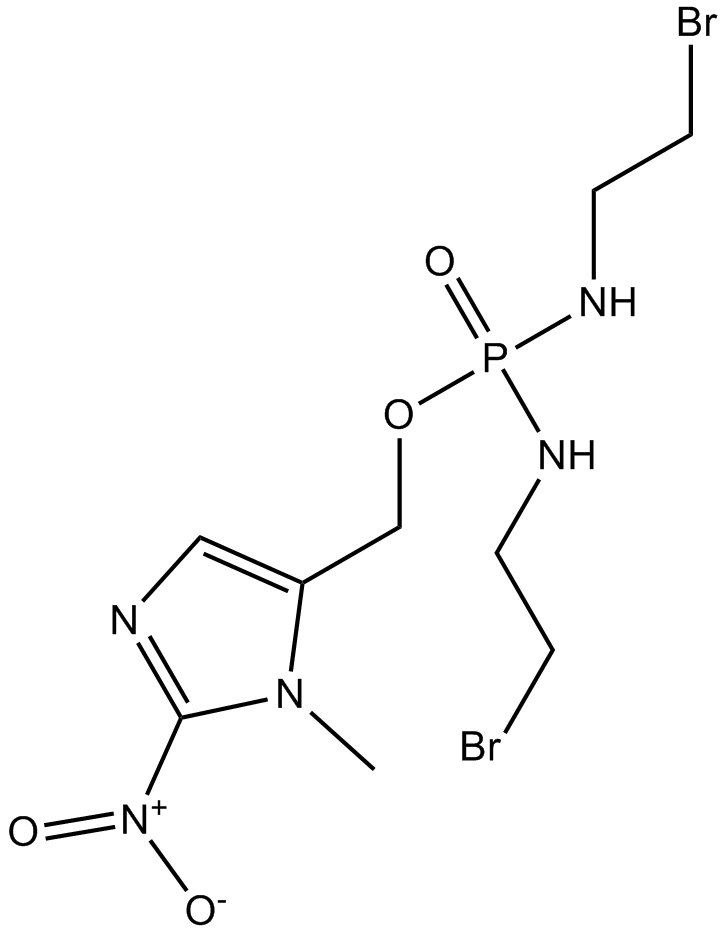
TH-302 (Synonyms: Evofosfamide) |
Catalog No.GC11298
 One-Click Copy Product Info
|

A hypoxia-activated anticancer agent
Products are for research use only. Not for human use. We do not sell to patients.
Cas No.: 918633-87-1
Sample solution is provided at 25 µL, 10mM.
_1-3.$$$39978408@51.jpg');)
_1-9.$$$38538795@65.jpg');)
_1-9.$$$39112701@51.jpg');)
_1-7.$$$37316672@70.jpg');)
_366-372.$$$36198801@70.jpg');)
.$$$38565142@65.jpg');)
_1867-1883.$$$33248023@67.jpg');)
_eads6055.$$$39977546@45.jpg');)
_eadm9805.$$$40080571@45.jpg');)
_eadj3020.$$$39666821@45.jpg');)
_1-20.$$$39757301@28.jpg');)
_1-24.$$$38898113@28.jpg');)
_273-287.$$$36806353@46.jpg');)
_1-16.$$$37156877@44.jpg');)
_1-19.$$$37460805@44.jpg');)
_1291-1307.$$$34518654@46.jpg');)
TH-302 is a 2-nitroimidazole triggered hypoxia-activated prodrug of bromo-isophosphoramide mustard [1].
Hypoxia is a prevailing feature of tumors due to the abnormal aspects and structure of tumor vasculatures. It is found that hypoxic tumors usually show resistance to the traditional chemo- and radiation therapies and hypoxic tumors are more metastatic and invasive. Since the hypoxic tumors are not hyperproliferative, the traditional anti-proliferation drugs are not suitable. As a hypoxia-activated prodrug, TH-302 can release the cytotoxic agent Br-IPM and selectively deliver it the to the tumor cells under the anoxic condition [1 and 2].
The activity of TH-302 is dependent on the degree of anoxia and the exposure time of the drug under hypoxia. Higher activity requires lower oxygen concentration. Different with tirapazamine (another HAP), TH-302 needed much severer hypoxia (about 0.1%) to keep high potency. When treated in a panel of 32 kinds of tumor cells, TH-302 showed modest cytotoxicity with IC50 values all above 40 μM under the normal air condition. In contrast, TH-302 exerted elevated anti-tumor potency under the hypoxic condition. The IC50 values of it were in a range from 0.1 to 90 μM. Among these tumor cells, the non-small cell lung cancer H460 cells were most sensitive against TH-302 treatment with IC50 value of 0.1±0.03 μM. Besides that, TH-302 also showed potent efficacies in many other tumor cells, including Caki-1 (renal), SK-MEL-5 (melanoma), DU145 (prostate) and HCT116 (colon), with IC50 values of 0.4, 0.7, 0.7 and 0.8 μM, respectively [1].
In mice bearing H460 xenografts, administration of TH-302 at doses of 6.25 to 50 mg/kg dose-dependently caused tumor growth inhibition (TGI) with 43% to 89% and 50 mg/kg TH-302 administration showed no hematologic toxicity. Apart from this, TH-302 was found to induce DNA damage. TH-302 at dose of 100 mg/kg for 6 hours resulted in notable increase of γH2AX-positive cells [2].
References:
[1] Meng F, Evans J W, Bhupathi D, et al. Molecular and cellular pharmacology of the hypoxia-activated prodrug TH-302. Molecular cancer therapeutics, 2012, 11(3): 740-751.
[2] Sun J D, Liu Q, Wang J, et al. Selective tumor hypoxia targeting by hypoxia-activated prodrug TH-302 inhibits tumor growth in preclinical models of cancer. Clinical cancer research, 2012, 18(3): 758-770.
Cell experiment: | Cells are treated with 0.1 μM of either PF477736 or AZD7762 and Evofosfamide (TH-302) for 2 h under either normoxia (21% O2) or hypoxia (N2). Following wash, cells are cultured for additional 22 h in the presence of Chk1 inhibitor under normoxia. Cells are fixed in 75% ethanol and cell cycle distribution is determined using cell cycle reagent and Guava flow cytometry. HT-29 cells are exposed to Evofosfamide (TH-302)e (8 nM, 40 nM, 200 nM, 1 μM, and 5 μM) and 0.1 μM of AZD7762 for 2 h under either normoxia (21% O2) or hypoxia (N2). After wash, cells are continuously cultured for additional 46 h in the presence of 0.1 μM of AZD7762. Luminescence-based caspase activity assay is performed[1]. |
Animal experiment: | Mice[2] Female SCID mice of age 5-6 weeks are inoculated with SU.86.86, Hs766t or Mia-PaCa2 cells (5×10⁶) subcutaneously on the left hind leg. Tumors are allowed to grow for an average of three weeks to an average size of ~150 mm3. Mice are then randomized and placed into cohorts and treated with saline (control) or Evofosfamide (TH-302) (50 mg/kg) injected intraperitoneally. A total of 34 mice underwent MR imaging studies. The SU.86.86 group consist of 5 TH-302 treated and 5 control animals; Mia-PaCa2 consist of 6 Evofosfamide treated and 5 control animals; Hs766t consist of 7 Evofosfamide treated and 6 control animals. Animals are sacrificed when tumors reach 2000 mm3. Rats[2] Syngeneic rhabdomyosarcoma R1 tumors (1 mm3) are implanted subcutaneously in the lateral flank of adult WAG/Rij rats. Experiments are started upon a mean tumor volume of 4.2 cm3(range, 2.0-8.1) to ensure a stable HF. Treatment is administered on 4 consecutive days and consist of an intraperitoneal injection (i.p.; QD×4) with either NaCl or Evofosfamide (TH-302) (25, 50, or 75 mg/kg). Before the start of treatment, a PET scan is made using [18F]HX4. Radiotherapy is applied in a single dose of 0, 4, 8, or 12 Gy on day 3 of the treatment, 3 hours after NaCl or Evofosfamide (TH-302) injection, 1 hour after oxygen modification. During both PET imaging and radiotherapy, rats are anesthetized using a mixture of ketamine/xylazine (i.p; 66.7 and 6.7 mg/kg, respectively). During the 5 days of treatment (1 day PET imaging, 4 days of injections with Evofosfamide or vehicle), animals are exposed to modified oxygen concentrations for 4 hours per day in order to alter the HF of the tumor. The combination oxygen modification of nicotinamide (i.p. 500 mg/kg) and carbogen (95% oxygen, 5% CO2; 5 L/minute) consist of a nicotinamide injection and 30 minutes later the exposure to carbogen breathing for 3.5 hours. In the middle of the nicotinamide/carbogen treatment, NaCl/Evofosfamide is administered. Reduced oxygen breathing (7%, residual N2; 2.5 L/minute) is given for 4 hours with the NaCl/Evofosfamide injection after the first 2 hours. The injection of the [18F]HX4 PET tracer [mean 18.8 MBq, range 7.1-25.1 MBq; lateral tail vein using an intravenous line (Venoflux 0.4 mm G27) flushed with 10% heparine)] is given 2 hours before the end of the oxygen modification. PET imaging is performed 3 hours after tracer injection. |
References: [1]. Meng F, et al. Enhancement of hypoxia-activated prodrug TH-302 anti-tumor activity by Chk1 inhibition. BMC Cancer. 2015 May 21;15:422. | |
| Cas No. | 918633-87-1 | SDF | |
| Synonyms | Evofosfamide | ||
| Chemical Name | 2-bromo-N-[(2-bromoethylamino)-[(3-methyl-2-nitroimidazol-4-yl)methoxy]phosphoryl]ethanamine | ||
| Canonical SMILES | CN1C(=CN=C1[N+](=O)[O-])COP(=O)(NCCBr)NCCBr | ||
| Formula | C9H16Br2N5O4P | M.Wt | 449.04 |
| Solubility | ≥ 22.45 mg/mL in DMSO, ≥ 34.2 mg/mL in EtOH with ultrasonic, ≥ 4.73 mg/mL in Water with ultrasonic and warming | Storage | Store at -20°C |
| General tips | Please select the appropriate solvent to prepare the stock solution according to the
solubility of the product in different solvents; once the solution is prepared, please store it in
separate packages to avoid product failure caused by repeated freezing and thawing.Storage method
and period of the stock solution: When stored at -80°C, please use it within 6 months; when stored
at -20°C, please use it within 1 month. To increase solubility, heat the tube to 37°C and then oscillate in an ultrasonic bath for some time. |
||
| Shipping Condition | Evaluation sample solution: shipped with blue ice. All other sizes available: with RT, or with Blue Ice upon request. | ||
| Prepare stock solution | |||

|
1 mg | 5 mg | 10 mg |
| 1 mM | 2.227 mL | 11.1349 mL | 22.2697 mL |
| 5 mM | 445.4 μL | 2.227 mL | 4.4539 mL |
| 10 mM | 222.7 μL | 1.1135 mL | 2.227 mL |
Step 1: Enter information below (Recommended: An additional animal making an allowance for loss during the experiment)
 g
μL
g
μL
Step 2: Enter the in vivo formulation (This is only the calculator, not formulation. Please contact us first if there is no in vivo formulation at the solubility Section.)
Calculation results:
Working concentration: mg/ml;
Method for preparing DMSO master liquid: mg drug pre-dissolved in μL DMSO ( Master liquid concentration mg/mL, Please contact us first if the concentration exceeds the DMSO solubility of the batch of drug. )
Method for preparing in vivo formulation: Take μL DMSO master liquid, next addμL PEG300, mix and clarify, next addμL Tween 80, mix and clarify, next add μL saline, mix and clarify.
Method for preparing in vivo formulation: Take μL DMSO master liquid, next add μL Corn oil, mix and clarify.
Note: 1. Please make sure the liquid is clear before adding the next solvent.
2. Be sure to add the solvent(s) in order. You must ensure that the solution obtained, in the previous addition, is a clear solution before proceeding to add the next solvent. Physical methods such as vortex, ultrasound or hot water bath can be used to aid dissolving.
3. All of the above co-solvents are available for purchase on the GlpBio website.
Quality Control & SDS
- View current batch:
- Purity: >98.50% Appearance: A solid
- COA (Certificate of Analysis)
- SDS (Safety Data Sheet)
- Datasheet
Average Rating: 5 (Based on Reviews and 30 reference(s) in Google Scholar.)