

UNC1215 (Synonyms: UNC 1215;UNC-1215) |
Catalog No.GC16794
 One-Click Copy Product Info
|

Potent L3MBTL3 domain inhibitor
Products are for research use only. Not for human use. We do not sell to patients.
Cas No.: 1415800-43-9
Sample solution is provided at 25 µL, 10mM.
_1-3.$$$39978408@51.jpg');)
_1-9.$$$38538795@65.jpg');)
_1-9.$$$39112701@51.jpg');)
_1-7.$$$37316672@70.jpg');)
_366-372.$$$36198801@70.jpg');)
.$$$38565142@65.jpg');)
_1867-1883.$$$33248023@67.jpg');)
_eads6055.$$$39977546@45.jpg');)
_eadm9805.$$$40080571@45.jpg');)
_eadj3020.$$$39666821@45.jpg');)
_1-20.$$$39757301@28.jpg');)
_1-24.$$$38898113@28.jpg');)
_273-287.$$$36806353@46.jpg');)
_1-16.$$$37156877@44.jpg');)
_1-19.$$$37460805@44.jpg');)
_1291-1307.$$$34518654@46.jpg');)
UNC1215 is a selective inhibitor of L3MBTL3 with IC50 value of 40 nM [1].
L3MBTL3 is a member of the MBT (malignant brain tumor) family of methyl-lysine reader proteins and is reported to play an important role in haematopoiesis and cancer biology. And it is reported that inhibition of L3MBTL3 can be regarded as a promising target used in clinic [2].
UNC1215 is a potent L3MBTL3 inhibitor and has a more potent inhibitory ability than other MBT family members. When tested with HEK293 cells transfected with a GFP fusion protein of the 3 MBT domains of L3MBTL3, UNC1215 treatment decreased the recovery time in a dose responsive manner via binding and co-localizing L3MBTL3 [1]. Using AlphaScreen○R methylated histone peptide competition assay, UNC1215 showed high antagonism ability to L3MBTL3 with IC50 value of 24±7.6 nM [3]. As the first potent and selective inhibitor for methyl-lysine reader protein-L3MBTL3-UNC1215 showed highly selective inhibitor ability via antagonizing the mono- and dimethyl-lysine reading function of L3MBTL3 [2].
References:
1. James, L.I., et al., Discovery of a chemical probe for the L3MBTL3 methyllysine reader domain. Nat Chem Biol, 2013. 9(3): p. 184-91.
2. James, L.I., et al., Small-molecule ligands of methyl-lysine binding proteins: optimization of selectivity for L3MBTL3. J Med Chem, 2013. 56(18): p. 7358-71.
3. Camerino, M.A., et al., The structure-activity relationships of L3MBTL3 inhibitors: flexibility of the dimer interface. Medchemcomm, 2013. 4(11): p. 1501-1507.
| Cell experiment [1]: | |
|
Cell lines |
Human embryonic kidney 293 cells transfected with a GFP fusion protein of the three MBT domains of L3MBTL3 (GFP-3MBT) |
|
Preparation method |
The solubility of this compound in DMSO is >26.05 mg/mL. General tips for obtaining a higher concentration: Please warm the tube at 37 ℃ for 10 minutes and/or shake it in the ultrasonic bath for a while. Stock solution can be stored below -20℃ for several months. |
|
Reacting condition |
EC50: 50–100 nM |
|
Applications |
Treatment with UNC1215 decreased the recovery time fluorescence intensity following photobleaching in a dose-responsive manner, with the EC50 of 50–100 nM, indicating that UNC1215 promoted diffusibility of GFP-3MBT within the nucleus. UNC1215 competed with cellular factors for binding of the MBT domains at concentrations well below 1 μM. UNC1215 showed potent effects on the subnuclear localization of GFP-3MBT, with an IC50 of approximately 500 nM for disruption of foci formation. |
|
Other notes |
Please test the solubility of all compounds indoor, and the actual solubility may slightly differ with the theoretical value. This is caused by an experimental system error and it is normal. |
|
References: [1]. James L I, Barsyte-Lovejoy D, Zhong N, et al. Discovery of a chemical probe for the L3MBTL3 methyllysine reader domain[J]. Nature chemical biology, 2013, 9(3): 184-191. | |
| Cas No. | 1415800-43-9 | SDF | |
| Synonyms | UNC 1215;UNC-1215 | ||
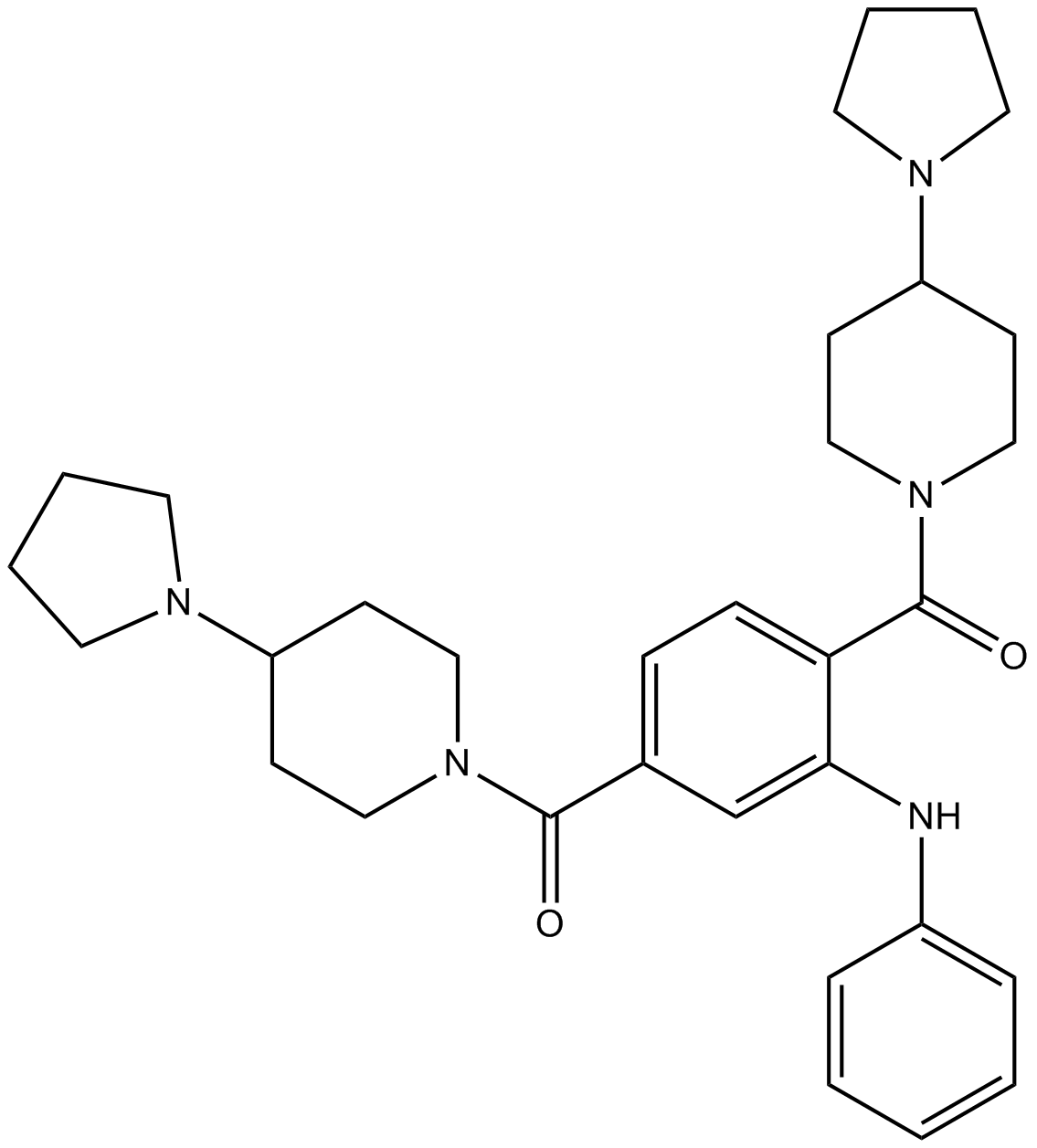
| Chemical Name | [3-anilino-4-(4-pyrrolidin-1-ylpiperidine-1-carbonyl)phenyl]-(4-pyrrolidin-1-ylpiperidin-1-yl)methanone | ||
| Canonical SMILES | C1CCN(C1)C2CCN(CC2)C(=O)C3=CC(=C(C=C3)C(=O)N4CCC(CC4)N5CCCC5)NC6=CC=CC=C6 | ||
| Formula | C32H43N5O2 | M.Wt | 529.72 |
| Solubility | ≥ 26.05 mg/mL in DMSO, ≥ 4.94 mg/mL in EtOH with ultrasonic and warming | Storage | Store at -20°C |
| General tips | Please select the appropriate solvent to prepare the stock solution according to the
solubility of the product in different solvents; once the solution is prepared, please store it in
separate packages to avoid product failure caused by repeated freezing and thawing.Storage method
and period of the stock solution: When stored at -80°C, please use it within 6 months; when stored
at -20°C, please use it within 1 month. To increase solubility, heat the tube to 37°C and then oscillate in an ultrasonic bath for some time. |
||
| Shipping Condition | Evaluation sample solution: shipped with blue ice. All other sizes available: with RT, or with Blue Ice upon request. | ||
| Prepare stock solution | |||

|
1 mg | 5 mg | 10 mg |
| 1 mM | 1.8878 mL | 9.4389 mL | 18.8779 mL |
| 5 mM | 377.6 μL | 1.8878 mL | 3.7756 mL |
| 10 mM | 188.8 μL | 943.9 μL | 1.8878 mL |
Step 1: Enter information below (Recommended: An additional animal making an allowance for loss during the experiment)
 g
μL
g
μL
Step 2: Enter the in vivo formulation (This is only the calculator, not formulation. Please contact us first if there is no in vivo formulation at the solubility Section.)
Calculation results:
Working concentration: mg/ml;
Method for preparing DMSO master liquid: mg drug pre-dissolved in μL DMSO ( Master liquid concentration mg/mL, Please contact us first if the concentration exceeds the DMSO solubility of the batch of drug. )
Method for preparing in vivo formulation: Take μL DMSO master liquid, next addμL PEG300, mix and clarify, next addμL Tween 80, mix and clarify, next add μL saline, mix and clarify.
Method for preparing in vivo formulation: Take μL DMSO master liquid, next add μL Corn oil, mix and clarify.
Note: 1. Please make sure the liquid is clear before adding the next solvent.
2. Be sure to add the solvent(s) in order. You must ensure that the solution obtained, in the previous addition, is a clear solution before proceeding to add the next solvent. Physical methods such as vortex, ultrasound or hot water bath can be used to aid dissolving.
3. All of the above co-solvents are available for purchase on the GlpBio website.
Quality Control & SDS
- View current batch:
- Purity: >98.00% Appearance: A solid
- COA (Certificate of Analysis)
- SDS (Safety Data Sheet)
- Datasheet
Average Rating: 5 (Based on Reviews and 30 reference(s) in Google Scholar.)