

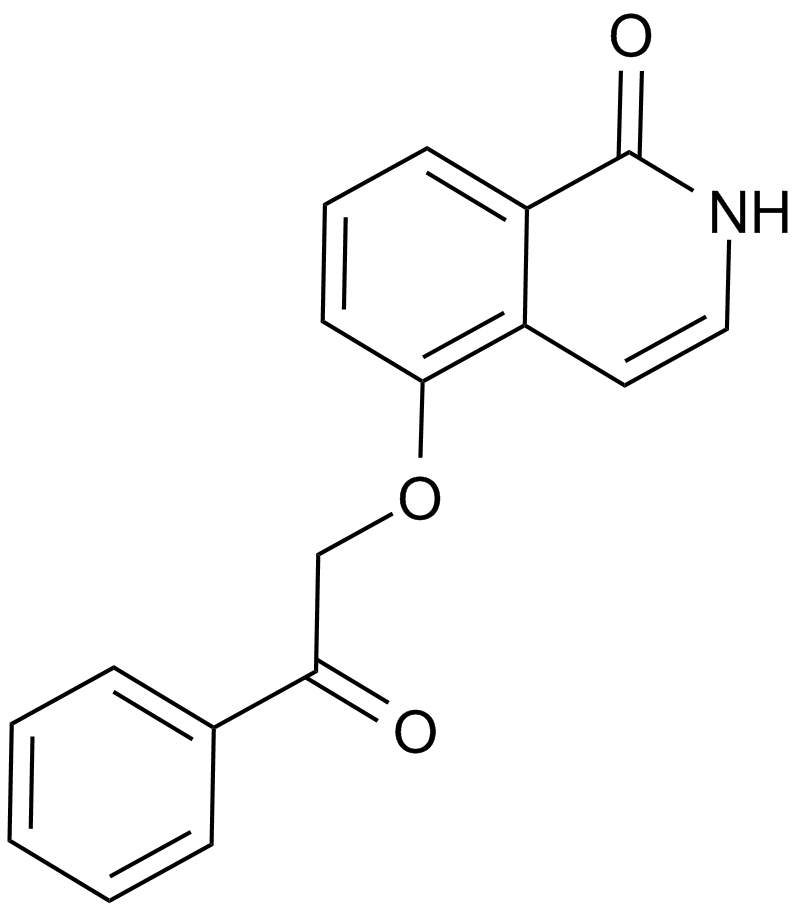
UPF 1069 (Synonyms: GKT237841) |
Catalog No.GC14509
 One-Click Copy Product Info
|

A selective PARP2 inhibitors
Products are for research use only. Not for human use. We do not sell to patients.
Cas No.: 1048371-03-4
Sample solution is provided at 25 µL, 10mM.
_1-3.$$$39978408@51.jpg');)
_1-9.$$$38538795@65.jpg');)
_1-9.$$$39112701@51.jpg');)
_1-7.$$$37316672@70.jpg');)
_366-372.$$$36198801@70.jpg');)
.$$$38565142@65.jpg');)
_1867-1883.$$$33248023@67.jpg');)
_eads6055.$$$39977546@45.jpg');)
_eadm9805.$$$40080571@45.jpg');)
_eadj3020.$$$39666821@45.jpg');)
_1-20.$$$39757301@28.jpg');)
_1-24.$$$38898113@28.jpg');)
_273-287.$$$36806353@46.jpg');)
_1-16.$$$37156877@44.jpg');)
_1-19.$$$37460805@44.jpg');)
_1291-1307.$$$34518654@46.jpg');)
UPF 1069, a derivative of isoquinolinone, is a potent and selective inhibitor of poly-(ADP-ribose) polymerase 2 (PARP-2), with the value of 50% inhibition concentration IC50 of 0.3 μmol/L, that is capable of reducing PAR formation both in recombinant enzyme preparations and in nuclear extracts from PARP-1-/- fibroblasts. Although its inhibition towards PARP-2 is most selective among other PARP-2 inhibitors, UPF 1069 also inhibits PARP-1 with a lesser potency (the value of IC50 of 8 μmol/L). Having been used to investigate the role of PARP-1 and PARP-2 in post-ischaemic brain damage, UPF 1069 enhances oxygen-glucose deprivation (OGD) injury in hippocampal slices.
Reference
[1].Moroni F, Formentini L, Gerace E, Camaioni E, Pellegrini-Giampietro DE, Chiarugi A, Pellicciari R. Selective PARP-2 inhibitors increase apoptosis in hippocampal slices but protect cortical cells in models of post-ischaemic brain damage. Br J Pharmacol. 2009;157(5):854-862
|
Kinase experiment: |
PARP activity is evaluated by utilizing commercially available recombinant bovine PARP-1 and mouse PARP-2. Briefly, the enzymatic reaction is carried out in 100 µL of 50 mM Tris-HCl (pH 8.0) containing 5 mM MgCl2, 2 mM dithiothreitol, 10 µg sonicated calf thymus DNA, 0.2 µCi [adenine-2,8-3H]NAD and recombinant enzyme PARP-1 or PARP-2 (0.03 U per sample). Different concentrations of the putative inhibitors are added, and the mixture is incubated for 1 h at 37°C. The reaction is terminated by adding 1 mL of 10% trichloroacetic acid (w/v) and centrifuged. Pellets are then washed twice with 1 mL of H2O and resuspended in 1 mL of 0.1 M NaOH. The radioactivity incorporated from [adenine-2,8-3H]NAD into proteins is evaluated by liquid scintillation spectrometry[2]. |
|
References: [1]. Pellicciari R, et al. On the way to selective PARP-2 inhibitors. Design, synthesis, and preliminary evaluation of a series of isoquinolinone derivatives. ChemMedChem. 2008 Jun;3(6):914-23. |
|
| Cas No. | 1048371-03-4 | SDF | |
| Synonyms | GKT237841 | ||
| Chemical Name | 5-phenacyloxy-2H-isoquinolin-1-one | ||
| Canonical SMILES | C1=CC=C(C=C1)C(=O)COC2=CC=CC3=C2C=CNC3=O | ||
| Formula | C17H13NO3 | M.Wt | 279.29 |
| Solubility | ≥ 12.7 mg/mL in DMSO, ≥ 6.73 mg/mL in EtOH with ultrasonic and warming | Storage | Store at -20°C |
| General tips | Please select the appropriate solvent to prepare the stock solution according to the
solubility of the product in different solvents; once the solution is prepared, please store it in
separate packages to avoid product failure caused by repeated freezing and thawing.Storage method
and period of the stock solution: When stored at -80°C, please use it within 6 months; when stored
at -20°C, please use it within 1 month. To increase solubility, heat the tube to 37°C and then oscillate in an ultrasonic bath for some time. |
||
| Shipping Condition | Evaluation sample solution: shipped with blue ice. All other sizes available: with RT, or with Blue Ice upon request. | ||
| Prepare stock solution | |||

|
1 mg | 5 mg | 10 mg |
| 1 mM | 3.5805 mL | 17.9025 mL | 35.8051 mL |
| 5 mM | 716.1 μL | 3.5805 mL | 7.161 mL |
| 10 mM | 358.1 μL | 1.7903 mL | 3.5805 mL |
Step 1: Enter information below (Recommended: An additional animal making an allowance for loss during the experiment)
 g
μL
g
μL
Step 2: Enter the in vivo formulation (This is only the calculator, not formulation. Please contact us first if there is no in vivo formulation at the solubility Section.)
Calculation results:
Working concentration: mg/ml;
Method for preparing DMSO master liquid: mg drug pre-dissolved in μL DMSO ( Master liquid concentration mg/mL, Please contact us first if the concentration exceeds the DMSO solubility of the batch of drug. )
Method for preparing in vivo formulation: Take μL DMSO master liquid, next addμL PEG300, mix and clarify, next addμL Tween 80, mix and clarify, next add μL saline, mix and clarify.
Method for preparing in vivo formulation: Take μL DMSO master liquid, next add μL Corn oil, mix and clarify.
Note: 1. Please make sure the liquid is clear before adding the next solvent.
2. Be sure to add the solvent(s) in order. You must ensure that the solution obtained, in the previous addition, is a clear solution before proceeding to add the next solvent. Physical methods such as vortex, ultrasound or hot water bath can be used to aid dissolving.
3. All of the above co-solvents are available for purchase on the GlpBio website.
Quality Control & SDS
- View current batch:
- Purity: >98.00% Appearance: A solid
- COA (Certificate of Analysis)
- SDS (Safety Data Sheet)
- Datasheet
Average Rating: 5 (Based on Reviews and 30 reference(s) in Google Scholar.)