

17-AAG (KOS953) (Synonyms: BMS 722782, CP 127374, KOS 953, NSC 330507, Tanespimycin) |
Catalog No.GC11720
 One-Click Copy Product Info
|

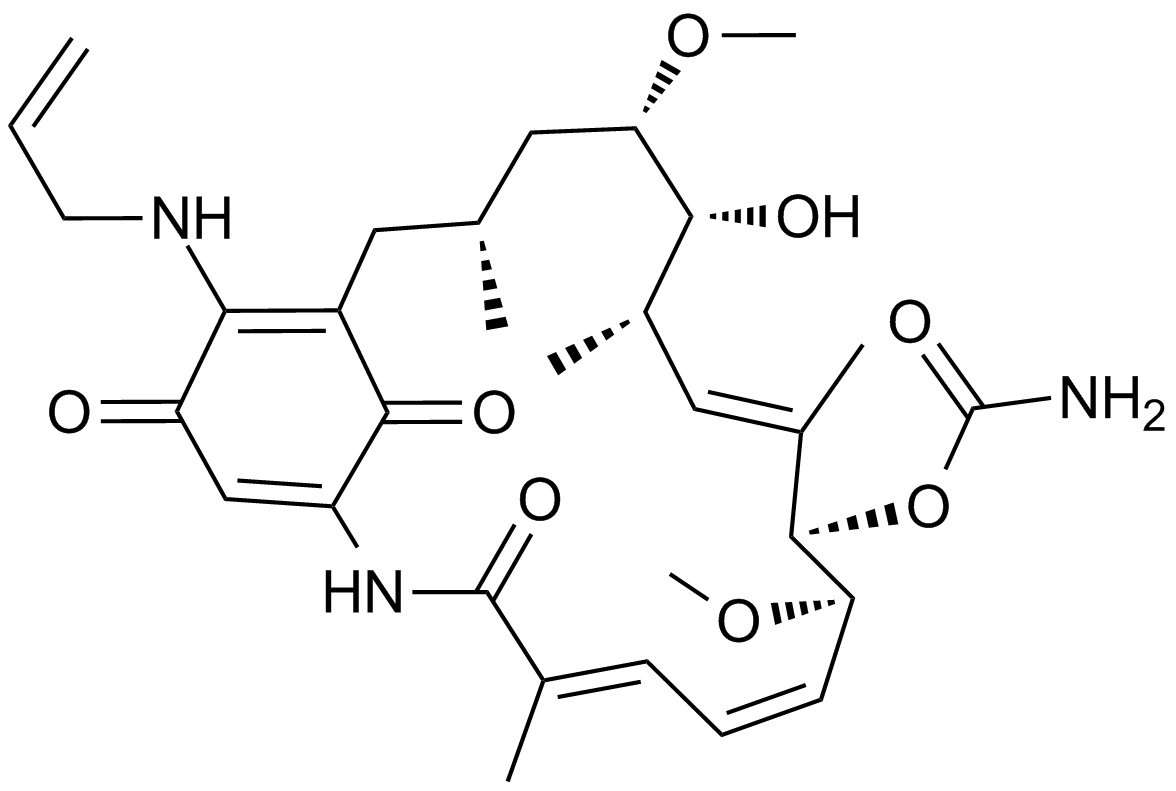
17-AAG (KOS953), un antibiótico natural de benzoquinone ansamycin, es el primer inhibidor establecido de Hsp90.
Products are for research use only. Not for human use. We do not sell to patients.
Cas No.: 75747-14-7
Sample solution is provided at 25 µL, 10mM.
_1-3.$$$39978408@51.jpg');)
_1-9.$$$38538795@65.jpg');)
_1-9.$$$39112701@51.jpg');)
_1-7.$$$37316672@70.jpg');)
_366-372.$$$36198801@70.jpg');)
.$$$38565142@65.jpg');)
_1867-1883.$$$33248023@67.jpg');)
_eads6055.$$$39977546@45.jpg');)
_eadm9805.$$$40080571@45.jpg');)
_eadj3020.$$$39666821@45.jpg');)
_1-20.$$$39757301@28.jpg');)
_1-24.$$$38898113@28.jpg');)
_273-287.$$$36806353@46.jpg');)
_1-16.$$$37156877@44.jpg');)
_1-19.$$$37460805@44.jpg');)
_1291-1307.$$$34518654@46.jpg');)
17-AAG (KOS953), un antibiótico natural de benzoquinone ansamycin, es el primer inhibidor establecido de Hsp90. Inhibe la función ATPase de Hsp90 a través de la unión a su dominio aminoterminal[5].
17-AAG como un potente inhibidor de HSP90 con un valor IC50 de 6 nM en células BT474, inhibió la unión de HSP90 a HIF-1α[2]. De manera dependiente de la concentración y el tiempo, la inhibición de Hsp90 por 17-AAG disminuyó la expresión de Akt y eNOS. La inhibición de la expresión de eNOS por 17-AAG ocurrió a nivel transcripcional. Además, el tratamiento con 17-AAG disminuyó la fosforilación de Akt y eNOS estimulada por el factor de crecimiento endotelial basal y vascular. Esto se correspondió con la disminución de la producción de NO y la inhibición de la migración de células endoteliales y la angiogénesis[3].17AAG aplicado tópicamente a la piel de ratón, inhibe el desarrollo inducido por UVR del carcinoma cutáneo de células escamosas (SCC) [7].
El potencial terapéutico de 17-AAG se investigó utilizando xenoinjerto intraperitoneal de ratones desnudos. Una combinación de 17-AAG y DDP podría inhibir el crecimiento tumoral de manera más eficiente. El tiempo de supervivencia de los ratones se prolongó significativamente, apoyando la noción de que 17-AAG combinado con DDP podría prolongar el tiempo de supervivencia de los ratones[1].17-AAG es capaz de inhibir el crecimiento tanto de las líneas celulares de glioma humanas como de las células madre de glioma in vitro. Además, 17-AAG puede inhibir el crecimiento de tumores intracraneales y puede sinergizar con la radiación tanto en el cultivo de tejidos como en tumoores intracraneales. No se encontró que este compuesto se sinergiara con temozolomida en minguno de nuestros modelos de gliomas[6].17-AAG más trastuzumab es bien tolerado y tiene actividad antitumoral en pacientes con cáncer de mama HER-2+ cuyos tumores han progresado durante el tratamiento con transtuzumab. Estos datos sugieren que la función Hsp90 se puede inhibir in vivo en un grado suficiente para causar la inhibición del crecimiento tumoral[4].
References:
[1]: Wang Y, Chen Q, et,al. Lamin-A interacting protein Hsp90 is required for DNA damage repair and chemoresistance of ovarian cancer cells. Cell Death Dis. 2021 Aug 12;12(8):786. doi: 10.1038/s41419-021-04074-z. PMID: 34381017; PMCID: PMC8358027.
[2]: Kamal A, Thao L, et,al. A high-affinity conformation of Hsp90 confers tumour selectivity on Hsp90 inhibitors. Nature. 2003 Sep 25;425(6956):407-10. doi: 10.1038/nature01913. PMID: 14508491.
[3]: Sun J, Liao JK. Induction of angiogenesis by heat shock protein 90 mediated by protein kinase Akt and endothelial nitric oxide synthase. Arterioscler Thromb Vasc Biol. 2004 Dec;24(12):2238-44. doi: 10.1161/01.ATV.0000147894.22300.4c. Epub 2004 Oct 14. PMID: 15486309; PMCID: PMC2633590.
[4]: Modi S, Stopeck AT, et,al. Combination of trastuzumab and tanespimycin (17-AAG, KOS-953) is safe and active in trastuzumab-refractory HER-2 overexpressing breast cancer: a phase I dose-escalation study. J Clin Oncol. 2007 Dec 1;25(34):5410-7. doi: 10.1200/JCO.2007.11.7960. PMID: 18048823.
[5]: Neckers L, Schulte TW, et,al. Geldanamycin as a potential anti-cancer agent: its molecular target and biochemical activity. Invest New Drugs. 1999;17(4):361-73. doi: 10.1023/a:1006382320697. PMID: 10759403.
[6]: Sauvageot CM, Weatherbee JL, et,al. Efficacy of the HSP90 inhibitor 17-AAG in human glioma cell lines and tumorigenic glioma stem cells. Neuro Oncol. 2009 Apr;11(2):109-21. doi: 10.1215/15228517-2008-060. Epub 2008 Aug 5. PMID: 18682579; PMCID: PMC2718982.
[7]: Singh A, Singh A, et,al. Topically applied Hsp90 inhibitor 17AAG inhibits UVR-induced cutaneous squamous cell carcinomas. J Invest Dermatol. 2015 Apr;135(4):1098-1107. doi: 10.1038/jid.2014.460. Epub 2014 Oct 22. PMID: 25337691; PMCID: PMC4366283.
| Experimentos celulares [1]: | |
Líneas celulares | Células HO-8910 |
Método de preparación | Las células HO-8910 fueron tratadas con diferentes concentraciones de inhibidor de Hsp90 17-AAG, y las células tratadas sin 17-AAG se consideraron como el grupo de control. |
Condiciones de reacción | 17-AAG 0.25、0.5 y 5 μM durante 4, 8, 12, y 24 h |
Áreas de aplicación | Los niveles de Rad50 y Ku80 disminuyeron después de 8 h en células tratadas con una concentración relativamente baja de 17-AAG (0.5 μM). En los grupos tratados con una concentración relativamente alta de 17-AAG (5 μM), Rad50 sdisminuyó significativamente después de 4 h, y Ku80 también disminuyó después de 8 h, lo que indica que las proteínas de reparación de DSBs se regularon a la baja de una manera dependiente de la dosis y del tiempo y la inhibición de Hsp90 podría afectar la reparación de DSBs. |
| Experimentos con animales [2]: | |
Modelos animales | Hembra de 4 a 5 semanas de edad, 18–20 g de ratones desnudos BALB/c |
Método de preparación | Los ratones fueron asignados aleatoriamente a tres grupos (n = 4/grupo). Las células HO-8910 que expresan luciferasa se inyectaron por vía intraperitoneal en grupos. Después de dos semanas, los ratones fueron inyectados por vía intraperitoneal con DDP, DDP combinado con 17-AAG (50 mg/kg), una vez a la semana durante hasta 6 semanas. |
Forma de dosificación | 50 mg/kg, una vez a la semana durante hasta 6 semanas. |
Áreas de aplicación | Una combinación de 17-AAG y DDP podría inhibir el crecimiento tumoral de manera más eficiente. El tiempo de supervivencia de los ratones se prolongó significativamente, apoyando la noción de que 17-AAG combinado con DDP podría prolongar el tiempo de supervivencia de los ratones. |
References: | |
| Cas No. | 75747-14-7 | SDF | |
| Sinónimos | BMS 722782, CP 127374, KOS 953, NSC 330507, Tanespimycin | ||
| Chemical Name | [(3R,5S,6R,7S,8E,10S,11S,12Z,14E)-6-hydroxy-5,11-dimethoxy-3,7,9,15-tetramethyl-16,20,22-trioxo-21-(prop-2-enylamino)-17-azabicyclo[16.3.1]docosa-1(21),8,12,14,18-pentaen-10-yl] carbamate | ||
| Canonical SMILES | CC1CC(C(C(C=C(C(C(C=CC=C(C(=O)NC2=CC(=O)C(=C(C1)C2=O)NCC=C)C)OC)OC(=O)N)C)C)O)OC | ||
| Formula | C31H43N3O8 | M.Wt | 585.7 |
| Solubility | ≥ 24.95 mg/mL in DMSO, ≥ 9.56 mg/mL in EtOH with ultrasonic | Storage | 4°C, protect from light |
| General tips | Please select the appropriate solvent to prepare the stock solution according to the
solubility of the product in different solvents; once the solution is prepared, please store it in
separate packages to avoid product failure caused by repeated freezing and thawing.Storage method
and period of the stock solution: When stored at -80°C, please use it within 6 months; when stored
at -20°C, please use it within 1 month. To increase solubility, heat the tube to 37°C and then oscillate in an ultrasonic bath for some time. |
||
| Shipping Condition | Evaluation sample solution: shipped with blue ice. All other sizes available: with RT, or with Blue Ice upon request. | ||
| Prepare stock solution | |||

|
1 mg | 5 mg | 10 mg |
| 1 mM | 1.7074 mL | 8.5368 mL | 17.0736 mL |
| 5 mM | 341.5 μL | 1.7074 mL | 3.4147 mL |
| 10 mM | 170.7 μL | 853.7 μL | 1.7074 mL |
Step 1: Enter information below (Recommended: An additional animal making an allowance for loss during the experiment)
 g
μL
g
μL
Step 2: Enter the in vivo formulation (This is only the calculator, not formulation. Please contact us first if there is no in vivo formulation at the solubility Section.)
Calculation results:
Working concentration: mg/ml;
Method for preparing DMSO master liquid: mg drug pre-dissolved in μL DMSO ( Master liquid concentration mg/mL, Please contact us first if the concentration exceeds the DMSO solubility of the batch of drug. )
Method for preparing in vivo formulation: Take μL DMSO master liquid, next addμL PEG300, mix and clarify, next addμL Tween 80, mix and clarify, next add μL saline, mix and clarify.
Method for preparing in vivo formulation: Take μL DMSO master liquid, next add μL Corn oil, mix and clarify.
Note: 1. Please make sure the liquid is clear before adding the next solvent.
2. Be sure to add the solvent(s) in order. You must ensure that the solution obtained, in the previous addition, is a clear solution before proceeding to add the next solvent. Physical methods such as vortex, ultrasound or hot water bath can be used to aid dissolving.
3. All of the above co-solvents are available for purchase on the GlpBio website.
Quality Control & SDS
- View current batch:
- Purity: >98.00% Appearance: A solid
- COA (Certificate of Analysis)
- SDS (Safety Data Sheet)
- Datasheet
Average Rating: 5 (Based on Reviews and 30 reference(s) in Google Scholar.)