

AM095 |
Catalog No.GC15220
 One-Click Copy Product Info
|

AM095 es un angonista selectivo y biodisponible por vía oral del receptor LPA1, con un valor de IC50 de 0.73μM para el LPA1 murino
Products are for research use only. Not for human use. We do not sell to patients.
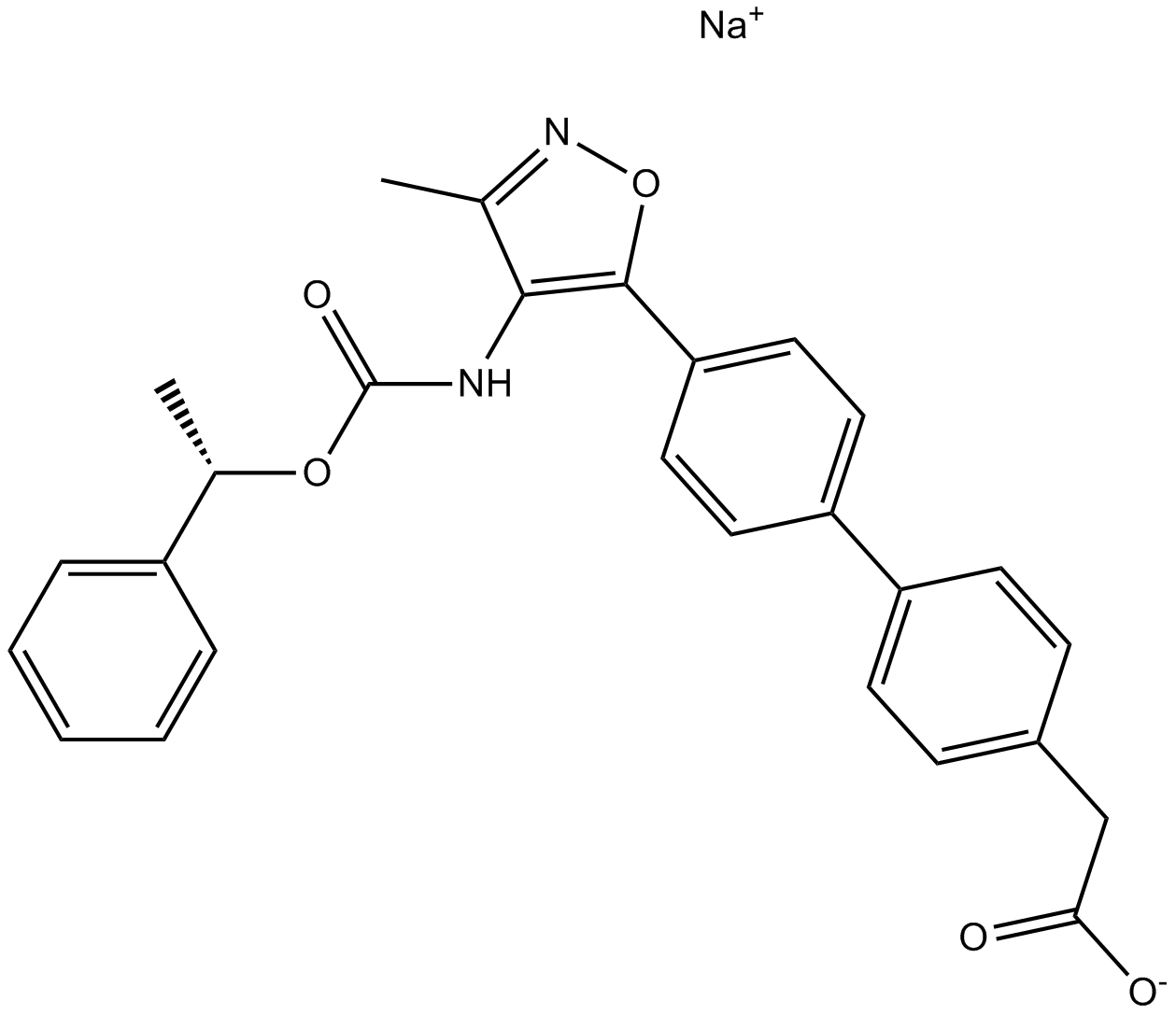
Cas No.: 1345614-59-6
Sample solution is provided at 25 µL, 10mM.
_1-3.$$$39978408@51.jpg');)
_1-9.$$$38538795@65.jpg');)
_1-9.$$$39112701@51.jpg');)
_1-7.$$$37316672@70.jpg');)
_366-372.$$$36198801@70.jpg');)
.$$$38565142@65.jpg');)
_1867-1883.$$$33248023@67.jpg');)
_eads6055.$$$39977546@45.jpg');)
_eadm9805.$$$40080571@45.jpg');)
_eadj3020.$$$39666821@45.jpg');)
_1-20.$$$39757301@28.jpg');)
_1-24.$$$38898113@28.jpg');)
_273-287.$$$36806353@46.jpg');)
_1-16.$$$37156877@44.jpg');)
_1-19.$$$37460805@44.jpg');)
_1291-1307.$$$34518654@46.jpg');)
AM095 es un angonista selectivo y biodisponible por vía oral del receptor LPA1, con un valor de IC50 de 0.73μM para el LPA1 murino[1]. AM095 puede reducir los niveles de expresión de mRNA de las citocinas proinflamatorias e inhibir la activación del NF-κB mediante la antagonización de la actividad del LPA1[2]. Este compuesto se ha utilizado para inhibir el desarrollo de fibrosis pulmonar idiopática y fibrosis sistémica en diferentes modelos animales[3].
In vitro, el tratamiento con AM095 (10μM) durante 48h inhibió la disminución de la expresión de E-cadherin inducidas por el ácido Lysophosphatidic (LPA) y redujo los niveles de expresión de los factores fibróticos (α-SMA y fibronectin)[4]. El pretratamiento con 0.5µM de AM095 durante 3 horas revitió la disminución de la viabilidad de las células madre del ligamento periodontal (Pg-LPS) inducida por el lipopolisacárido derivado de Porphyromonas gingivalis (PDLSCs), así como la expresión de IL-1β y TNF-α[5]. El pretratamiento de células MDA-MB-231 con 0.5µM de AM095 durante 5 minutos inhibió la proliferación de estas células inducidas por 30µM de lisofosfatidiletanolamina (LPE) durante 24h [6].
In vivo, el tratamiento con AM095 por vía oral a dosis de 30mg/kg/día durante 8 semanas alivió la hiperglucemia y la dislipidemia, además, de mejorar la función renal en ratones diabéticos inducidos por estreptozotocina (STZ)[7]. La admnistración por sonda gástrica de AM095 a dosis de 10mg/kg una vez al día durante 18 días redujo la gravedad de la enfermedad y aumentó el número de células de Schwann rediferenciadas en un modelo de neuritis auttoinmune experimental inducida en ratas[8].
References:
[1] Swaney J S, Chapman C, Correa L D, et al. Pharmacokinetic and pharmacodynamic characterization of an oral lysophosphatidic acid type 1 receptor-selective antagonist[J]. The Journal of pharmacology and experimental therapeutics, 2011, 336(3): 693-700.
[2] Gaire B P, Sapkota A, Song M R, et al. Lysophosphatidic acid receptor 1 (LPA1) plays critical roles in microglial activation and brain damage after transient focal cerebral ischemia[J]. Journal of Neuroinflammation, 2019, 16(1): 170.
[3] Im D S. First-in-class antifibrotic therapy targeting type 1 lysophosphatidic acid receptor[J]. Archives of pharmacal research, 2012, 35(6): 945-948.
[4] Lee G H, Cheon J, Kim D, et al. Lysophosphatidic Acid Promotes Epithelial–Mesenchymal Transition in Kidney Epithelial Cells via the LPAR1/MAPK-AKT/KLF5 Signaling Pathway in Diabetic Nephropathy[J]. International Journal of Molecular Sciences, 2022, 23(18): 10497.
[5] Kim D H, Seo E J, Tigyi G J, et al. The role of lysophosphatidic acid receptor 1 in inflammatory response induced by lipopolysaccharide from Porphyromonas gingivalis in human periodontal ligament stem cells[J]. Intern J Oral Biol, 2020, 45: 42-50.
[6] Park S J, Lee K P, Im D S. Action and signaling of lysophosphatidylethanolamine in MDA-MB-231 breast cancer cells[J]. Biomolecules & Therapeutics, 2014, 22(2): 129.
[7] Lee J H, Sarker M K, Choi H, et al. Lysophosphatidic acid receptor 1 inhibitor, AM095, attenuates diabetic nephropathy in mice by downregulation of TLR4/NF-κB signaling and NADPH oxidase[J]. Biochimica et Biophysica Acta (BBA)-Molecular Basis of Disease, 2019, 1865(6): 1332-1340.
[8] Szepanowski F, Winkelhausen M, Steubing R D, et al. LPA1 signaling drives Schwann cell dedifferentiation in experimental autoimmune neuritis[J]. Journal of Neuroinflammation, 2021, 18(1): 293.
| Experimentos celulares [1]: | |
Líneas celulares | Células HK-2 |
Método de preparación | Las células HK-2 se cultivaron en un medio RPMI-1640 que contenía un 5% de suero bovino fetal y un 1% de penicillin-streptomycin en un ambiente humidificado a 37℃, 5% de CO2 y 95% de aire. Las células HK-2 (1×10⁵ células en un plato de 60) fueron sembradas y cultivas durante 24 horas. Luego, el medio fue reemplazado por un medio libre de suero (SFM) que contenía alumina sérica bovino sin ácidos grasos al 0.1% (BSA), y el cultivo se continuó durante 17 a 18 horas. Las células HK-2 se trataron con 20µM LPA en presencia o ausencia de 10µM AM095 durante 48 horas y luego se analizaron para detectar cambios en los niveles de expresión de marcadores EMT y factores de fibrosis. |
Condiciones de reacción | 10µM; 48h |
Áreas de aplicación | El tratamiinhibió la disminución inducida por LPA en la expresión de E-cadherin y redujo los niveles de expresión de factores de fibrosis (α-SMA y fibronectin). |
| Experimentos con animales [2]: | |
Modelos animales | Ratones macho C57BL/6J |
Método de preparación | Los ratones machos C57BL/6J de ocho semanas de edad fueron inyectados intraperitonealmente con STZ a una dosis de 50mg/kg durante 5 días consecutivos después de un ayuno matutino temprano de 4 horas. La diabetes se diagnosticó cuando los niveles de glucosa en sangre eran>350mg/dl. Posteriormente, los ratones diabéticos STZ con un peso corporal similar se dividieron en tres grupos: grupo de vehículos STZ, grupo de tratamiento STZ-AM095 y grupo de tratamiento STZ-losartan. Se utilizaron ratones machos C57BL/6J no diabéticos de la misma edad como grupo de control de vectores. AM095 se administró por vía oral a primera hora de la mañana a una dosis de 30 mg/kg/día, grupo de tratamiento de losartan 10 mg/kg, durante 8 semanas. Se analizaron la glucosa en sangre, los lípidos en la sangre y la función renal de los ratones. |
Forma de dosificación | 30mg/kg/día durante 8 semanas; p.o. |
Áreas de aplicación | El tratamiento con AM095 alivió la hiperglucemia y la dislipidemia y mejoró la función renal en ratones diabéticos inducidos por STZ. |
References: | |
| Cas No. | 1345614-59-6 | SDF | |
| Chemical Name | sodium;2-[4-[4-[3-methyl-4-[[(1R)-1-phenylethoxy]carbonylamino]-1,2-oxazol-5-yl]phenyl]phenyl]acetate | ||
| Canonical SMILES | CC1=NOC(=C1NC(=O)OC(C)C2=CC=CC=C2)C3=CC=C(C=C3)C4=CC=C(C=C4)CC(=O)[O-].[Na+] | ||
| Formula | C27H23N2NaO5 | M.Wt | 478.47 |
| Solubility | ≥ 23.9 mg/mL in DMSO, ≥ 16.77 mg/mL in EtOH with ultrasonic | Storage | Store at -20°C |
| General tips | Please select the appropriate solvent to prepare the stock solution according to the
solubility of the product in different solvents; once the solution is prepared, please store it in
separate packages to avoid product failure caused by repeated freezing and thawing.Storage method
and period of the stock solution: When stored at -80°C, please use it within 6 months; when stored
at -20°C, please use it within 1 month. To increase solubility, heat the tube to 37°C and then oscillate in an ultrasonic bath for some time. |
||
| Shipping Condition | Evaluation sample solution: shipped with blue ice. All other sizes available: with RT, or with Blue Ice upon request. | ||
| Prepare stock solution | |||

|
1 mg | 5 mg | 10 mg |
| 1 mM | 2.09 mL | 10.45 mL | 20.9 mL |
| 5 mM | 418 μL | 2.09 mL | 4.18 mL |
| 10 mM | 209 μL | 1.045 mL | 2.09 mL |
Step 1: Enter information below (Recommended: An additional animal making an allowance for loss during the experiment)
 g
μL
g
μL
Step 2: Enter the in vivo formulation (This is only the calculator, not formulation. Please contact us first if there is no in vivo formulation at the solubility Section.)
Calculation results:
Working concentration: mg/ml;
Method for preparing DMSO master liquid: mg drug pre-dissolved in μL DMSO ( Master liquid concentration mg/mL, Please contact us first if the concentration exceeds the DMSO solubility of the batch of drug. )
Method for preparing in vivo formulation: Take μL DMSO master liquid, next addμL PEG300, mix and clarify, next addμL Tween 80, mix and clarify, next add μL saline, mix and clarify.
Method for preparing in vivo formulation: Take μL DMSO master liquid, next add μL Corn oil, mix and clarify.
Note: 1. Please make sure the liquid is clear before adding the next solvent.
2. Be sure to add the solvent(s) in order. You must ensure that the solution obtained, in the previous addition, is a clear solution before proceeding to add the next solvent. Physical methods such as vortex, ultrasound or hot water bath can be used to aid dissolving.
3. All of the above co-solvents are available for purchase on the GlpBio website.
Quality Control & SDS
- View current batch:
- Purity: >99.50% Appearance: A solid
- COA (Certificate of Analysis)
- SDS (Safety Data Sheet)
- Datasheet
Average Rating: 5 (Based on Reviews and 30 reference(s) in Google Scholar.)