

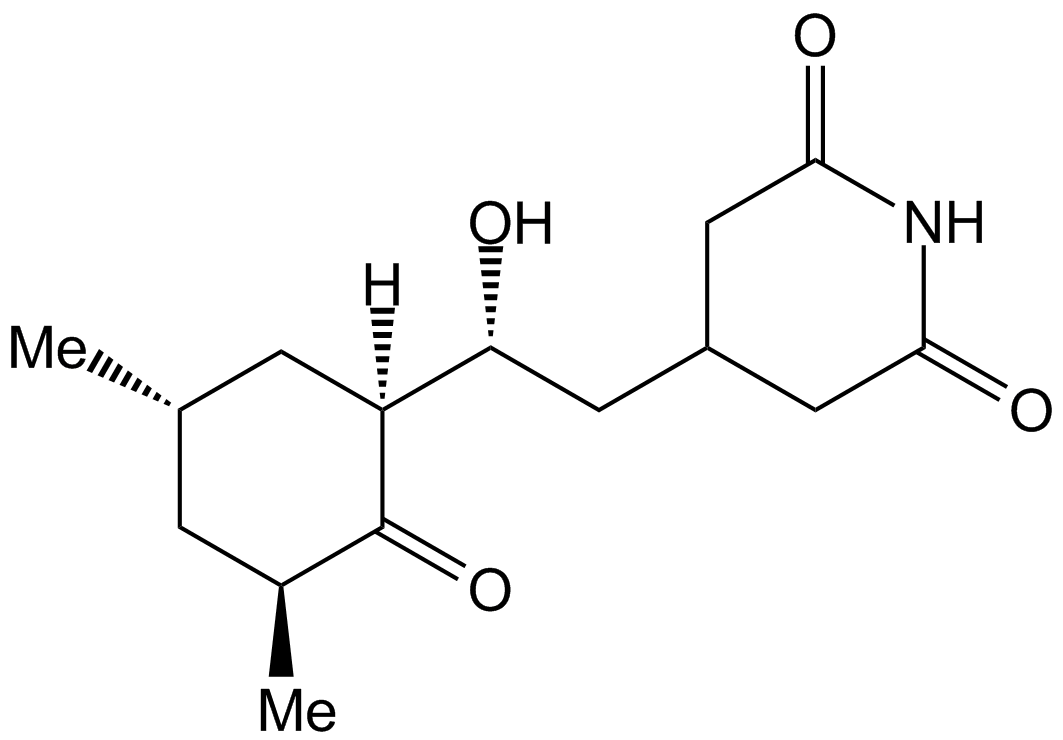
Cycloheximide (Synonyms: Naramycin A; Actidione; 3-[2-(3,5-Dimethyl-2-oxocyclohexyl)-2-hydroxyethyl]glutarimide) |
Catalog No.GC17198
 One-Click Copy Product Info
|

Cycloheximide es un antibiótico que inhibe la síntesis de proteínas a nivel de traducción, actuando exclusivamente sobre los ribosomas citoplasmáticos (80 años) de eucariotas. Cycloheximide afectó a todas las etapas dependientes de la energía en el proceso de síntesis de proteínas. Sin embargo, la iniciación parece la más sensible. Cycloheximide también afecta la respiración, la absorción de iones, la biosíntesis de aminoácidos y la síntesis de DNA y RNA, efectos que probablemente sean secundarios a su efecto en la síntesis de proteínas.
Products are for research use only. Not for human use. We do not sell to patients.
Cas No.: 66-81-9
Sample solution is provided at 25 µL, 10mM.
- Adv Sci (2025):e04378.PMID:40831238
- Nano Today 61 (2025):102560.
- Cell Death Dis: (2026).
- Cell Commun Signal: (2026).
- Cell Death Dis: (2026).
- J Exp Clin Canc Res 43.1 (2024):208.PMID:39061061
- Mater Today Bio (2025):102305.
- Cell Death Discov (2026).
- Npj Precis Oncol: (2026).
- Clin Transl Med 13.1 (2023):e1164.PMID:36629054
- Mol Ther Nucl Acids 28 (2022):219-230.PMID:35402071
- J Pharm Anal 14.1 (2024):69-85.PMID:38352950
- J Clin Immunol 44.6 (2024):1-14.PMID:38773005
- Oncogene (2026):1-13.PMID:42493547
- Oncogene (2023):1-13.PMID:38040806
- Cell Death Dis 15.12 (2024):1-12.PMID:39695153
- Cell Commun Signal 23.1 (2025):1-16.PMID:39985085
- Clin. Transl. Med. 15.3 (2025):e70270.PMID:40088428
- Cell Death Dis 16.1 (2025):240.PMID:40175350
- Aging Cell 25.7 (2026):e70603.PMID:42348295
- Cancer Sci 112.10 (2021):4075-4086.PMID:34310804
- Acta Pharmacol Sin (2024):1-14.PMID:38992120
- Brit J Cancer (2025):1-11.PMID:40783630
- Diabetes (2025):db250484.PMID:41100887
- Cell Rep 44.12 (2025).PMID:41348543
- Acta Pharmacol Sin 43.10 (2022):2609-2623.PMID:35347248
- J Nutr Biochem (2024):109678.PMID:38844080
- Cell Mol Life Sci 81.1 (2024):292.PMID:38976080
- Ecotox Environ Safe 283 (2024):116816.PMID:39096685
- Am J Resp Cell Mol (2024).PMID:39265182
- Acta Physiol 241.9 (2025):e70085.PMID:40844176
- Oncogenesis 14.1 (2025):19.PMID:40527876
- Cancer Cell Int 25.1 (2025):333.PMID:41044601
- Embo Mol Med (2025):1-30.PMID:41068431
- Front Immunol 16 (2025):1617864.PMID:41293174
- Int Immunopharmacol: (2026): 117304.
- Cell Signal (2024):111064.PMID:38266744
- J Biol Chem (2024):107139.PMID:38447792
- J Biol Chem 300.4 (2024).PMID:38447792
- Aging 16.8 (2024):6773-6795.PMID:38643468
- Aging (Albany NY) 16.8 (2024):6773.PMID:38643468
- Commun Biol 8.1 (2025):71.PMID:39820362
- Front Cell Dev Biol 13 (2025):1542356.PMID:40486906
- J Mol Cell Cardiol (2026).PMID:41506595
- Int Immunopharmacol 175 (2026):116400.PMID:41740338
- Eur J Pharmacol (2026):178853.PMID:41962420
- J Mol Endocrinol 72.3 (2024).PMID:38261314
- Lipids Health Dis 23.1 (2024):381.PMID:39558335
- Mol Genet Metab (2025):109292.PMID:41275642
- Acta Bioch Bioph Sin 57.12 (2025):2094.PMID:41311215
- J Biol Chem 296 (2021).PMID:33811857
- Drug Resist Update (2024):101063.PMID:38335844
- bioRxiv (2026):2026-01.
Cycloheximide es un antibiótico que inhibe la síntesis de proteínas a nivel de traducción, actuando exclusivamente sobre los ribosomas citoplasmáticos (80 años) de eucariotas. Cycloheximide afectó a todas las etapas dependientes de la energía en el proceso de síntesis de proteínas. Sin embargo, la iniciación parece la más sensible. Cycloheximide también afecta la respiración, la absorción de iones, la biosíntesis de aminoácidos y la síntesis de DNA y RNA, efectos que probablemente sean secundarios a su efecto en la síntesis de proteínas .[1]
El estudio in vitro indicó que Cycloheximide a 1 μM inhibió la incorporación de [3H]leucina tanto en proteínas celulares como secretadas en al menos un 86%, sin tener efectos perjudiciales en la integridad de la membrana como lo indica la absorción de la lactato deshidrogenasa. Los polisomas de clase de mayor tamaño (7+) aumentaron con el tratamiento con Cycloheximide y permanecieron aumentados durante la recuperación. [2]
El análisis in vivo indicó que Cycloheximide produjo hiperactividad inicial. Esta hiperactividad inicial fue evidente a los 3 minutos después de la inyección de Cycloheximide. Cycloheximide afecta la actividad al actuar sobre el cerebro, y esto no está relacionado con su inhibición de la síntesis de proteínas. Además, los efectos de Cycloheximide sobre la actividad no parecían ser responsables de su acción amnésica. Sin embargo, Cycloheximide podría tener alguna otra propiedad, no relacionada con la inhibición de la síntesis de proteínas cerebrales, que es responsable de su efecto amnésico.[3]
References:
[1]. Marcos R, et al. Effect of Cycloheximide on different stages of Drosophila melanogaster. Toxicol Lett. 1982 Sep;13(1-2):105-12.
[2].Helinek TG, et al. Initial inhibition and recovery of protein synthesis in cycloheximide-treated hepatocytes. Biochem Pharmacol. 1982 Apr 1;31(7):1219-25.
[3]. Segal DS, et al. Cycloheximide: its effects on activity are dissociable from its effects on memory. Science. 1971 Apr 2;172(3978):82-4.
| Experimentos celulares [1]: | |
Líneas celulares | Hepatocitos |
Método de preparación | Las suspensiones de hepatocitos (2 x 10⁶ células/ml) se incubaron en frascos de policarbonato, a 37℃, bajo un flujo constante de 95% O2- 5% CO2, con agitación constante (72 ciclos/min), durante 15 min antes de la adición de cycloheximide. |
Condiciones de reacción | Los hepatocitos se trataron con un rango de concentraciones de cycloheximide de 1 x 10⁻⁷ a 5 x 10⁻³ M). |
Áreas de aplicación | La dosis baja y no tóxica de cycloheximide proporciona una garantía razonable de que la capacidad sintética de las proteínas podría ser perturbada sin causar alteraciones indebidas en otras funciones bioquímicas de la célula. Una dosis no tóxica de cycloheximide (1 μM) inhibió la terminación en mayor medida que oros pasos translacionales. Este efecto mostró una manera dependiente de la dosis. |
| Experimentos con animales [2]: | |
Modelos animales | Ratas Sprague-Dawley macho,con un peso de entre 160 y 230 g |
Método de preparación | Mantuveron en Purina Chow y agua ad libitum. Se retiró la comida de los animales la noche antes de que se les administrara 14C-ANIT, se inyectó Cycloheximide 1/2, 1, 2, 4, 8 o 24 h antes de la administración de ANIT . |
Forma de dosificación | 2 mg/kg |
Áreas de aplicación | Cycloheximide es capaz de proteger contra la hiperbilirrubinemia inducida por ANIT incluso si se administra 24 horas antes de ANIT. Se hizo evidante que el tratamiento con cycloheximide resultó en cantidades sustancialmente reducidas de equivalentes de ANIT en todos los tejidos examanidos, incluso si la cycloheximide se administró 24 horas antes de ANIT. |
References: | |
| Cas No. | 66-81-9 | SDF | |
| Sinónimos | Naramycin A; Actidione; 3-[2-(3,5-Dimethyl-2-oxocyclohexyl)-2-hydroxyethyl]glutarimide | ||
| Chemical Name | 4-[(2R)-2-[(1S,3S,5S)-3,5-dimethyl-2-oxocyclohexyl]-2-hydroxyethyl]piperidine-2,6-dione | ||
| Canonical SMILES | CC1CC(C(=O)C(C1)C(CC2CC(=O)NC(=O)C2)O)C | ||
| Formula | C15H23NO4 | M.Wt | 281.4 |
| Solubility | ≥ 100 mg/mL (355.87 mM) in DMSO, ≥ 57.6 mg/mL in EtOH, ≥ 14.05 mg/mL in Water with ultrasonic and warming | Storage | 4°C, protect from light |
| General tips | Please select the appropriate solvent to prepare the stock solution according to the
solubility of the product in different solvents; once the solution is prepared, please store it in
separate packages to avoid product failure caused by repeated freezing and thawing.Storage method
and period of the stock solution: When stored at -80°C, please use it within 6 months; when stored
at -20°C, please use it within 1 month. To increase solubility, heat the tube to 37°C and then oscillate in an ultrasonic bath for some time. |
||
| Shipping Condition | Evaluation sample solution: shipped with blue ice. All other sizes available: with RT, or with Blue Ice upon request. | ||
| Prepare stock solution | |||

|
1 mg | 5 mg | 10 mg |
| 1 mM | 3.5537 mL | 17.7683 mL | 35.5366 mL |
| 5 mM | 710.7 μL | 3.5537 mL | 7.1073 mL |
| 10 mM | 355.4 μL | 1.7768 mL | 3.5537 mL |
Step 1: Enter information below (Recommended: An additional animal making an allowance for loss during the experiment)
 g
μL
g
μL
Step 2: Enter the in vivo formulation (This is only the calculator, not formulation. Please contact us first if there is no in vivo formulation at the solubility Section.)
Calculation results:
Working concentration: mg/ml;
Method for preparing DMSO master liquid: mg drug pre-dissolved in μL DMSO ( Master liquid concentration mg/mL, Please contact us first if the concentration exceeds the DMSO solubility of the batch of drug. )
Method for preparing in vivo formulation: Take μL DMSO master liquid, next addμL PEG300, mix and clarify, next addμL Tween 80, mix and clarify, next add μL saline, mix and clarify.
Method for preparing in vivo formulation: Take μL DMSO master liquid, next add μL Corn oil, mix and clarify.
Note: 1. Please make sure the liquid is clear before adding the next solvent.
2. Be sure to add the solvent(s) in order. You must ensure that the solution obtained, in the previous addition, is a clear solution before proceeding to add the next solvent. Physical methods such as vortex, ultrasound or hot water bath can be used to aid dissolving.
3. All of the above co-solvents are available for purchase on the GlpBio website.
Quality Control & SDS
- View current batch:
- Purity: >98.00% Appearance: A solid
- COA (Certificate of Analysis)
- SDS (Safety Data Sheet)
- Datasheet
-
Related Biological Data

(F-G)Western blotting and quantification analyses of the effect of GPRC5A overexpression on LAMTOR1 stability in TNBC cells.
TNBC cells incubated with CHX (GlpBio, USA) (50ug/ml for SUM159PT, 25ug/mg for MDA-MB-231) or MG132 (10uM) at the indicated time points.
Drug Resistance Updates (2024): 101063. PMID: 38335844 IF: 24.3008 -
Related Biological Data

BAG3 induces PARP1-K249 ubiquitination by WWP2. (C) NC or shBAG3 HUVECs underwent subsequent treatment with CHX for different lengths of time, and the degradation speed (slope) of PARP1 was determined by immunoblot.
The proteasome suppressor MG132 (A2585; 20μM in DMSO) and cycloheximide (CHX, GC17198; 100μM in DMSO) were from GlpBio (USA).
Redox Biology (2022): 102238. PMID: 35066290 IF: 11.79 -
Related Biological Data

Epimedin B (EB) improves tyrosinase (TYR) and TYR-related protein 1 (TYRP1) stability by affecting the ubiquitin-proteasome degradation pathway. (A) The protein expression levels of TYR, TYRP1, and dopachrome tautomerase (DCT) (cycloheximide (CHX): 50 mg/mL; monobenzone: 30 mM; EB: 100 mM for 0, 6, 12, and 24 h), and statistics for TYR, TYRP1, and DCT expression.
Cells were treated with CHX (GlpBio, USA) (25ug/mL), which is a protein synthesis inhibitor, and cotreated with monobenzone (30uM) and EB (100uM) for 0, 6, 12, and 24 h.
J Pharm Anal, 2024, 14(1): 69-85. PMID: 38352950 IF: 8.8005 -
Related Biological Data

The result of protein half-life assay showed that overexpression of IMPDH2 significantly extended the half-life of endogenous IMPDH1.
Cells transfected with the indicated plasmids were treated with CHX (100μg/ml) (GlpBio, USA) for the indicated times before collection.
Clin Transl Med 13.1 (2023): e1164. PMID: 36629054 IF: 8.5535 -
Related Biological Data

Analysis of c-Myc expression by Western blot (with β-tubulin and GAPDH as loading controls). F Western blots of c-Myc in cells treated with CHX after pretreated with MG132 for 6h.
Cells were treated with 50μg/ml cycloheximide (CHX, GC17198 from GLPBIO) for 30 min, 60 min and 90 min.
Cell Death & Disease 13.4 (2022): 1-12. PMID: 35365616 IF: 8.4685
Average Rating: 5 (Based on Reviews and 30 reference(s) in Google Scholar.)