

Cycloheximide (Synonyms: Naramycin A; Actidione; 3-[2-(3,5-Dimethyl-2-oxocyclohexyl)-2-hydroxyethyl]glutarimide) |
Katalog-Nr.GC17198
 One-Click Copy Product Info
|

Cycloheximide ist ein Antibiotikum, das die Proteinbiosynthese auf Translationsebene hemmt und ausschließlich an zytoplasmischen(80S) Ribosomen von Eukaryoten wirkt.
Products are for research use only. Not for human use. We do not sell to patients.
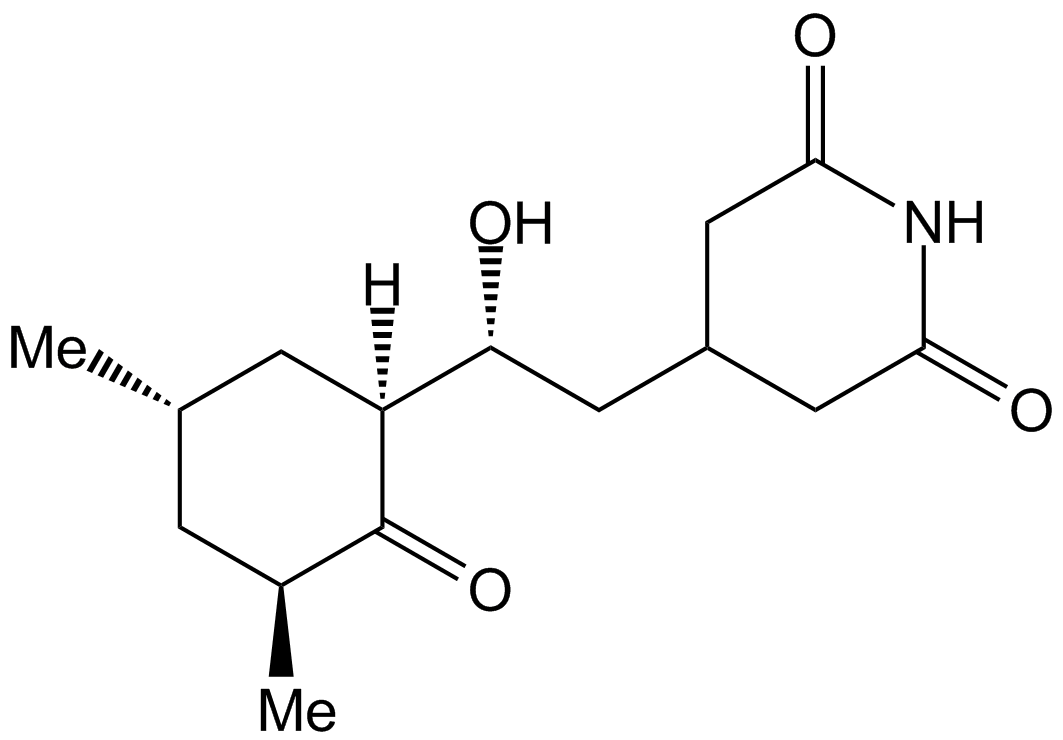
Cas No.: 66-81-9
Sample solution is provided at 25 µL, 10mM.
- Adv Sci (2025):e04378.PMID:40831238
- Nano Today 61 (2025):102560.
- Cell Death Dis: (2026).
- Cell Commun Signal: (2026).
- J Exp Clin Canc Res 43.1 (2024):208.PMID:39061061
- Mater Today Bio (2025):102305.
- Cell Death Discov (2026).
- Npj Precis Oncol: (2026).
- Clin Transl Med 13.1 (2023):e1164.PMID:36629054
- Mol Ther Nucl Acids 28 (2022):219-230.PMID:35402071
- J Pharm Anal 14.1 (2024):69-85.PMID:38352950
- J Clin Immunol 44.6 (2024):1-14.PMID:38773005
- Oncogene (2026):1-13.PMID:42493547
- Oncogene (2023):1-13.PMID:38040806
- Cell Death Dis 15.12 (2024):1-12.PMID:39695153
- Cell Commun Signal 23.1 (2025):1-16.PMID:39985085
- Clin. Transl. Med. 15.3 (2025):e70270.PMID:40088428
- Cell Death Dis 16.1 (2025):240.PMID:40175350
- Aging Cell 25.7 (2026):e70603.PMID:42348295
- Cancer Sci 112.10 (2021):4075-4086.PMID:34310804
- Acta Pharmacol Sin (2024):1-14.PMID:38992120
- Brit J Cancer (2025):1-11.PMID:40783630
- Diabetes (2025):db250484.PMID:41100887
- Cell Rep 44.12 (2025).PMID:41348543
- Acta Pharmacol Sin 43.10 (2022):2609-2623.PMID:35347248
- J Nutr Biochem (2024):109678.PMID:38844080
- Cell Mol Life Sci 81.1 (2024):292.PMID:38976080
- Ecotox Environ Safe 283 (2024):116816.PMID:39096685
- Am J Resp Cell Mol (2024).PMID:39265182
- Acta Physiol 241.9 (2025):e70085.PMID:40844176
- Oncogenesis 14.1 (2025):19.PMID:40527876
- Cancer Cell Int 25.1 (2025):333.PMID:41044601
- Embo Mol Med (2025):1-30.PMID:41068431
- Front Immunol 16 (2025):1617864.PMID:41293174
- Int Immunopharmacol: (2026): 117304.
- Cell Signal (2024):111064.PMID:38266744
- J Biol Chem (2024):107139.PMID:38447792
- J Biol Chem 300.4 (2024).PMID:38447792
- Aging 16.8 (2024):6773-6795.PMID:38643468
- Aging (Albany NY) 16.8 (2024):6773.PMID:38643468
- Commun Biol 8.1 (2025):71.PMID:39820362
- Front Cell Dev Biol 13 (2025):1542356.PMID:40486906
- J Mol Cell Cardiol (2026).PMID:41506595
- Int Immunopharmacol 175 (2026):116400.PMID:41740338
- Eur J Pharmacol (2026):178853.PMID:41962420
- J Mol Endocrinol 72.3 (2024).PMID:38261314
- Lipids Health Dis 23.1 (2024):381.PMID:39558335
- Mol Genet Metab (2025):109292.PMID:41275642
- Acta Bioch Bioph Sin 57.12 (2025):2094.PMID:41311215
- J Biol Chem 296 (2021).PMID:33811857
- Drug Resist Update (2024):101063.PMID:38335844
- bioRxiv (2026):2026-01.
Cycloheximide ist ein Antibiotikum, das die Proteinbiosynthese auf Translationsebene hemmt und ausschließlich an zytoplasmischen(80S) Ribosomen von Eukaryoten wirkt. Cycloheximide beeinflusst alle Energie-abhängigen Phasen der Proteinbiosynthese, wobei die Initiation am empfindlichsten zu sein scheint. Cycloheximide beeinflusst auch die Atmung, die Ionen-Aufnahme, die Aminosäure-Biosynthese sowie die DNA- und RNA-Synthese. Die Effekte sind wahrscheinlich sekundär zu seiner Wirkung auf die Proteinbiosynthese[1].
In-vitro-Studien zeigten, dass Cycloheximide in einer Konzentration von 1 μM den Einbau von [3H]Leucin in zelluläre und sezernierte Proteine um mindestens 86% hemmte, ohne die Membranintegrität zu beeinträchtigen, wie die Trypanblau-Aufnahme und die Freisetzung von Lactatdehydrogenase zeigten. Die Anzahl größerer Polysomen(7+) war nach Cycloheximide-Behandlung erhöht und blieb auch während der Erholungsphase erhöht[2].
In-vivo-Analysen zeigten, dass Cycloheximide eine initiale Hyperaktivität hervorrief. Diese Hyperaktivität trat innerhalb von 3 Minuten nach der Injektion von Cycloheximide auf. Cycloheximide beeinflusst die Aktivität durch seine Wirkung auf das Gehirn und das steht in keinem Zusammenhang mit seiner Hemmung der Proteinsynthese. Außerdem scheinen die Effekte von Cycloheximide auf die Aktivität nicht für seine amnestische Wirkung verantwortlich zu sein. Es ist aber möglich, dass Cycloheximide eine andere Eigenschaft hat, die nicht mit der Hemmung der zerebralen Proteinsynthese zusammenhängt und für seine amnestische Wirkung verantwortlich ist[3].
References:
[1]. Marcos R, et al. Effect of Cycloheximide on different stages of Drosophila melanogaster. Toxicol Lett. 1982 Sep;13(1-2):105-12.
[2].Helinek TG, et al. Initial inhibition and recovery of protein synthesis in cycloheximide-treated hepatocytes. Biochem Pharmacol. 1982 Apr 1;31(7):1219-25.
[3]. Segal DS, et al. Cycloheximide: its effects on activity are dissociable from its effects on memory. Science. 1971 Apr 2;172(3978):82-4.
| Zellexperiment [1]: | |
Zelllinien | Hepatozyten |
Vorbereitungsmethode | Hepatozyten-Suspensionen(2 x 10⁶ Zellen/ml) wurden in Polycarbonat-Flaschen bei 37℃ unter einem konstanten Strom von 95% O2- 5% CO2 und konstantem Schütteln(72 Zyklen/Minute) 15 Minuten lang inkubiert, bevor Cycloheximide hinzugefügt wurde. |
Reaktionsbedingungen | Hepatozyten wurden mit verschiedenen Cycloheximide-Konzentrationen von 1 x 10⁻⁷ bis 5 x 10⁻³ M behandelt. |
Anwendungen | Eine niedrige, nicht-toxische Dosis von Cycloheximide bietet hinreichende Sicherheit, dass die Proteinsynthese beeinträchtigt werden kann, ohne andere biochemische Zellfunktionen übermäßig zu verändern. Eine nicht-toxische Dosis von Cycloheximide(1 μM) hemmte den Translationsabbruch stärker als andere Translationsschritte. Dieser Effekt war dosisabhängig. |
| Tierversuch [2]: | |
Tiermodelle | Männliche Sprague-Dawley-Ratten mit einem Gewicht zwischen 160-230 g |
Vorbereitungsmethode | Die Mäuse wurden mit Purina Chow und Wasser ad libitum gefüttert. Am Abend vor der Verabreichung von 14C-ANIT wurde den Tieren das Futter entzogen. Cycloheximide wurde 1/2, 1, 2, 4, 8 oder 24 Stunden vor der ANIT-Gabe injiziert. |
Dosierungsform | 2 mg/kg |
Anwendungen | Cycloheximide kann vor ANIT-induzierter Hyperbilirubinämie schützen, selbst wenn es 24 Stunden vor ANIT verabreicht wird. Es zeigte sich, dass die Behandlung mit Cycloheximide die Menge an ANIT-Äquivalenten in allen untersuchten Geweben deutlich reduzierte, selbst wenn Cycloheximide 24 Stunden vor ANIT verabreicht wurde. |
References: | |
| Cas No. | 66-81-9 | SDF | |
| Überlieferungen | Naramycin A; Actidione; 3-[2-(3,5-Dimethyl-2-oxocyclohexyl)-2-hydroxyethyl]glutarimide | ||
| Chemical Name | 4-[(2R)-2-[(1S,3S,5S)-3,5-dimethyl-2-oxocyclohexyl]-2-hydroxyethyl]piperidine-2,6-dione | ||
| Canonical SMILES | CC1CC(C(=O)C(C1)C(CC2CC(=O)NC(=O)C2)O)C | ||
| Formula | C15H23NO4 | M.Wt | 281.4 |
| Löslichkeit | ≥ 100 mg/mL (355.87 mM) in DMSO, ≥ 57.6 mg/mL in EtOH, ≥ 14.05 mg/mL in Water with ultrasonic and warming | Storage | 4°C, protect from light |
| General tips | Please select the appropriate solvent to prepare the stock solution according to the
solubility of the product in different solvents; once the solution is prepared, please store it in
separate packages to avoid product failure caused by repeated freezing and thawing.Storage method
and period of the stock solution: When stored at -80°C, please use it within 6 months; when stored
at -20°C, please use it within 1 month. To increase solubility, heat the tube to 37°C and then oscillate in an ultrasonic bath for some time. |
||
| Shipping Condition | Evaluation sample solution: shipped with blue ice. All other sizes available: with RT, or with Blue Ice upon request. | ||
| Prepare stock solution | |||

|
1 mg | 5 mg | 10 mg |
| 1 mM | 3.5537 mL | 17.7683 mL | 35.5366 mL |
| 5 mM | 710.7 μL | 3.5537 mL | 7.1073 mL |
| 10 mM | 355.4 μL | 1.7768 mL | 3.5537 mL |
Step 1: Enter information below (Recommended: An additional animal making an allowance for loss during the experiment)
 g
μL
g
μL
Step 2: Enter the in vivo formulation (This is only the calculator, not formulation. Please contact us first if there is no in vivo formulation at the solubility Section.)
Calculation results:
Working concentration: mg/ml;
Method for preparing DMSO master liquid: mg drug pre-dissolved in μL DMSO ( Master liquid concentration mg/mL, Please contact us first if the concentration exceeds the DMSO solubility of the batch of drug. )
Method for preparing in vivo formulation: Take μL DMSO master liquid, next addμL PEG300, mix and clarify, next addμL Tween 80, mix and clarify, next add μL saline, mix and clarify.
Method for preparing in vivo formulation: Take μL DMSO master liquid, next add μL Corn oil, mix and clarify.
Note: 1. Please make sure the liquid is clear before adding the next solvent.
2. Be sure to add the solvent(s) in order. You must ensure that the solution obtained, in the previous addition, is a clear solution before proceeding to add the next solvent. Physical methods such as vortex, ultrasound or hot water bath can be used to aid dissolving.
3. All of the above co-solvents are available for purchase on the GlpBio website.
Quality Control & SDS
- View current batch:
- Purity: >98.00% Appearance: A solid
- COA (Certificate of Analysis)
- SDS (Safety Data Sheet)
- Datasheet
-
Related Biological Data

(F-G)Western blotting and quantification analyses of the effect of GPRC5A overexpression on LAMTOR1 stability in TNBC cells.
TNBC cells incubated with CHX (GlpBio, USA) (50ug/ml for SUM159PT, 25ug/mg for MDA-MB-231) or MG132 (10uM) at the indicated time points.
Drug Resistance Updates (2024): 101063. PMID: 38335844 IF: 24.3008 -
Related Biological Data

BAG3 induces PARP1-K249 ubiquitination by WWP2. (C) NC or shBAG3 HUVECs underwent subsequent treatment with CHX for different lengths of time, and the degradation speed (slope) of PARP1 was determined by immunoblot.
The proteasome suppressor MG132 (A2585; 20μM in DMSO) and cycloheximide (CHX, GC17198; 100μM in DMSO) were from GlpBio (USA).
Redox Biology (2022): 102238. PMID: 35066290 IF: 11.79 -
Related Biological Data

Epimedin B (EB) improves tyrosinase (TYR) and TYR-related protein 1 (TYRP1) stability by affecting the ubiquitin-proteasome degradation pathway. (A) The protein expression levels of TYR, TYRP1, and dopachrome tautomerase (DCT) (cycloheximide (CHX): 50 mg/mL; monobenzone: 30 mM; EB: 100 mM for 0, 6, 12, and 24 h), and statistics for TYR, TYRP1, and DCT expression.
Cells were treated with CHX (GlpBio, USA) (25ug/mL), which is a protein synthesis inhibitor, and cotreated with monobenzone (30uM) and EB (100uM) for 0, 6, 12, and 24 h.
J Pharm Anal, 2024, 14(1): 69-85. PMID: 38352950 IF: 8.8005 -
Related Biological Data

The result of protein half-life assay showed that overexpression of IMPDH2 significantly extended the half-life of endogenous IMPDH1.
Cells transfected with the indicated plasmids were treated with CHX (100μg/ml) (GlpBio, USA) for the indicated times before collection.
Clin Transl Med 13.1 (2023): e1164. PMID: 36629054 IF: 8.5535 -
Related Biological Data

Analysis of c-Myc expression by Western blot (with β-tubulin and GAPDH as loading controls). F Western blots of c-Myc in cells treated with CHX after pretreated with MG132 for 6h.
Cells were treated with 50μg/ml cycloheximide (CHX, GC17198 from GLPBIO) for 30 min, 60 min and 90 min.
Cell Death & Disease 13.4 (2022): 1-12. PMID: 35365616 IF: 8.4685
Average Rating: 5 (Based on Reviews and 30 reference(s) in Google Scholar.)