

DPPH (Synonyms: 2,2-Diphenyl-1-Picrylhydrazyl DPPH radical) |
Catalog No.GC19475
 One-Click Copy Product Info
|

DPPH (1,1-diphenyl2-picrylhydrazyl) es un radical libre estable debido a su deslocalización de electrones de repuesto en toda la molécula. El ensayo DPPH, que es uno de los métodos más conocidos, empleados con frecuencia y precios.
Products are for research use only. Not for human use. We do not sell to patients.
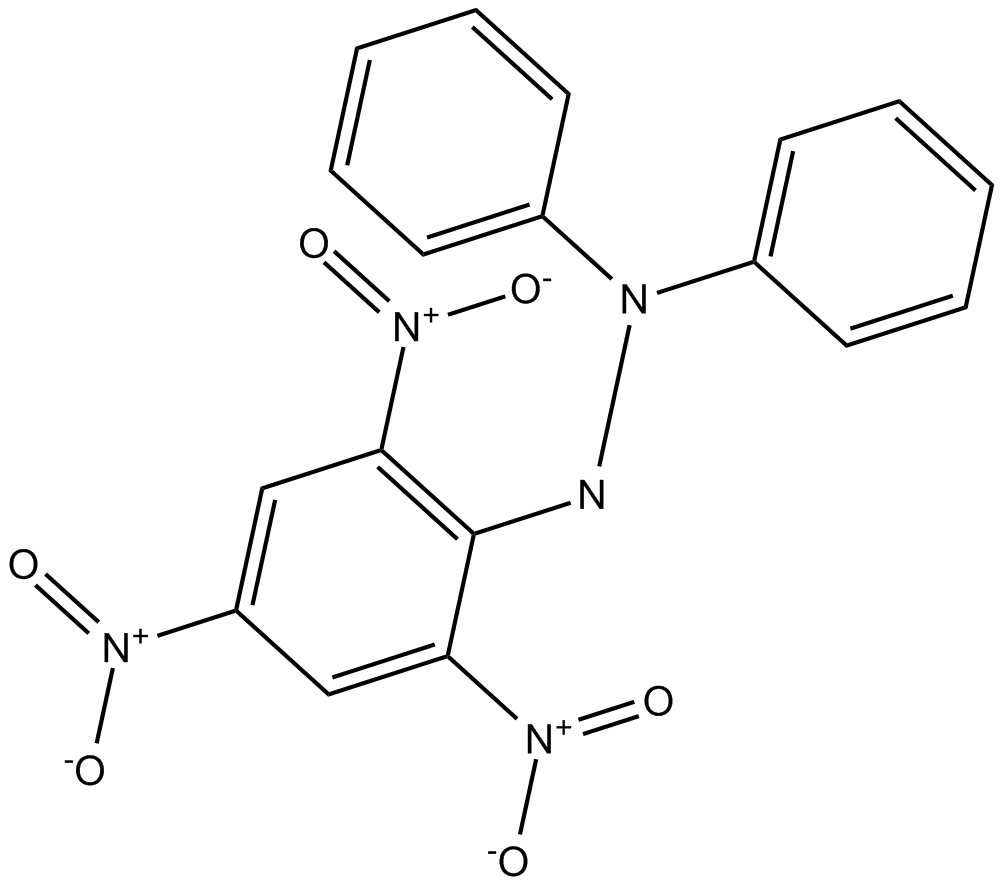
Cas No.: 1898-66-4
Sample solution is provided at 25 µL, 10mM.
DPPH (1,1-diphenyl2-picrylhydrazyl) es un radical libre estable debido a su deslocalización de electrones de repuesto en toda la molécula. El ensayo DPPH, que es uno de los métodos más conocidos, empleados con frecuencia y precios. La deslocalización causa un calor violeta intenso con λmax alrededor de 520 nm. Cuando se mezcla una solución de DPPH con un sustrato que actúa como donante de átomos de hidrógeno, se obtiene una forma estable no radical de DPPH con un cambio simultáneo del color violeta a amarillo pálido[1].
El ensayo DPPH se ha utilizado con éxito para investigar las propiedades antioxidantes del grano y salvado de trigo, verduras, ácidos linoleicos conjugados, hierbas, aceitesde semillas comestibles y harinas en varios sistemas de disolventes diferentes, incluyendo etanol, acetona acuosa, metanol, alcohol acuoso y benceno [2,3]. El ensayo DPPH es un método conveniente para el ensayo antioxidante de cisteína, glutatión, ácido ascórbico, tocoferol y compuestos polihidroxiaromáticos [4], para aceite de oliva, frutas, juegos y vinos[5].
References:[1]. Szabo M, Idioiu C, Chambre D, et al. Improved DPPH determination for antioxidant activity spectrophotometric assay[J]. Chemical Papers, 2007, 61(3): 214-216.[2]. Yu L. Free radical scavenging properties of conjugated linoleic acids[J]. Journal of Agricultural and Food Chemistry, 2001, 49(7): 3452-3456.[3]. Parry J, Su L, Luther M, et al. Fatty acid composition and antioxidant properties of cold-pressed marionberry, boysenberry, red raspberry, and blueberry seed oils[J]. Journal of agricultural and food chemistry, 2005, 53(3): 566-573.[4]. Nishizawa M, Kohno M, Nishimura M, et al. Non-reductive scavenging of 1, 1-diphenyl-2-picrylhydrazyl (DPPH) by peroxyradical: a useful method for quantitative analysis of peroxyradical[J]. Chemical and Pharmaceutical bulletin, 2005, 53(6): 714-716.[5]. Sanchez-Moreno C. Methods used to evaluate the free radical scavenging activity in foods and biological systems[J]. Food science and technology international, 2002, 8(3): 121-137.
El ensayo DPPH [1]
Se analizaron las actividades de eliminación de radicales libres DPPH de los extractos. La solución de DPPH (40 μg mL-1) se preparó en metanol. A cada pozo en una placa de microtiter se añadieron 20 μL de muestra (en triplicado) de concentración adecuada (1000, 500, 100, 50, y 10 μg mL-1) y 180 μL de solución DPPH. Como control negativo, se utilizaron 20 μL de metanol en lugar de una muestra. BHA, BHT, y ácido ascórbico (AA) se utilizaron como controles positivos. Las placas de reacción se mantuvieron en la oscuridad a 37℃ durante 30 minutos, después de lo cual se midió la absorbancia a 517 nm utilizando el lector de placas de microtiter Multiskan Sky Thermo Scientific. La inhibición de los radicales DPPH en la muestra de prueba se calculó utilizando la siguiente fórmula y se expresó como porcentaje (%): Donde Ab es la absorbancia del control negativo (sinmuestra) y As es la absorbancia de la muestra a diferentes concentraciones y los controles positivos, también. Los resultados se presentan como la media del porcentaje de inhibición de los radicales DPPH ± serror estándar.
References:
[1]. Mandi? M R, Oal?e M M, Luni? T M, et al. Chemical characterization and in vitro immunomodulatory effects of different extracts of moss Hedwigia ciliata (Hedw.) P. Beauv. from the Vrša?ke Planine Mts., Serbia[J]. PloS one, 2021, 16(2): e0246810.
| Cas No. | 1898-66-4 | SDF | |
| Sinónimos | 2,2-Diphenyl-1-Picrylhydrazyl DPPH radical | ||
| Chemical Name | 2,2-diphenyl-1-(2,4,6-trinitrophenyl)-hydrazinyl | ||
| Canonical SMILES | O=[N+](C1=C(C([N+]([O-])=O)=CC([N+]([O-])=O)=C1)[N]N(C2=CC=CC=C2)C3=CC=CC=C3)[O-] | ||
| Formula | C18H12N5O6 | M.Wt | 394.3 |
| Solubility | 10mg/mL in DMF, 10mg/mL in Ethanol, 79mg/mL in DMSO | Storage | Store at 2-8°C, protect from light |
| General tips | Please select the appropriate solvent to prepare the stock solution according to the
solubility of the product in different solvents; once the solution is prepared, please store it in
separate packages to avoid product failure caused by repeated freezing and thawing.Storage method
and period of the stock solution: When stored at -80°C, please use it within 6 months; when stored
at -20°C, please use it within 1 month. To increase solubility, heat the tube to 37°C and then oscillate in an ultrasonic bath for some time. |
||
| Shipping Condition | Evaluation sample solution: shipped with blue ice. All other sizes available: with RT, or with Blue Ice upon request. | ||
| Prepare stock solution | |||

|
1 mg | 5 mg | 10 mg |
| 1 mM | 2.5361 mL | 12.6807 mL | 25.3614 mL |
| 5 mM | 507.2 μL | 2.5361 mL | 5.0723 mL |
| 10 mM | 253.6 μL | 1.2681 mL | 2.5361 mL |
Step 1: Enter information below (Recommended: An additional animal making an allowance for loss during the experiment)
 g
μL
g
μL
Step 2: Enter the in vivo formulation (This is only the calculator, not formulation. Please contact us first if there is no in vivo formulation at the solubility Section.)
Calculation results:
Working concentration: mg/ml;
Method for preparing DMSO master liquid: mg drug pre-dissolved in μL DMSO ( Master liquid concentration mg/mL, Please contact us first if the concentration exceeds the DMSO solubility of the batch of drug. )
Method for preparing in vivo formulation: Take μL DMSO master liquid, next addμL PEG300, mix and clarify, next addμL Tween 80, mix and clarify, next add μL saline, mix and clarify.
Method for preparing in vivo formulation: Take μL DMSO master liquid, next add μL Corn oil, mix and clarify.
Note: 1. Please make sure the liquid is clear before adding the next solvent.
2. Be sure to add the solvent(s) in order. You must ensure that the solution obtained, in the previous addition, is a clear solution before proceeding to add the next solvent. Physical methods such as vortex, ultrasound or hot water bath can be used to aid dissolving.
3. All of the above co-solvents are available for purchase on the GlpBio website.
Quality Control & SDS
- View current batch:
- Purity: >98.00% Appearance: A solid
- COA (Certificate of Analysis)
- SDS (Safety Data Sheet)
- Datasheet
-
Related Biological Data

D Free-radical scavengabilities of ascorbic acid, PADM, and AgNP–PADM hydrogels in range 50–250μg mL^−1. E IC50 values of ascorbic acid, PADM, and AgNP–PADM hydrogel groups IC50: the 50% inhibiting concentration
Then, the ascorbic acid, the PADM hydrogel, and the AgNP–PADM hydrogel prepared using the 80-μg mL^-1 AgNP solution were added to a 0.4 mM DPPH(GlpBio) anhydrous ethanol solution, and the solution was stored in the dark for 10 min.
Biomater Res 26.1 (2022): 36. PMID: 35879746 IF: 11.2997 -
Related Biological Data

The free radical scavenging ratio was determined by the DPPH method. CNMs at different MIC levels were mixed with DPPH solution. The mixtures were shaken well and put in the dark at room temperature for 30 min.
CNMs at different MIC levels were mixed with DPPH(GlpBio) solution. The mixtures were shaken well and put in the dark at room temperature for 30 min.
Front Immunol 12 (2022): 5955. PMID: 35126369 IF: 8.7864
Average Rating: 5 (Based on Reviews and 6 reference(s) in Google Scholar.)