

DPPH (Synonyms: 2,2-Diphenyl-1-Picrylhydrazyl DPPH radical) |
カタログ番号GC19475
 One-Click Copy Product Info
|

DPPH (1,1-diphenyl2-picrylhydrazyl)は、分子全体にわたって電子が非局在化するため、安定したフリーラジカルである。DPPHアッセイは、最もよく知られ使われており、正確率が高い。
Products are for research use only. Not for human use. We do not sell to patients.
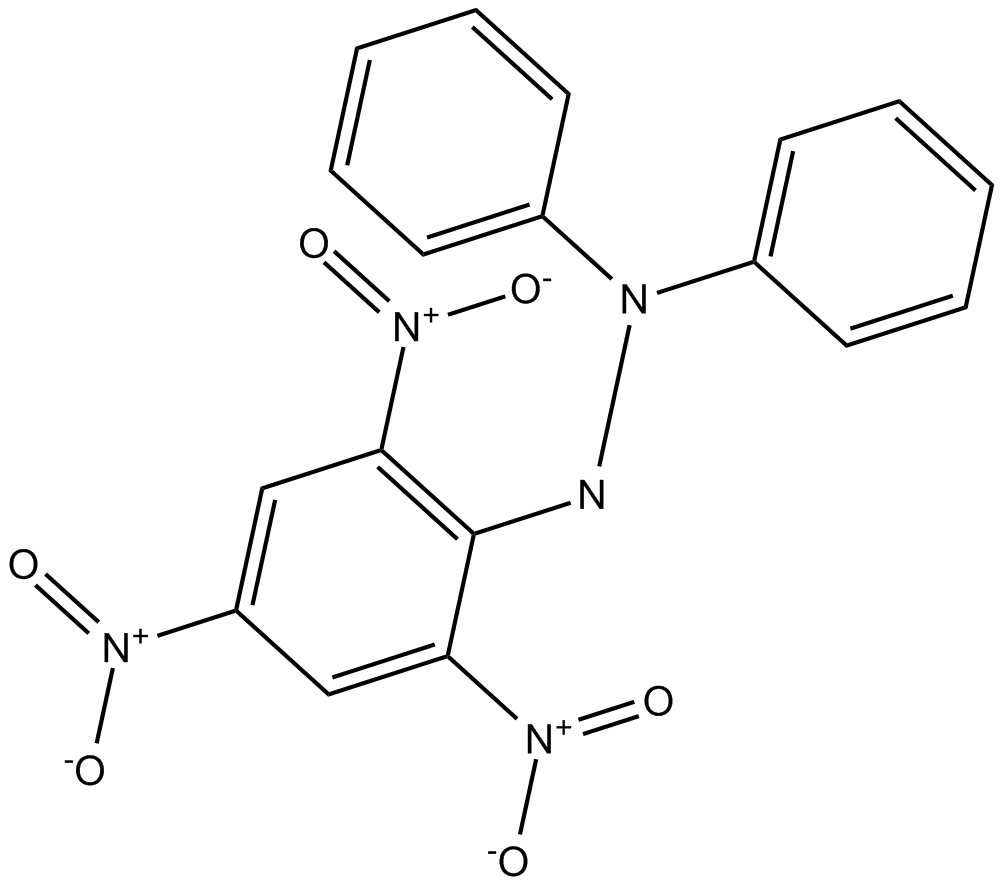
Cas No.: 1898-66-4
Sample solution is provided at 25 µL, 10mM.
DPPH (1,1-diphenyl2-picrylhydrazyl)は、分子全体にわたって電子が非局在化するため、安定したフリーラジカルである。DPPHアッセイは、最もよく知られ使われており、正確率が高い。非局在化により、λmaxが520nmあたりで濃い紫色を呈している。DPPH溶液を水素原子供与体として作用する基質と混合すると、安定した非ラジカル型DPPHが得られ、同時に紫色が淡黄色に変化する。
DPPHアッセイはエタノール、アセトン水溶液、メタノール、アルコール水溶液、ベンゼンなど、さまざまな溶媒系で、小麦穀物やふすま、野菜、共役リノール酸、ハーブ、食用種子油、小麦粉の抗酸化特性を調べるのに利用されている。DPPHアッセイはオリーブオイル、果実、ジュース、ワインの使用するシステイン、グルタチオン、アスコルビン酸、トコフェロール、ポリヒドロキシ芳香族化合物の抗酸化物質のアッセイに便利である。
References:[1]. Szabo M, Idioiu C, Chambre D, et al. Improved DPPH determination for antioxidant activity spectrophotometric assay[J]. Chemical Papers, 2007, 61(3): 214-216.[2]. Yu L. Free radical scavenging properties of conjugated linoleic acids[J]. Journal of Agricultural and Food Chemistry, 2001, 49(7): 3452-3456.[3]. Parry J, Su L, Luther M, et al. Fatty acid composition and antioxidant properties of cold-pressed marionberry, boysenberry, red raspberry, and blueberry seed oils[J]. Journal of agricultural and food chemistry, 2005, 53(3): 566-573.[4]. Nishizawa M, Kohno M, Nishimura M, et al. Non-reductive scavenging of 1, 1-diphenyl-2-picrylhydrazyl (DPPH) by peroxyradical: a useful method for quantitative analysis of peroxyradical[J]. Chemical and Pharmaceutical bulletin, 2005, 53(6): 714-716.[5]. Sanchez-Moreno C. Methods used to evaluate the free radical scavenging activity in foods and biological systems[J]. Food science and technology international, 2002, 8(3): 121-137.
DPPHアッセイ
抽出物のDPPHラジカル消去活性を調べた。DPPH溶液(40 μg mL-1) をメタノールで調製した。マイクロタイタープレートの各ウェルに、適切な濃度 (1000, 500, 100, 50, 10 μg mL-1) の試料20 μL(三回調査)とDPPH溶液180 μLを加えた。ネガティブコントロールとして、試料の代わりにメタノール20 μLを用いた。ポジティブコントロールとしてBHA、BHT、アスコルビン酸 (AA)を用いた。反応プレートを37℃の暗所で30分間静置した後、Multiskan Sky Thermo Scientific Microtiter plate readerで517nmの吸光度を測定した。試験試料中のDPPHラジカルの阻害率を以下の式で算出し、百分率(%)で表した:(%inhibition=[(Ab-As)/Ab]*100)
Abはネガティブコントロール(試料なし)の吸光度、Asは異なる濃度の試料およびポジティブコントロールの吸光度である。結果はDPPHラジカル阻害率の平均値+標準誤差で示す。このプロトコールはあくまでガイドラインであり、ニーズに応じて変更する必要がある。
References:
[1]. Mandi? M R, Oal?e M M, Luni? T M, et al. Chemical characterization and in vitro immunomodulatory effects of different extracts of moss Hedwigia ciliata (Hedw.) P. Beauv. from the Vrša?ke Planine Mts., Serbia[J]. PloS one, 2021, 16(2): e0246810.
| Cas No. | 1898-66-4 | SDF | |
| 同義語 | 2,2-Diphenyl-1-Picrylhydrazyl DPPH radical | ||
| Chemical Name | 2,2-diphenyl-1-(2,4,6-trinitrophenyl)-hydrazinyl | ||
| Canonical SMILES | O=[N+](C1=C(C([N+]([O-])=O)=CC([N+]([O-])=O)=C1)[N]N(C2=CC=CC=C2)C3=CC=CC=C3)[O-] | ||
| Formula | C18H12N5O6 | M.Wt | 394.3 |
| 溶解度 | 10mg/mL in DMF, 10mg/mL in Ethanol, 79mg/mL in DMSO | Storage | Store at 2-8°C, protect from light |
| General tips | Please select the appropriate solvent to prepare the stock solution according to the
solubility of the product in different solvents; once the solution is prepared, please store it in
separate packages to avoid product failure caused by repeated freezing and thawing.Storage method
and period of the stock solution: When stored at -80°C, please use it within 6 months; when stored
at -20°C, please use it within 1 month. To increase solubility, heat the tube to 37°C and then oscillate in an ultrasonic bath for some time. |
||
| Shipping Condition | Evaluation sample solution: shipped with blue ice. All other sizes available: with RT, or with Blue Ice upon request. | ||
| Prepare stock solution | |||

|
1 mg | 5 mg | 10 mg |
| 1 mM | 2.5361 mL | 12.6807 mL | 25.3614 mL |
| 5 mM | 507.2 μL | 2.5361 mL | 5.0723 mL |
| 10 mM | 253.6 μL | 1.2681 mL | 2.5361 mL |
Step 1: Enter information below (Recommended: An additional animal making an allowance for loss during the experiment)
 g
μL
g
μL
Step 2: Enter the in vivo formulation (This is only the calculator, not formulation. Please contact us first if there is no in vivo formulation at the solubility Section.)
Calculation results:
Working concentration: mg/ml;
Method for preparing DMSO master liquid: mg drug pre-dissolved in μL DMSO ( Master liquid concentration mg/mL, Please contact us first if the concentration exceeds the DMSO solubility of the batch of drug. )
Method for preparing in vivo formulation: Take μL DMSO master liquid, next addμL PEG300, mix and clarify, next addμL Tween 80, mix and clarify, next add μL saline, mix and clarify.
Method for preparing in vivo formulation: Take μL DMSO master liquid, next add μL Corn oil, mix and clarify.
Note: 1. Please make sure the liquid is clear before adding the next solvent.
2. Be sure to add the solvent(s) in order. You must ensure that the solution obtained, in the previous addition, is a clear solution before proceeding to add the next solvent. Physical methods such as vortex, ultrasound or hot water bath can be used to aid dissolving.
3. All of the above co-solvents are available for purchase on the GlpBio website.
Quality Control & SDS
- View current batch:
- Purity: >98.00% Appearance: A solid
- COA (Certificate of Analysis)
- SDS (Safety Data Sheet)
- Datasheet
-
Related Biological Data

D Free-radical scavengabilities of ascorbic acid, PADM, and AgNP–PADM hydrogels in range 50–250μg mL^−1. E IC50 values of ascorbic acid, PADM, and AgNP–PADM hydrogel groups IC50: the 50% inhibiting concentration
Then, the ascorbic acid, the PADM hydrogel, and the AgNP–PADM hydrogel prepared using the 80-μg mL^-1 AgNP solution were added to a 0.4 mM DPPH(GlpBio) anhydrous ethanol solution, and the solution was stored in the dark for 10 min.
Biomater Res 26.1 (2022): 36. PMID: 35879746 IF: 11.2997 -
Related Biological Data

The free radical scavenging ratio was determined by the DPPH method. CNMs at different MIC levels were mixed with DPPH solution. The mixtures were shaken well and put in the dark at room temperature for 30 min.
CNMs at different MIC levels were mixed with DPPH(GlpBio) solution. The mixtures were shaken well and put in the dark at room temperature for 30 min.
Front Immunol 12 (2022): 5955. PMID: 35126369 IF: 8.7864
Average Rating: 5 (Based on Reviews and 6 reference(s) in Google Scholar.)