

Luteolin |
Catalog No.GN10370
 One-Click Copy Product Info
|

Luteolin es un compuesto flavonoide con múltiples funciones como antiinflamatoria, antioxidante y anticancerígena. La luteolina es un inhibidor eficaz del factor nuclear relacionado con el factor eritroide 2 (Nrf2).
Products are for research use only. Not for human use. We do not sell to patients.
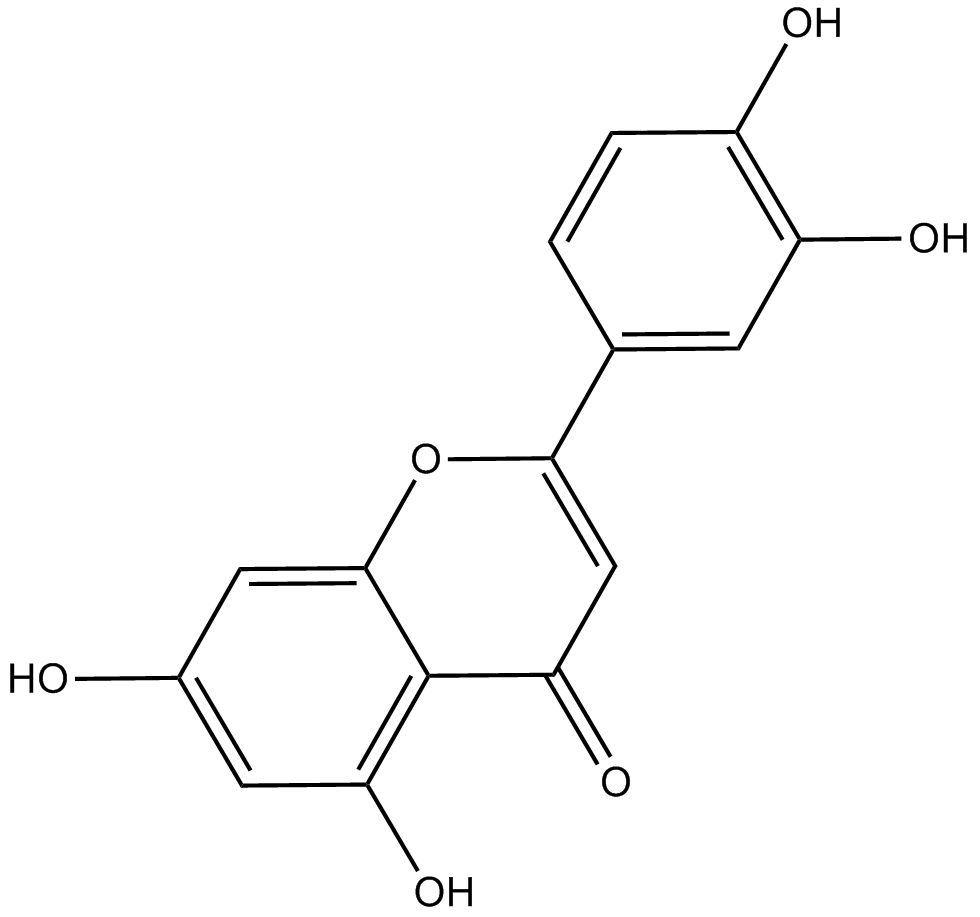
Cas No.: 491-70-3
Sample solution is provided at 25 µL, 10mM.
Luteolin es un compuesto flavonoide con múltiples funciones como antiinflamatoria, antioxidante y anticancerígena. La luteolina es un inhibidor eficaz del factor nuclear relacionado con el factor eritroide 2 (Nrf2)[3].
In vitro, el tratamiento con luteolina (0-160 µM) de células NCI-H460 durante 24 horas inhibió la viabilidad celular de manera dependiente de la concentración, indujo el arresto del ciclo celular en la fase S, aumentó el nivel de expresión de proteínas reguladoras de la apoptosis y también inhibió la migración celular[4]. El tratamiento con luteolina (0.05, 0.1, 5 µM) de células madre mesenquimales de médula ósea de rata (BMSC) durante 24-72 horas activó la vía de señalización PI3K/Akt y promovió la diferenciación osteogénica de las BMSC[5].
In vivo, la administración oral de luteolina (10, 25, 50, 100 mg/kg/día) para tratar ratas con esteatohepatitis no alcohólica (NASH) redujo significativamente los niveles de biomarcadores de función hepática en suero (ALT, AST, bilirrubina total), ácido hialurónico y malondialdehído, además de reducir los niveles de factores proinflamatorios IFN-γ, TNF-α, IL-1α e IL-18[6]. La luteolina (50, 100 mg/kg/día) para tratar ratas con deterioro cognitivo inducido por la infusión del péptido Aβ (1-40) mejoró significativamente el deterioro de la memoria espacial y el aprendizaje espacial inducido por Aβ, aumentó los niveles de SOD y GSH-Px en el homogeneizado del hipocampo, y redujo el nivel de MDA[7].
References:
[1] Coleta M, Campos M G, Cotrim M D, et al. Assessment of luteolin (3′, 4′, 5, 7-tetrahydroxyflavone) neuropharmacological activity[J]. Behavioural brain research, 2008, 189(1): 75-82.
[2] Ziyan L, Yongmei Z, Nan Z, et al. Evaluation of the anti-inflammatory activity of luteolin in experimental animal models[J]. Planta medica, 2007, 73(03): 221-226.
[3] Tang X, Wang H, Fan L, et al. Luteolin inhibits Nrf2 leading to negative regulation of the Nrf2/ARE pathway and sensitization of human lung carcinoma A549 cells to therapeutic drugs[J]. Free Radical Biology and Medicine, 2011, 50(11): 1599-1609.
[4] Ma L, Peng H, Li K, et al. Luteolin exerts an anticancer effect on NCI-H460 human non-small cell lung cancer cells through the induction of Sirt1-mediated apoptosis[J]. Molecular medicine reports, 2015, 12(3): 4196-4202.
[5] Liang G, Zhao J, Dou Y, et al. Mechanism and experimental verification of luteolin for the treatment of osteoporosis based on network pharmacology[J]. Frontiers in Endocrinology, 2022, 13: 866641.
[6] Abu-Elsaad N, El-Karef A. Protection against nonalcoholic steatohepatitis through targeting IL-18 and IL-1alpha by luteolin[J]. Pharmacological Reports, 2019, 71: 688-694.
[7] Yu T X, Zhang P, Guan Y, et al. Protective effects of luteolin against cognitive impairment induced by infusion of Aβ peptide in rats[J]. International Journal of Clinical and Experimental Pathology, 2015, 8(6): 6740.
| Experimentos celulares [1]: | |
Líneas celulares | Células NCI-H460 |
Método de preparación | Las células fueron sembradas en placas de 96 pocillos y tratadas con 0, 20, 40, 80 o 160 µM de luteolina durante 24 h a 37°C. |
Condiciones de reacción | 0, 20, 40, 80 o 160 µM; 24 h |
Áreas de aplicación | La luteolina inhibe la viabilidad de las células NCI-H460 de manera dependiente de la concentración. |
| Experimentos con animales [2]: | |
Modelos animales | Ratas Wistar |
Método de preparación | Las ratas fueron alimentadas con una dieta alta en carbohidratos/alta en grasas (30% carbohidratos y 42% grasas) diariamente durante 12 semanas para inducir esteatohepatitis no alcohólica (NASH). La luteolina (10, 25, 50 o 100 mg/kg/día) se administró como una suspensión (10% p/v en NaCl al 0.9%) utilizando una cánula oral. |
Forma de dosificación | 10, 25, 50 o 100 mg/kg/día; vía oral (p.o.) |
Áreas de aplicación | La luteolina reduce significativamente la actividad de ALT y AST, así como los niveles de bilirrubina, ácido hialurónico y malondialdehído. |
Referencias: [1] Ma L, Peng H, Li K, et al. Luteolin exerts an anticancer effect on NCI-H460 human non-small cell lung cancer cells through the induction of Sirt1-mediated apoptosis[J]. Molecular medicine reports, 2015, 12(3): 4196-4202. [2] Abu-Elsaad N, El-Karef A. Protection against nonalcoholic steatohepatitis through targeting IL-18 and IL-1alpha by luteolin[J]. Pharmacological Reports, 2019, 71: 688-694. | |
| Cas No. | 491-70-3 | SDF | |
| Chemical Name | 2-(3,4-dihydroxyphenyl)-5,7-dihydroxychromen-4-one | ||
| Canonical SMILES | C1=CC(=C(C=C1C2=CC(=O)C3=C(C=C(C=C3O2)O)O)O)O | ||
| Formula | C15H10O6 | M.Wt | 286.24 |
| Solubility | DMF: 20 mg/ml,DMF:PBS (pH 7.2) (1:5): 1 mg/ml,DMSO: 10 mg/ml,Ethanol: 5 mg/ml | Storage | Store at -20°C |
| General tips | Please select the appropriate solvent to prepare the stock solution according to the
solubility of the product in different solvents; once the solution is prepared, please store it in
separate packages to avoid product failure caused by repeated freezing and thawing.Storage method
and period of the stock solution: When stored at -80°C, please use it within 6 months; when stored
at -20°C, please use it within 1 month. To increase solubility, heat the tube to 37°C and then oscillate in an ultrasonic bath for some time. |
||
| Shipping Condition | Evaluation sample solution: shipped with blue ice. All other sizes available: with RT, or with Blue Ice upon request. | ||
| Prepare stock solution | |||

|
1 mg | 5 mg | 10 mg |
| 1 mM | 3.4936 mL | 17.4679 mL | 34.9357 mL |
| 5 mM | 698.7 μL | 3.4936 mL | 6.9871 mL |
| 10 mM | 349.4 μL | 1.7468 mL | 3.4936 mL |
Step 1: Enter information below (Recommended: An additional animal making an allowance for loss during the experiment)
 g
μL
g
μL
Step 2: Enter the in vivo formulation (This is only the calculator, not formulation. Please contact us first if there is no in vivo formulation at the solubility Section.)
Calculation results:
Working concentration: mg/ml;
Method for preparing DMSO master liquid: mg drug pre-dissolved in μL DMSO ( Master liquid concentration mg/mL, Please contact us first if the concentration exceeds the DMSO solubility of the batch of drug. )
Method for preparing in vivo formulation: Take μL DMSO master liquid, next addμL PEG300, mix and clarify, next addμL Tween 80, mix and clarify, next add μL saline, mix and clarify.
Method for preparing in vivo formulation: Take μL DMSO master liquid, next add μL Corn oil, mix and clarify.
Note: 1. Please make sure the liquid is clear before adding the next solvent.
2. Be sure to add the solvent(s) in order. You must ensure that the solution obtained, in the previous addition, is a clear solution before proceeding to add the next solvent. Physical methods such as vortex, ultrasound or hot water bath can be used to aid dissolving.
3. All of the above co-solvents are available for purchase on the GlpBio website.
Quality Control & SDS
- View current batch:
- Purity: >98.00% Appearance: A solid
- COA (Certificate of Analysis)
- SDS (Safety Data Sheet)
- Datasheet
Average Rating: 5 (Based on Reviews and 30 reference(s) in Google Scholar.)