

PQR309 (Synonyms: PI3K-IN-2) |
Catalog No.GC19300
 One-Click Copy Product Info
|

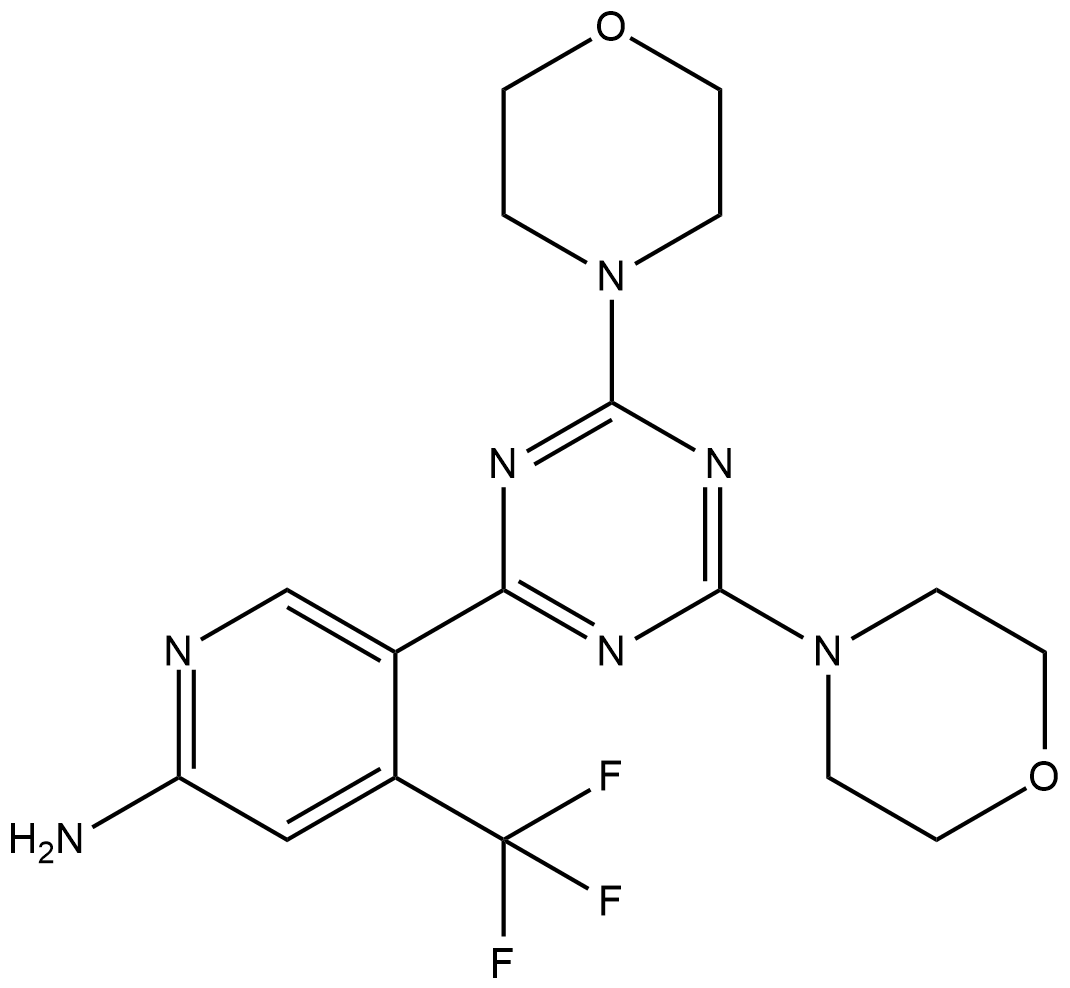
PQR309 es un potente inhibidor pan-clase I de PI3K/mTOR, que penetra en el cerebro y es biodisponible por vía oral, con IC50 de 33nM, 451nM, 661nM, 708nM y 89nM para PI3Kα, PI3Kδ, PI3Kβ, PI3Kγ y mTOR, respectivamente.
Products are for research use only. Not for human use. We do not sell to patients.
Cas No.: 1225037-39-7
Sample solution is provided at 25 µL, 10mM.
_1-3.$$$39978408@51.jpg');)
_1-9.$$$38538795@65.jpg');)
_1-9.$$$39112701@51.jpg');)
_1-7.$$$37316672@70.jpg');)
_366-372.$$$36198801@70.jpg');)
.$$$38565142@65.jpg');)
_1867-1883.$$$33248023@67.jpg');)
_eads6055.$$$39977546@45.jpg');)
_eadm9805.$$$40080571@45.jpg');)
_eadj3020.$$$39666821@45.jpg');)
_1-20.$$$39757301@28.jpg');)
_1-24.$$$38898113@28.jpg');)
_273-287.$$$36806353@46.jpg');)
_1-16.$$$37156877@44.jpg');)
_1-19.$$$37460805@44.jpg');)
_1291-1307.$$$34518654@46.jpg');)
PQR309 es un potente inhibidor pan-clase I de PI3K/mTOR, que penetra en el cerebro y es biodisponible por vía oral, con IC50 de 33nM, 451nM, 661nM, 708nM y 89nM para PI3Kα, PI3Kδ, PI3Kβ, PI3Kγ y mTOR, respectivamente[1][2].
PQR309 ejerce un efecto antitumoral al inhibir la proliferación, inducir apoptosis, inducir arresto del ciclo celular en G1 e inhibir la invasión y migración en células de glioma humano[3]. PQR309 reduce la proliferación en células de cáncer endometrial y células madre de cáncer endometrial al disminuir CDK6 y aumentar p27, induciendo posteriormente el arresto en fase G1. La inhibición de la cascada c-Myc/mtp53 jugó un papel crítico en la acción anti-cáncer endometrial de PQR309. PQR309 puede ser un fármaco potencial contra el cáncer endometrial[4].
PQR309 tiene actividad anti-linfoma como agente único y en combinación in vitro e in vivo[5]. PQR309 muestra solo una respuesta modesta pero una toxicidad significativa en 50 pacientes con linfoma recidivante o refractario fuertemente pretratado de varios subtipos histológicos a dosis continuas de 80 mg y 60 mg[6]. La MTD y RP2D de PQR309 es de 80 mg por vía oral OD[2].
References:
[1]. Beaufils F, Cmiljanovic N, et al. 5-(4,6-Dimorpholino-1,3,5-triazin-2-yl)-4-(trifluoromethyl)pyridin-2-amine (PQR309), a Potent, Brain-Penetrant, Orally Bioavailable, Pan-Class I PI3K/mTOR Inhibitor as Clinical Candidate in Oncology. J Med Chem. 2017;60(17):7524-7538.
[2]. Wicki A, Brown N, et al. First-in human, phase 1, dose-escalation pharmacokinetic and pharmacodynamic study of the oral dual PI3K and mTORC1/2 inhibitor PQR309 in patients with advanced solid tumors (SAKK 67/13). Eur J Cancer. 2018;96:6-16.
[3]. Yang K, Tang XJ, et al. PI3K/mTORC1/2 inhibitor PQR309 inhibits proliferation and induces apoptosis in human glioblastoma cells. Oncol Rep. 2020;43(3):773-782.
[4]. Hsin IL, Shen HP, et al. Suppression of PI3K/Akt/mTOR/c-Myc/mtp53 Positive Feedback Loop Induces Cell Cycle Arrest by Dual PI3K/mTOR Inhibitor PQR309 in Endometrial Cancer Cell Lines. Cells. 2021;10(11):2916. Published 2021 Oct 27.
[5]. Tarantelli C, Gaudio E, et al. PQR309 Is a Novel Dual PI3K/mTOR Inhibitor with Preclinical Antitumor Activity in Lymphomas as a Single Agent and in Combination Therapy. Clin Cancer Res. 2018;24(1):120-129.
[6]. Collins GP, Eyre TA, et al. A Phase II Study to Assess the Safety and Efficacy of the Dual mTORC1/2 and PI3K Inhibitor Bimiralisib (PQR309) in Relapsed, Refractory Lymphoma. Hemasphere. 2021;5(11):e656. Published 2021 Oct 27.
| Experimentos celulares [1]: | |
Líneas celulares | Líneas celulares GBM humanas (U87 y U251). |
Método de preparación | Se sembraron 5x10³ células en placas de 96 pocillos y se añadió PQR309 a cada pocillo. Se evaluaron diversas concentraciones de PQR309 (0, 1, 5, 10, 20, 50 y 100µM), así como una determinada concentración aplicada en diferentes puntos de tiempo (24, 48, 72 y 96 h). Posteriormente, se añadió 10µL de CCK-8 y se incubaron las células durante 1 h a 37℃. |
Condiciones de reacción | 0, 1, 5, 10, 20, 50 y 100µM. |
Áreas de aplicación | PQR309 tuvo un efecto supresor significativo en las células U87 y U251. La viabilidad de las células disminuyó significativamente (P < 0.05) en comparación con el control. Los valores de IC50 de PQR309 fueron 7.104 (IC del 95%, 5.6-8.5) y 11.986 (IC del 95%, 10.6-13.4) en células U87 y U251, respectivamente. |
| Experimentos con animales [2]: | |
Modelos animales | Ratas NIH macho desnudas y sanas. |
Método de preparación | Se inyectaron 2×10⁷ células de cáncer de próstata humano PC3 en un flanco de las ratas, que fueron aleatorizadas después de 16 días. A partir del día 17, se administró PQR309 por vía oral a 5 mg/kg, 10 mg/kg (ambos diariamente, QD) o 15 mg/kg [5 días consecutivos, 2 días sin fármaco (QD×5, 2 días de descanso)] durante 28 días para coincidir con los cronogramas de los estudios de toxicología regulatoria. |
Forma de dosificación | 5, 10, 15 mg/kg, administración oral. |
Áreas de aplicación | El tratamiento con PQR309 condujo a reducciones significativas del tamaño del tumor: el crecimiento tumoral se inhibió de manera dependiente de la dosis (mejor T/C de 31-12%). PQR309 fue mejor tolerado a 5 mg/kg sin cambios significativos en el peso corporal. A 10 mg/kg, PQR309 causó una reducción del peso corporal, acumulando una reducción del 15% después de 28 días de tratamiento. De manera similar, 15 mg/kg de PQR309 provocaron pérdida de peso corporal después de 5 días de tratamiento, que fue reversible durante el período de recuperación. Después de 28 días de exposición al fármaco, los animales con pérdida de peso corporal se recuperaron completamente en un período libre de tratamiento (días 45-50) sin signos evidentes de proliferación celular tumoral. |
Referencias: [1]. Yang K, Tang XJ, et al. El inhibidor de PI3K/mTORC1/2 PQR309 inhibe la proliferación e induce apoptosis en células de glioblastoma humano. Oncol Rep. 2020;43(3):773-782. [2]. Beaufils F, Cmiljanovic N, et al. 5-(4,6-Dimorfolino-1,3,5-triazin-2-il)-4-(trifluorometil)piridin-2-amina (PQR309), un potente inhibidor de PI3K/mTOR clase I de penetración cerebral, biodisponible por vía oral y candidato clínico en oncología. J Med Chem. 2017;60(17):7524-7538. | |
| Cas No. | 1225037-39-7 | SDF | |
| Sinónimos | PI3K-IN-2 | ||
| Canonical SMILES | NC1=NC=C(C2=NC(N3CCOCC3)=NC(N4CCOCC4)=N2)C(C(F)(F)F)=C1 | ||
| Formula | C17H20F3N7O2 | M.Wt | 411.38 |
| Solubility | DMSO : ≥ 50 mg/mL (121.54 mM) | Storage | Store at -20°C |
| Shipping Condition | Evaluation sample solution: shipped with blue ice. All other sizes available: with RT, or with Blue Ice upon request. | ||
| Prepare stock solution | |||

|
1 mg | 5 mg | 10 mg |
| 1 mM | 2.4308 mL | 12.1542 mL | 24.3084 mL |
| 5 mM | 486.2 μL | 2.4308 mL | 4.8617 mL |
| 10 mM | 243.1 μL | 1.2154 mL | 2.4308 mL |
Step 1: Enter information below (Recommended: An additional animal making an allowance for loss during the experiment)
 g
μL
g
μL
Step 2: Enter the in vivo formulation (This is only the calculator, not formulation. Please contact us first if there is no in vivo formulation at the solubility Section.)
Calculation results:
Working concentration: mg/ml;
Method for preparing DMSO master liquid: mg drug pre-dissolved in μL DMSO ( Master liquid concentration mg/mL, Please contact us first if the concentration exceeds the DMSO solubility of the batch of drug. )
Method for preparing in vivo formulation: Take μL DMSO master liquid, next addμL PEG300, mix and clarify, next addμL Tween 80, mix and clarify, next add μL saline, mix and clarify.
Method for preparing in vivo formulation: Take μL DMSO master liquid, next add μL Corn oil, mix and clarify.
Note: 1. Please make sure the liquid is clear before adding the next solvent.
2. Be sure to add the solvent(s) in order. You must ensure that the solution obtained, in the previous addition, is a clear solution before proceeding to add the next solvent. Physical methods such as vortex, ultrasound or hot water bath can be used to aid dissolving.
3. All of the above co-solvents are available for purchase on the GlpBio website.
Quality Control & SDS
- View current batch:
- Purity: >98.50% Appearance: A solid
- COA (Certificate of Analysis)
- SDS (Safety Data Sheet)
- Datasheet
Average Rating: 5 (Based on Reviews and 2 reference(s) in Google Scholar.)