

SR3335 (Synonyms: ML 176) |
Catalog No.GC12877
 One-Click Copy Product Info
|

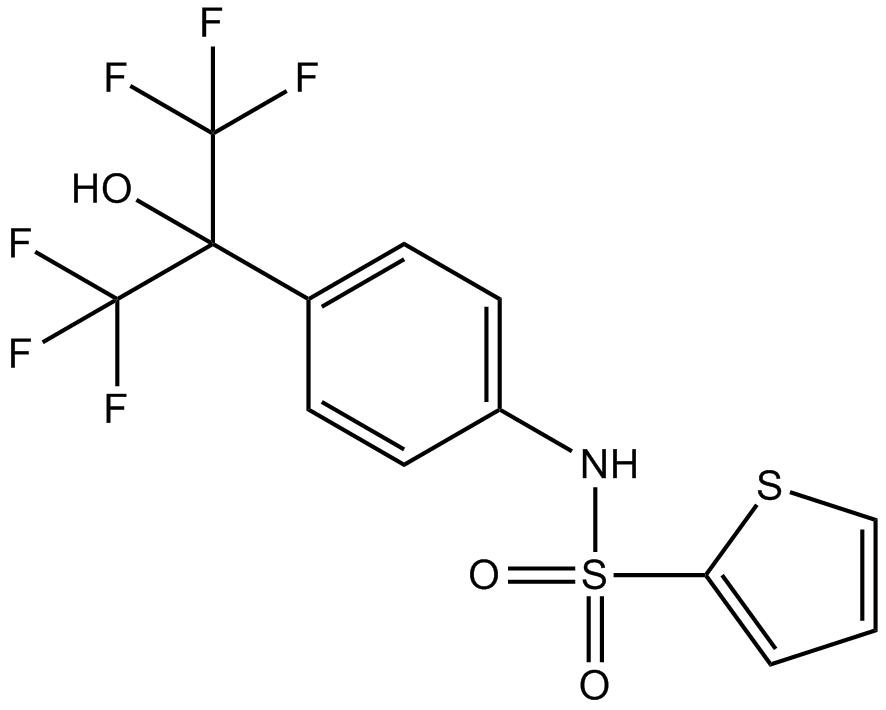
SR3335 es un agonista inverso altamente potente y selectivo del receptor huérfano alfa (RORα) relacionado con el receptor de ácido retinoico, con un valor de Ki de 220nM.
Products are for research use only. Not for human use. We do not sell to patients.
Cas No.: 293753-05-6
Sample solution is provided at 25 µL, 10mM.
_1-3.$$$39978408@51.jpg');)
_1-9.$$$38538795@65.jpg');)
_1-9.$$$39112701@51.jpg');)
_1-7.$$$37316672@70.jpg');)
_366-372.$$$36198801@70.jpg');)
.$$$38565142@65.jpg');)
_1867-1883.$$$33248023@67.jpg');)
_eads6055.$$$39977546@45.jpg');)
_eadm9805.$$$40080571@45.jpg');)
_eadj3020.$$$39666821@45.jpg');)
_1-20.$$$39757301@28.jpg');)
_1-24.$$$38898113@28.jpg');)
_273-287.$$$36806353@46.jpg');)
_1-16.$$$37156877@44.jpg');)
_1-19.$$$37460805@44.jpg');)
_1291-1307.$$$34518654@46.jpg');)
SR3335 es un agonista inverso altamente potente y selectivo del receptor huérfano alfa (RORα) relacionado con el receptor de ácido retinoico, con un valor de Ki de 220nM[1]. RORα es un membro de la superfamilia de receptores nucleares que funciona como un factor de transcripción que regula el metabolismo lipídico, el ritmo circadiano, las respuestas inmunitarias y la diferenciación celular[2]. SR3335 se usa en estudios sobre el tratamiento de la obesidad, así como en trastornos metabólicos, enfermedades autoinmunes y afecciones inflamatorias[3,4].
In vireo, el tratamiento de SR3335 (20μM) durante 4 horas seguido de una alta glucosa (33.3mM) de la estimulación de lso fibroblastos cardíacos durante 48 horas aumentó el número de células positivas de 5-ethynyl-2’-deoxyuridine (EdU) y elevó el nivel de expresión de proteínas del antígeno nuclear celular proliferante (PCNA)[5]. El tratamiento SR3335 (2μM) de células madre mesenquimales de la médula ósea (BMSCs) durante 14 días promovió la diferenciación adipogénica de los BMSCs[6]. El pretratamiento con SR3335 (1μM) de las células del núcleo pulposo humano durante 2 horas seguio del tratamiento con TNF-α (10ng/mL) restauró la regulación a la baja inducida por TNF-α de los niveles de expresión de mRNA de colágeno tipo II (COL2A1) y Aggrecan (ACAN)[7].
In vivo, SR3335 (15mg/kg; dos veces al día) administrado a través de inyección intraperitoneal a ratones C57BL/6J con choroidal neovascularization (CNV) inducida por láser durante 8 días (del día 0 al día 7 después del láser) aumentó el área de la lesión del CNV y la proporción de fuga vascualr del fondo[8].
References:
[1] KUMAR N, KOJETIN D J, SOLT L A, et al. Identification of SR3335 (ML-176): a synthetic RORα selective inverse agonist[J]. ACS Chemical Biology, 2011, 6(3): 218-222.
[2] JETTEN A M. Retinoid-related orphan receptors (RORs): critical roles in development, immunity, circadian rhythm, and cellular metabolism[J]. Nuclear Receptor Signaling, 2009, 7(1): nrs.07003.
[3] KAMENECKA T M, LYDA B, CHANG M R, et al. Synthetic modulators of the retinoic acid receptor-related orphan receptors[J]. MedChemComm, 2013, 4(5): 764-776.
[4] AUCLAIR M, ROBLOT N, CAPEL E, et al. Pharmacological modulation of RORα controls fat browning, adaptive thermogenesis, and body weight in mice[J]. American Journal of Physiology-Endocrinology and Metabolism, 2021, 320(2): E219-E233.
[5] SAN W, ZHOU Q, SHEN D, et al. Roles of retinoic acid-related orphan receptor α in high glucose-induced cardiac fibroblasts proliferation[J]. Frontiers in Pharmacology, 2025, 16: 1539690.
[6] HE L, CHEN Z, HE T, et al. Retinoic acid-related orphan nuclear receptor alpha inhibits adipogenic differentiation of bone marrow mesenchymal stem cells via activating WNT/β-catenin signaling pathway[J]. European Journal of Medical Research, 2025, 30(1): 1073.
[7] LIANG T, QIU J, LI S, et al. Inverse Agonist of Retinoid‐Related Orphan Receptor‐Alpha Prevents Apoptosis and Degeneration in Nucleus Pulposus Cells via Upregulation of YAP[J]. Mediators of Inflammation, 2021, 2021(1): 9954909.
[8] LIU C H, YEMANYI F, BORA K, et al. Genetic deficiency and pharmacological modulation of RORα regulate laser-induced choroidal neovascularization[J]. Aging (Albany NY), 2023, 15(1): 37.
| Experimentos celulares [1]: | |
Líneas celulares | Fibroblastos cardíacos |
Método de preparación | Los fibroblastos cardíacos se pretratron con 20μM SR3335 durante 4 horas y se incubaron con glucosa alta (33.3mM) durante 48h, luego se evaluó la proliferación celular mediante tinción EdU, y se evaluó la expresión proteica de PCNA mediante análisis de transferencia Western. |
Condiciones de reacción | 20μM; 4h |
Áreas de aplicación | El tratamiento de SR3335 aumentó el número de células positivas para EdU y mejoró el nivel de expresión de proteínas de PCNA. |
| Experimentos con animales [2]: | |
Modelos animales | Ratones C57BL/6J con CNV inducido por láser |
Método de preparación | Los ratones C57BL/6J fueron sometidos a CNV inducida por láser y tratados con SR3335 (15mg/kg; dos veces al día, i.p.) durante 8 días (del día 0 al día 7 después del láser), la CNV se analizó en soportes palnos coroidales con tinción de isolectina B4 para visualizar y cuantificar el tamaño de la lesión. |
Forma de dosificación | 15mg/kg; dos veces al día; 8 días; i.p. |
Áreas de aplicación | El tratamiento de SR3335 aumenta el área de lesiones por CNV. |
References: | |
| Cas No. | 293753-05-6 | SDF | |
| Sinónimos | ML 176 | ||
| Chemical Name | N-[4-(1,1,1,3,3,3-hexafluoro-2-hydroxypropan-2-yl)phenyl]thiophene-2-sulfonamide | ||
| Canonical SMILES | C1=CSC(=C1)S(=O)(=O)NC2=CC=C(C=C2)C(C(F)(F)F)(C(F)(F)F)O | ||
| Formula | C13H9F6NO3S2 | M.Wt | 405.34 |
| Solubility | ≥ 88.8 mg/mL in DMSO, ≥ 87.4 mg/mL in EtOH | Storage | Store at -20°C |
| General tips | Please select the appropriate solvent to prepare the stock solution according to the
solubility of the product in different solvents; once the solution is prepared, please store it in
separate packages to avoid product failure caused by repeated freezing and thawing.Storage method
and period of the stock solution: When stored at -80°C, please use it within 6 months; when stored
at -20°C, please use it within 1 month. To increase solubility, heat the tube to 37°C and then oscillate in an ultrasonic bath for some time. |
||
| Shipping Condition | Evaluation sample solution: shipped with blue ice. All other sizes available: with RT, or with Blue Ice upon request. | ||
| Prepare stock solution | |||

|
1 mg | 5 mg | 10 mg |
| 1 mM | 2.4671 mL | 12.3353 mL | 24.6706 mL |
| 5 mM | 493.4 μL | 2.4671 mL | 4.9341 mL |
| 10 mM | 246.7 μL | 1.2335 mL | 2.4671 mL |
Step 1: Enter information below (Recommended: An additional animal making an allowance for loss during the experiment)
 g
μL
g
μL
Step 2: Enter the in vivo formulation (This is only the calculator, not formulation. Please contact us first if there is no in vivo formulation at the solubility Section.)
Calculation results:
Working concentration: mg/ml;
Method for preparing DMSO master liquid: mg drug pre-dissolved in μL DMSO ( Master liquid concentration mg/mL, Please contact us first if the concentration exceeds the DMSO solubility of the batch of drug. )
Method for preparing in vivo formulation: Take μL DMSO master liquid, next addμL PEG300, mix and clarify, next addμL Tween 80, mix and clarify, next add μL saline, mix and clarify.
Method for preparing in vivo formulation: Take μL DMSO master liquid, next add μL Corn oil, mix and clarify.
Note: 1. Please make sure the liquid is clear before adding the next solvent.
2. Be sure to add the solvent(s) in order. You must ensure that the solution obtained, in the previous addition, is a clear solution before proceeding to add the next solvent. Physical methods such as vortex, ultrasound or hot water bath can be used to aid dissolving.
3. All of the above co-solvents are available for purchase on the GlpBio website.
Quality Control & SDS
- View current batch:
- Purity: >99.00% Appearance: A solid
- COA (Certificate of Analysis)
- SDS (Safety Data Sheet)
- Datasheet
Average Rating: 5 (Based on Reviews and 30 reference(s) in Google Scholar.)