

SR3335 (Synonyms: ML 176) |
カタログ番号GC12877
 One-Click Copy Product Info
|

SR3335はレチノイン酸受容体関連オーファン受容体アルファ(RORα)の非常に有力で、選択的な逆アゴニストであり、Ki値は220nMである。
Products are for research use only. Not for human use. We do not sell to patients.
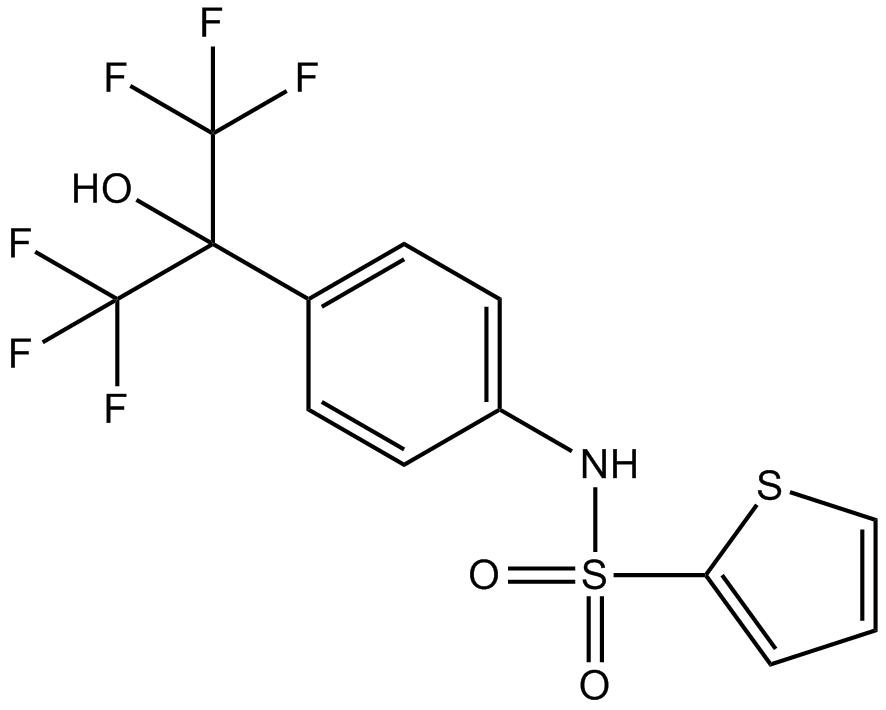
Cas No.: 293753-05-6
Sample solution is provided at 25 µL, 10mM.
_1-3.$$$39978408@51.jpg');)
_1-9.$$$38538795@65.jpg');)
_1-9.$$$39112701@51.jpg');)
_1-7.$$$37316672@70.jpg');)
_366-372.$$$36198801@70.jpg');)
.$$$38565142@65.jpg');)
_1867-1883.$$$33248023@67.jpg');)
_eads6055.$$$39977546@45.jpg');)
_eadm9805.$$$40080571@45.jpg');)
_eadj3020.$$$39666821@45.jpg');)
_1-20.$$$39757301@28.jpg');)
_1-24.$$$38898113@28.jpg');)
_273-287.$$$36806353@46.jpg');)
_1-16.$$$37156877@44.jpg');)
_1-19.$$$37460805@44.jpg');)
_1291-1307.$$$34518654@46.jpg');)
SR3335はレチノイン酸受容体関連オーファン受容体アルファ(RORα)の非常に有力で、選択的な逆アゴニストであり、Ki値は220nMである[1]。RORαは核受容体スーパーファミリーのメンバーであり、脂質代謝、概日リズム、免疫反応と細胞分化を調節する転写因子として機能する[2]。SR3335は通常、肥満の治療、代謝障害、自己免疫疾患と炎症疾患に関する研究に使われている[3,4]。
In vitro(体外)実験で、SR3335(20μM)で4時間前処理し、その後は高グルコース(33.3mM)で心臓線維芽細胞を48時間刺激したところ、5-ethynyl-2’-deoxyuridine(EdU)陽性細胞の数が増え、増殖細胞核抗原(PCNA)のタンパク質発現レベルが向上した[5]。SR3335(2μM)で骨髄間葉系幹細胞(BMSC)を14日間処理したところ、BMSCの脂肪細胞分化を著しく促進した[6]。SR3335(1μM)でヒト髄核細胞を2時間前処理し、TNF-α(10ng/mL)で処理したところ、Collagen type II(COL2A1)とAggrecan(ACAN)mRNA発現レベルのTNF-αに誘発された下方制御を著しく回復させた[7]。
In vivo(体内)実験で、レーザー誘発性の脈絡膜新生血管(CNV)を持つC57BL/6JマウスにSR3335(15mg/kg;毎日二回)を8日間腹腔内注射した(レーザー照射後の0日目から7日目まで)ところ、CNV病変の面積、眼底血管漏出の割合が著しく増えた[8]。
References:
[1] KUMAR N, KOJETIN D J, SOLT L A, et al. Identification of SR3335 (ML-176): a synthetic RORα selective inverse agonist[J]. ACS Chemical Biology, 2011, 6(3): 218-222.
[2] JETTEN A M. Retinoid-related orphan receptors (RORs): critical roles in development, immunity, circadian rhythm, and cellular metabolism[J]. Nuclear Receptor Signaling, 2009, 7(1): nrs.07003.
[3] KAMENECKA T M, LYDA B, CHANG M R, et al. Synthetic modulators of the retinoic acid receptor-related orphan receptors[J]. MedChemComm, 2013, 4(5): 764-776.
[4] AUCLAIR M, ROBLOT N, CAPEL E, et al. Pharmacological modulation of RORα controls fat browning, adaptive thermogenesis, and body weight in mice[J]. American Journal of Physiology-Endocrinology and Metabolism, 2021, 320(2): E219-E233.
[5] SAN W, ZHOU Q, SHEN D, et al. Roles of retinoic acid-related orphan receptor α in high glucose-induced cardiac fibroblasts proliferation[J]. Frontiers in Pharmacology, 2025, 16: 1539690.
[6] HE L, CHEN Z, HE T, et al. Retinoic acid-related orphan nuclear receptor alpha inhibits adipogenic differentiation of bone marrow mesenchymal stem cells via activating WNT/β-catenin signaling pathway[J]. European Journal of Medical Research, 2025, 30(1): 1073.
[7] LIANG T, QIU J, LI S, et al. Inverse Agonist of Retinoid‐Related Orphan Receptor‐Alpha Prevents Apoptosis and Degeneration in Nucleus Pulposus Cells via Upregulation of YAP[J]. Mediators of Inflammation, 2021, 2021(1): 9954909.
[8] LIU C H, YEMANYI F, BORA K, et al. Genetic deficiency and pharmacological modulation of RORα regulate laser-induced choroidal neovascularization[J]. Aging (Albany NY), 2023, 15(1): 37.
| 細胞実験[1]: | |
細胞株 | 心臓線維芽細胞 |
準備方法 | 心臓線維芽細胞を20μM SR3335で4時間前処理し、高グルコース(33.3mM)で48時間インキュベートし、その後細胞の増殖をEdU染色で評価し、PCNAのタンパク質発現をウエスタンブロット分析で評価した。 |
反応条件 | 20μM;4時間 |
アプリケーション | SR3335の処理は、EdU陽性細胞の数を増やし、PCNAのタンパク質発現レベルを向上させた。 |
| 動物実験 [2]: | |
動物モデル | レーザーに誘発されたCNVを持つC57BL/6J |
準備方法 | C57BL/6Jマウスにレーザー誘発性CNVを投与し、SR3335(15mg/kg;毎日二回、腹腔内注射)で8日間処理し(レーザー後の0日目から7日目まで)、イソレクチンB4染色を行った脈絡膜フラットマウント標本でCNVを解析し、病変のサイズを可視化して定量化した。 |
投与形態 | 15mg/kg;毎日二回;8日間;腹腔内注射 |
アプリケーション | SR3335の処理は、CNV病変の面積を著しく増やす。 |
References: | |
| Cas No. | 293753-05-6 | SDF | |
| 同義語 | ML 176 | ||
| Chemical Name | N-[4-(1,1,1,3,3,3-hexafluoro-2-hydroxypropan-2-yl)phenyl]thiophene-2-sulfonamide | ||
| Canonical SMILES | C1=CSC(=C1)S(=O)(=O)NC2=CC=C(C=C2)C(C(F)(F)F)(C(F)(F)F)O | ||
| Formula | C13H9F6NO3S2 | M.Wt | 405.34 |
| 溶解度 | ≥ 88.8 mg/mL in DMSO, ≥ 87.4 mg/mL in EtOH | Storage | Store at -20°C |
| General tips | Please select the appropriate solvent to prepare the stock solution according to the
solubility of the product in different solvents; once the solution is prepared, please store it in
separate packages to avoid product failure caused by repeated freezing and thawing.Storage method
and period of the stock solution: When stored at -80°C, please use it within 6 months; when stored
at -20°C, please use it within 1 month. To increase solubility, heat the tube to 37°C and then oscillate in an ultrasonic bath for some time. |
||
| Shipping Condition | Evaluation sample solution: shipped with blue ice. All other sizes available: with RT, or with Blue Ice upon request. | ||
| Prepare stock solution | |||

|
1 mg | 5 mg | 10 mg |
| 1 mM | 2.4671 mL | 12.3353 mL | 24.6706 mL |
| 5 mM | 493.4 μL | 2.4671 mL | 4.9341 mL |
| 10 mM | 246.7 μL | 1.2335 mL | 2.4671 mL |
Step 1: Enter information below (Recommended: An additional animal making an allowance for loss during the experiment)
 g
μL
g
μL
Step 2: Enter the in vivo formulation (This is only the calculator, not formulation. Please contact us first if there is no in vivo formulation at the solubility Section.)
Calculation results:
Working concentration: mg/ml;
Method for preparing DMSO master liquid: mg drug pre-dissolved in μL DMSO ( Master liquid concentration mg/mL, Please contact us first if the concentration exceeds the DMSO solubility of the batch of drug. )
Method for preparing in vivo formulation: Take μL DMSO master liquid, next addμL PEG300, mix and clarify, next addμL Tween 80, mix and clarify, next add μL saline, mix and clarify.
Method for preparing in vivo formulation: Take μL DMSO master liquid, next add μL Corn oil, mix and clarify.
Note: 1. Please make sure the liquid is clear before adding the next solvent.
2. Be sure to add the solvent(s) in order. You must ensure that the solution obtained, in the previous addition, is a clear solution before proceeding to add the next solvent. Physical methods such as vortex, ultrasound or hot water bath can be used to aid dissolving.
3. All of the above co-solvents are available for purchase on the GlpBio website.
Quality Control & SDS
- View current batch:
- Purity: >99.00% Appearance: A solid
- COA (Certificate of Analysis)
- SDS (Safety Data Sheet)
- Datasheet
Average Rating: 5 (Based on Reviews and 30 reference(s) in Google Scholar.)