

α-Hydroxylinoleic acid (ABTL-0812) |
Katalog-Nr.GC30761
 One-Click Copy Product Info
|

α-HydroxylinolsÄure (α-HydroxylinolsÄure) induziert die Stress-vermittelte Autophagie des endoplasmatischen Retikulums (ER).
Products are for research use only. Not for human use. We do not sell to patients.
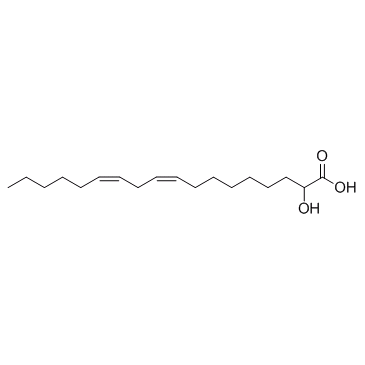
Cas No.: 57818-44-7
Sample solution is provided at 25 µL, 10mM.
_1-3.$$$39978408@51.jpg');)
_1-9.$$$38538795@65.jpg');)
_1-9.$$$39112701@51.jpg');)
_1-7.$$$37316672@70.jpg');)
_366-372.$$$36198801@70.jpg');)
.$$$38565142@65.jpg');)
_1867-1883.$$$33248023@67.jpg');)
_eads6055.$$$39977546@45.jpg');)
_eadm9805.$$$40080571@45.jpg');)
_eadj3020.$$$39666821@45.jpg');)
_1-20.$$$39757301@28.jpg');)
_1-24.$$$38898113@28.jpg');)
_273-287.$$$36806353@46.jpg');)
_1-16.$$$37156877@44.jpg');)
_1-19.$$$37460805@44.jpg');)
_1291-1307.$$$34518654@46.jpg');)
α-Hydroxylinoleic acid (ABTL-0812) is an orally active anticancer compound. α-Hydroxylinoleic acid induces endoplasmic reticulum stress by activating PPARα/γ nuclear receptors, while simultaneously inhibiting the Akt/mTOR pathway through the induction of TRIB3 overexpression, thereby triggering autophagy-mediated cancer cell death. α-Hydroxylinoleic acid can be used in research related to various cancers such as lung cancer, endometrial cancer, and pancreatic cancer[1-4].
In vitro, α-Hydroxylinoleic acid (30–60μM) was used to treat neuroblastoma cell lines (including SK-N-AS, SH-SY5Y, IMR-32, CHLA-90, SK-N-BE(2), and LA1-5s) for 24–72 hours. α-Hydroxylinoleic acid significantly impaired cell viability, induced endoplasmic reticulum stress (ER stress), unfolded protein response (UPR), autophagy, and apoptosis[5]. α-Hydroxylinoleic acid (10–100μM) was used to treat human cancer cell lines (including lung adenocarcinoma A549, pancreatic cancer MiaPaca2, endometrial cancer Ishikawa, squamous non-small cell lung cancer H157, etc.) for 48 hours. α-Hydroxylinoleic acid significantly increased intracellular long-chain dihydroceramide levels and induced apoptosis[6].
In vivo, α-Hydroxylinoleic acid (120mg/kg and 240mg/kg; once daily; 5 days per week) was administered orally to CD1-nu/nu mice bearing U87MG or T98G tumors for 5 weeks. α-Hydroxylinoleic acid significantly impaired tumor growth and increased disease-free survival and overall survival of mice[7]. α-Hydroxylinoleic acid (60mg/kg or 120mg/kg; once daily) was administered orally to immunodeficient female athymic nude mice bearing HEC-1A tumors for 25 or 46 days. α-Hydroxylinoleic acid significantly reduced tumor growth[8].
References:
[1] Vidal L, Victoria I, Gaba L, et al. A first-in-human phase I/Ib dose-escalation clinical trial of the autophagy inducer ABTL0812 in patients with advanced solid tumours. Eur J Cancer. 2021 Mar;146:87-94.
[2] Erazo T, Lorente M, López-Plana A, et al. The New Antitumor Drug ABTL0812 Inhibits the Akt/mTORC1 Axis by Upregulating Tribbles-3 Pseudokinase. Clin Cancer Res. 2016 May 15;22(10):2508-19.
[3] Noguera-Castells A, Mancino M, Morán T, et al. The novel proautophagy anticancer drug ABTL0812 potentiates chemotherapy in adenocarcinoma and squamous nonsmall cell lung cancer. Int J Cancer. 2020 Aug 15;147(4):1163-1179.
[4] Leary A, Estévez-García P, Sabatier R, et al. ENDOLUNG trial. A phase 1/2 study of the Akt/mTOR inhibitor and autophagy inducer Ibrilatazar (ABTL0812) in combination with paclitaxel/carboplatin in patients with advanced/recurrent endometrial cancer. BMC Cancer. 2024 Jul 22;24(1):876.
[5] París-Coderch L, Soriano A, Jiménez C, et al. The antitumour drug ABTL0812 impairs neuroblastoma growth through endoplasmic reticulum stress-mediated autophagy and apoptosis. Cell Death Dis. 2020 Sep 17;11(9):773.
[6] Muñoz-Guardiola P, Casas J, Megías-Roda E, et al. The anti-cancer drug ABTL0812 induces ER stress-mediated cytotoxic autophagy by increasing dihydroceramide levels in cancer cells. Autophagy. 2021 Jun;17(6):1349-1366.
[7] Mancini A, Colapietro A, Cristiano L, et al. Anticancer effects of ABTL0812, a clinical stage drug inducer of autophagy-mediated cancer cell death, in glioblastoma models. Front Oncol. 2022 Nov 2;12:943064.
[8] Felip I, Moiola CP, Megino-Luque C, et al. Therapeutic potential of the new TRIB3-mediated cell autophagy anticancer drug ABTL0812 in endometrial cancer. Gynecol Oncol. 2019 May;153(2):425-435.
| Cell experiment [1]: | |
Cell lines | Neuroblastoma cell lines (SK-N-AS, SH-SY5Y, IMR-32, CHLA-90, SK-N-BE(2), LA1-5s) |
Preparation Method | Neuroblastoma cell lines were cultured and maintained in Iscove's modified Dulbecco's medium supplemented with 10% heat-inactivated fetal bovine serum, 1% insulin-transferrin-selenium supplement, 100U/mL penicillin, 100μg/mL streptomycin and 5μg/mL plasmocin at 37°C in 5% CO₂. Cells were treated with α-Hydroxylinoleic acid diluted in culture medium supplemented with 0.5% FBS. |
Reaction Conditions | 30–60μM; 24–72hours |
Applications | α-Hydroxylinoleic acid significantly impaired cell viability, induced endoplasmic reticulum stress (ER stress), activated the unfolded protein response (UPR), triggered autophagy and apoptosis, and potentiated the antitumour activity of irinotecan and 13-cis-retinoic acid. |
| Animal experiment [2]: | |
Animal models | Immunodeficient female athymic nude mice (for HEC-1A subcutaneous xenografts) |
Preparation Method | For xenografts, mice were subcutaneously injected with HEC-1A cells (1.5×10⁶) and tumors were allowed to grow for 15 days before treatment. α-Hydroxylinoleic acid was administered daily by oral gavage at doses of 60mg/Kg or 120mg/Kg (for HEC-1A xenografts, treatment lasted 25 or 46 days). |
Dosage form | 60mg/kg or 120mg/kg; 25 or 46 days |
Applications | α-Hydroxylinoleic acid treatment significantly reduced tumor growth in HEC-1A xenografts in a dose-dependent manner, increased TRIB3 expression and LC3-II conversion. |
References: | |
| Cas No. | 57818-44-7 | SDF | |
| Canonical SMILES | CCCCC/C=C\C/C=C\CCCCCCC(O)C(O)=O | ||
| Formula | C18H32O3 | M.Wt | 296.44 |
| Löslichkeit | DMSO: 5 mg/mL (16.87 mM) | Storage | Store at -20°C |
| General tips | Please select the appropriate solvent to prepare the stock solution according to the
solubility of the product in different solvents; once the solution is prepared, please store it in
separate packages to avoid product failure caused by repeated freezing and thawing.Storage method
and period of the stock solution: When stored at -80°C, please use it within 6 months; when stored
at -20°C, please use it within 1 month. To increase solubility, heat the tube to 37°C and then oscillate in an ultrasonic bath for some time. |
||
| Shipping Condition | Evaluation sample solution: shipped with blue ice. All other sizes available: with RT, or with Blue Ice upon request. | ||
| Prepare stock solution | |||

|
1 mg | 5 mg | 10 mg |
| 1 mM | 3.3734 mL | 16.8668 mL | 33.7336 mL |
| 5 mM | 674.7 μL | 3.3734 mL | 6.7467 mL |
| 10 mM | 337.3 μL | 1.6867 mL | 3.3734 mL |
Step 1: Enter information below (Recommended: An additional animal making an allowance for loss during the experiment)
 g
μL
g
μL
Step 2: Enter the in vivo formulation (This is only the calculator, not formulation. Please contact us first if there is no in vivo formulation at the solubility Section.)
Calculation results:
Working concentration: mg/ml;
Method for preparing DMSO master liquid: mg drug pre-dissolved in μL DMSO ( Master liquid concentration mg/mL, Please contact us first if the concentration exceeds the DMSO solubility of the batch of drug. )
Method for preparing in vivo formulation: Take μL DMSO master liquid, next addμL PEG300, mix and clarify, next addμL Tween 80, mix and clarify, next add μL saline, mix and clarify.
Method for preparing in vivo formulation: Take μL DMSO master liquid, next add μL Corn oil, mix and clarify.
Note: 1. Please make sure the liquid is clear before adding the next solvent.
2. Be sure to add the solvent(s) in order. You must ensure that the solution obtained, in the previous addition, is a clear solution before proceeding to add the next solvent. Physical methods such as vortex, ultrasound or hot water bath can be used to aid dissolving.
3. All of the above co-solvents are available for purchase on the GlpBio website.
Quality Control & SDS
- View current batch:
- Purity: >98.00% Appearance: A solid
- COA (Certificate of Analysis)
- SDS (Safety Data Sheet)
- Datasheet
Average Rating: 5 (Based on Reviews and 15 reference(s) in Google Scholar.)