
Startseite>>Peptides>>Antioxidant peptide A

Antioxidant peptide A

Katalog-Nr.GC34392

Antioxidans-Peptid A ist ein kurzes Peptid, das alternativ aromatische oder schwefelhaltige AminosÄuren enthÄlt. Es wird angenommen, dass die Seitenketten des antioxidativen Peptids A zu starken RadikalfÄngeraktivitÄten von Peptiden in der Krebszelle beitragen.

Products are for research use only. Not for human use. We do not sell to patients.
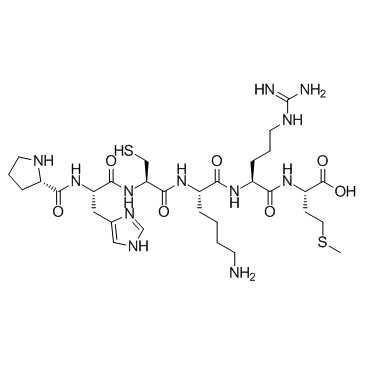
Antioxidant peptide A Chemische Struktur

Größe Preis Lagerbestand Menge
1mg
82,00 $
Auf Lager
5mg
248,00 $
Auf Lager
10mg
405,00 $
Auf Lager

Tel:(909) 407-4943 Email: sales@glpbio.com


Kundenbewertungen

Basiert auf Kundenrezensionen.

Sample solution is provided at 25 µL, 10mM.

Description of Antioxidant peptide A

Antioxidant peptide A is a short peptide, which contains alternative aromatic or sulfur-containing amino acid. The side chains of Antioxidant peptide A are believed to contribute to strong radical scavenging activities of peptides in the cancer cell.

The effects of 10-100 μM of Antioxidant peptide A (Pep-A) concentrations are studied on the superoxide dismutase (SOD) enzyme activity. The enzyme activity decreases by 0.5 and 0.7-folds at 10 and 50 µM Antioxidant peptide A concentrations, respectively, and increases by 1.79-folds at 100 µM Antioxidant peptide A treatment, indicating that this concentration can be ideal for the treatment on Y79 a, RB cells. Furthermore, the Antioxidant peptide A can be involved in decreasing the ROS by increasing the antioxidant enzyme activity. A similar increase in the antioxidative enzyme levels in the presence of Hoki skin antioxidative peptide in hepatocarcinoma cells is attributed to the peptide's role in maintaining the redox balance in the cellular environment. Cell viability analysis results show that the Antioxidant peptide A shows no toxicity to cancerous (Y79) cells and non-cancerous cells even after 48 h of treatment. The Y79 RB cell viability ranges between 115 and 157 % and 111-126 % after 24 and 48 h of exposures with Antioxidant peptide A, respectively. The cancer cell death from the treatment of 10-100 µM GNPs concentration is studied[1].

[1]. Kalmodia S, et al. Bio-conjugation of antioxidant peptide on surface-modified gold nanoparticles: a novel approach to enhance the radical scavenging property in cancer cell. Cancer Nanotechnol. 2016;7:1.

Protocol of Antioxidant peptide A

Kinase experiment:

Y79 cells are seeded at 2×10⁵ cells/well in 12-well plates with 1000 μL of culture media and incubated at 37°C overnight. The cells are then exposed to varying dosages of Antioxidant peptide A (Pep-A) and Pep-B (10, 50, and 100 μM) in fresh medium and then incubated for 6 h. At the end of the incubation, the cells are collected and washed with ice-cold PBS twice and lysed with cell lysis buffer [0.1 M Tris/HCl, pH 7.4 containing 0.5 % Triton X-100, 5 mM β-Mercaptoethanol, 0.1 mg/mL PMSF]. Cell lysate is centrifuged at 14000×g for 5 min at 4°C. The supernatant contains a combined SOD activity from cytosol and mitochondria. The SOD activity is measured using the superoxide dismutase (SOD) activity assay kit. In brief, the cell lysate, buffer, enzyme, and the WST reagent are diluted, and the solution is added as per the protocol and incubated at 37°C for 20 min and read at 450 nm on a microplate reader. SOD activity is then calculated as a percentage of the inhibition activity of xanthine oxidase[1].

Cell experiment:

Y79 retinoblastoma and MIOM1 cells are seeded at 5×10³ cells/well in 96-well plates and incubated at 37°C overnight. The cells are then treated with varying concentrations (10, 30, 60, and 100 µM) of Antioxidant peptide A (Pep-A) and Pep-B in a fresh medium and incubated for specific time periods (24 and 48 h). At the end of the incubation, 10 µL of MTT (5 mg/mL) is added to the cells with fresh medium (100 µL) and incubated at 37°C until formazan crystals are formed. The formazan crystals are dissolved in 100 µL of DMSO, and the reading is taken at 570 nm. Cell viability is calculated[1].

References:

[1]. Kalmodia S, et al. Bio-conjugation of antioxidant peptide on surface-modified gold nanoparticles: a novel approach to enhance the radical scavenging property in cancer cell. Cancer Nanotechnol. 2016;7:1.

Chemical Properties of Antioxidant peptide A

Cas No. SDF
Canonical SMILES Pro-His-Cys-Lys-Arg-Met
Formula C31H54N12O7S2 M.Wt 770.97
Löslichkeit Soluble in Water Storage Store at -20°C
General tips Please select the appropriate solvent to prepare the stock solution according to the solubility of the product in different solvents; once the solution is prepared, please store it in separate packages to avoid product failure caused by repeated freezing and thawing.Storage method and period of the stock solution: When stored at -80°C, please use it within 6 months; when stored at -20°C, please use it within 1 month.
To increase solubility, heat the tube to 37°C and then oscillate in an ultrasonic bath for some time.
Shipping Condition Evaluation sample solution: shipped with blue ice. All other sizes available: with RT, or with Blue Ice upon request.

Complete Stock Solution Preparation Table of Antioxidant peptide A

Prepare stock solution
1 mg 5 mg 10 mg
1 mM 1.2971 mL 6.4853 mL 12.9707 mL
5 mM 259.4 μL 1.2971 mL 2.5941 mL
10 mM 129.7 μL 648.5 μL 1.2971 mL
  • Molaritätsrechner

  • Verdünnung-Rechner

  • Molecular Weight Calculator

Gewicht
=
Konzentration
x
Inhalt
x
MW*


**Bei der Herstellung von Stammlösungen ist immer das chargenspezifische Molekulargewicht von

Berechnen

In vivo Formulation Calculator (Clear solution) of Antioxidant peptide A

Step 1: Enter information below (Recommended: An additional animal making an allowance for loss during the experiment)

mg/kg g μL

Step 2: Enter the in vivo formulation (This is only the calculator, not formulation. Please contact us first if there is no in vivo formulation at the solubility Section.)

% DMSO % % Tween 80 % ddH2O
%DMSO %

Calculation results:

Working concentration: mg/ml;

Method for preparing DMSO master liquid: mg drug pre-dissolved in μL DMSO ( Master liquid concentration mg/mL, Please contact us first if the concentration exceeds the DMSO solubility of the batch of drug. )

Method for preparing in vivo formulation: Take μL DMSO master liquid, next addμL PEG300, mix and clarify, next addμL Tween 80, mix and clarify, next add μL ddH2O, mix and clarify.

Method for preparing in vivo formulation: Take μL DMSO master liquid, next add μL Corn oil, mix and clarify.

Note: 1. Please make sure the liquid is clear before adding the next solvent.
2. Be sure to add the solvent(s) in order. You must ensure that the solution obtained, in the previous addition, is a clear solution before proceeding to add the next solvent. Physical methods such as vortex, ultrasound or hot water bath can be used to aid dissolving.
3. All of the above co-solvents are available for purchase on the GlpBio website.

Product Documents

Quality Control & SDS

View current batch:

Bewertungen

Review for Antioxidant peptide A

Average Rating: 5 ★★★★★ (Based on Reviews and 31 reference(s) in Google Scholar.)

5 Star
100%
4 Star
0%
3 Star
0%
2 Star
0%
1 Star
0%
Review for Antioxidant peptide A

GLPBIO products are for RESEARCH USE ONLY. Please make sure your review or question is research based.

Required fields are marked with *

You may receive emails regarding this submission. Any emails will include the ability to opt-out of future communications.