

Bisphenol A |
Katalog-Nr.GC39480
 One-Click Copy Product Info
|

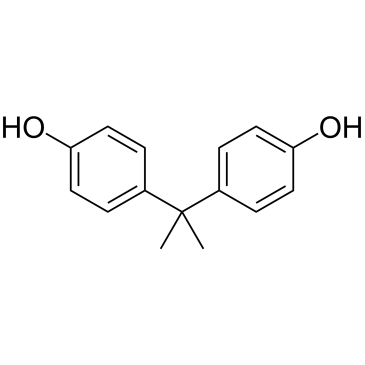
Bisphenol A ist eine phenolische, organische synthetische Verbindung, die in großem Umfang bei der Herstellung von Polycarbonat-Kunststoffen und Epoxidharzen verwendet wird.
Products are for research use only. Not for human use. We do not sell to patients.
Cas No.: 80-05-7
Sample solution is provided at 25 µL, 10mM.
Bisphenol A is a phenolic organic synthetic compound, which is used as a raw material for synthetic plastics (mainly certain polycarbonates and epoxy resins), and polysulfones [1]. Bisphenol A can be used in studies related to cancer, cardiovascular diseases, respiratory diseases, diabetes, kidney diseases, obesity, and reproductive disorders [2].
In vitro, Bisphenol A (0-400μM, 24 hours) inhibited the proliferation of human colon cancer cells HCT116 and induced their apoptosis through the mitochondrial and MAPK/AKT pathways [3]. Bisphenol A (0.5-12.5μM, 5 days) dose-dependently inhibited the formation of TRAP-positive multinucleated cells induced by RANKL in bone marrow-derived macrophages (BMM) [4].
In vivo, Bisphenol A (200mg/kg/d; SC; 4 weeks) significantly reduced the weights of the testes, epididymis, prostate and seminal vesicles in Wistar rats, as well as the daily sperm production in the testes [5]. Bisphenol A (100µg/kg; twice a day for 8 days; SC) inhibited the basal insulin secretion in mice, reduced food intake, body temperature and activity ability of mice, and upregulated the expression of IRS-1 protein under basal conditions in skeletal muscle [6].
References:
[1] Rubin BS. Bisphenol A: an endocrine disruptor with widespread exposure and multiple effects. J Steroid Biochem Mol Biol. 2011 Oct;127(1-2):27-34.
[2] Rochester J R. Bisphenol A and human health: a review of the literature[J]. Reproductive toxicology, 2013, 42: 132-155.
[3] Qu W, Zhao Z, Chen S, Zhang L, Wu D, Chen Z. Bisphenol A suppresses proliferation and induces apoptosis in colonic epithelial cells through mitochondrial and MAPK/AKT pathways. Life Sci. 2018 Sep 1;208:167-174.
[4] Hwang JK, Min KH, Choi KH, Hwang YC, Jeong IK, Ahn KJ, Chung HY, Chang JS. Bisphenol A reduces differentiation and stimulates apoptosis of osteoclasts and osteoblasts. Life Sci. 2013 Sep 17;93(9-11):367-72.
[5] Takahashi O, Oishi S. Testicular toxicity of dietarily or parenterally administered bisphenol A in rats and mice. Food Chem Toxicol. 2003 Jul;41(7):1035-44.
[6] Batista T M, Alonso-Magdalena P, Vieira E, et al. Short-term treatment with bisphenol-A leads to metabolic abnormalities in adult male mice[J]. PloS one, 2012, 7(3): e33814.
| Cell experiment [1]: | |
Cell lines | RAW 264.7 cells |
Preparation Method | Cell viability assay was carried out with the MTT assay. 3-(4,5-Dimethylthiazol-2-yl)-2,5-diphenyltetrazolium bromide reduction was also used to assess cell viability. Briefly, RAW 264.7 cells (1.0×10⁴ cells/wells) were seeded in a 96 well plate with α-MEM containing 10% FBS for 24h. Cells were added with various concentrations of Bisphenol A for 24h, washed with PBS three times and treated with medium containing 100μg/ml of MTT for 2h at 37 °C, washed with PBS, and then solubilized in DMSO. The resulting intracellular purple formazan was quantified with a spectrophotometer by measuring the absorbance at 570nm. |
Reaction Conditions | 0.5, 2.5 and 12.5μM; 24h |
Applications | Cell viability significantly reduced to 80% with 12.5μM of Bisphenol A, but a lower dosage of BPA did not decreased cell viability. |
| Animal experiment [2]: | |
Animal models | Swiss albino OF1 mice |
Preparation Method | Experiments were performed with 3 months old male Swiss albino OF1 mice that were individually maintained under standard housing conditions. BPA was dissolved in tocopherol-stripped corn oil and administered subcutaneously during 8 days twice a day (9:00a.m. and 2:00p.m.). Control mice were injected with 100µl of vehicle at the same time-points. The total daily dose used for Bisphenol A was 100µg/kg. To measure plasma metabolites blood samples were collected from the tail vein. Insulin was measured by enzyme-linked immunosorbent assay and NEFA was measured using a commercial kit. |
Dosage form | 100µg/kg; twice a day for 8 days; SC |
Applications | Bisphenol A inhibited the basal insulin secretion in mice, reduced their food intake, decreased their body temperature and impaired their activity. Moreover, it upregulated the expression of IRS-1 protein under basal conditions in skeletal muscle. |
References: | |
| Cas No. | 80-05-7 | SDF | |
| Canonical SMILES | CC(C1=CC=C(O)C=C1)(C2=CC=C(O)C=C2)C | ||
| Formula | C15H16O2 | M.Wt | 228.29 |
| Löslichkeit | DMSO: 100 mg/mL (438.04 mM); Water: < 0.1 mg/mL (insoluble) | Storage | Store at RT |
| General tips | Please select the appropriate solvent to prepare the stock solution according to the
solubility of the product in different solvents; once the solution is prepared, please store it in
separate packages to avoid product failure caused by repeated freezing and thawing.Storage method
and period of the stock solution: When stored at -80°C, please use it within 6 months; when stored
at -20°C, please use it within 1 month. To increase solubility, heat the tube to 37°C and then oscillate in an ultrasonic bath for some time. |
||
| Shipping Condition | Evaluation sample solution: shipped with blue ice. All other sizes available: with RT, or with Blue Ice upon request. | ||
| Prepare stock solution | |||

|
1 mg | 5 mg | 10 mg |
| 1 mM | 4.3804 mL | 21.902 mL | 43.8039 mL |
| 5 mM | 876.1 μL | 4.3804 mL | 8.7608 mL |
| 10 mM | 438 μL | 2.1902 mL | 4.3804 mL |
Step 1: Enter information below (Recommended: An additional animal making an allowance for loss during the experiment)
 g
μL
g
μL
Step 2: Enter the in vivo formulation (This is only the calculator, not formulation. Please contact us first if there is no in vivo formulation at the solubility Section.)
Calculation results:
Working concentration: mg/ml;
Method for preparing DMSO master liquid: mg drug pre-dissolved in μL DMSO ( Master liquid concentration mg/mL, Please contact us first if the concentration exceeds the DMSO solubility of the batch of drug. )
Method for preparing in vivo formulation: Take μL DMSO master liquid, next addμL PEG300, mix and clarify, next addμL Tween 80, mix and clarify, next add μL saline, mix and clarify.
Method for preparing in vivo formulation: Take μL DMSO master liquid, next add μL Corn oil, mix and clarify.
Note: 1. Please make sure the liquid is clear before adding the next solvent.
2. Be sure to add the solvent(s) in order. You must ensure that the solution obtained, in the previous addition, is a clear solution before proceeding to add the next solvent. Physical methods such as vortex, ultrasound or hot water bath can be used to aid dissolving.
3. All of the above co-solvents are available for purchase on the GlpBio website.
Quality Control & SDS
- View current batch:
- Purity: >99.50% Appearance: A solid
- COA (Certificate of Analysis)
- SDS (Safety Data Sheet)
- Datasheet
Average Rating: 5 (Based on Reviews and 39 reference(s) in Google Scholar.)