

Febuxostat (Synonyms: FBX, TEI 6720, TMX 67) |
Katalog-Nr.GC16319
 One-Click Copy Product Info
|

Febuxostat (TEI 6720) ist ein potenter, selektiver und kein Purin-Xanthinoxidase (XO)-Inhibitor mit einem Ki-Wert von 0,6 nM.
Products are for research use only. Not for human use. We do not sell to patients.
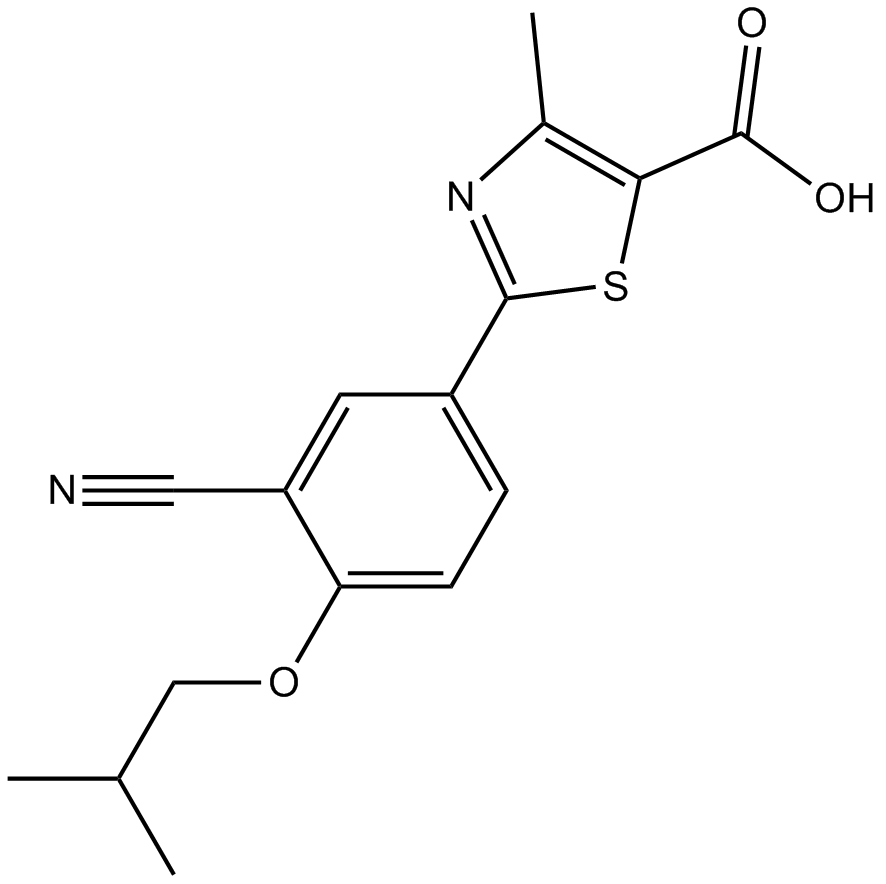
Cas No.: 144060-53-7
Sample solution is provided at 25 µL, 10mM.
_1-3.$$$39978408@51.jpg');)
_1-9.$$$38538795@65.jpg');)
_1-9.$$$39112701@51.jpg');)
_1-7.$$$37316672@70.jpg');)
_366-372.$$$36198801@70.jpg');)
.$$$38565142@65.jpg');)
_1867-1883.$$$33248023@67.jpg');)
_eads6055.$$$39977546@45.jpg');)
_eadm9805.$$$40080571@45.jpg');)
_eadj3020.$$$39666821@45.jpg');)
_1-20.$$$39757301@28.jpg');)
_1-24.$$$38898113@28.jpg');)
_273-287.$$$36806353@46.jpg');)
_1-16.$$$37156877@44.jpg');)
_1-19.$$$37460805@44.jpg');)
_1291-1307.$$$34518654@46.jpg');)
Febuxostat is a potent, selective, non-purine inhibitor of xanthine oxidase (XO) and xanthine dehydrogenase (XDH), with an inhibition constant (Ki) of 0.6nM against XO[1]. Febuxostat binds the molybdenum-pterin center of oxidized and reduced xanthine oxidoreductase (XOR), suppressing hypoxanthine-to-xanthine and xanthine-to-uric-acid conversion and reducing endothelial-bound XOR-derived reactive oxygen species (ROS)[1,4]. Febuxostat is used in research on purine and urate metabolism, macrophage inflammation, endothelial oxidative injury, atherosclerosis, and hyperuricemia-associated cardiorenal injury[1-7].
In vitro, Febuxostat (30μM; 10min pretreatment followed by 100ng/mL lipopolysaccharide for 20h) reduced monocyte chemoattractant protein-1 (MCP-1) production in phorbol 12-myristate 13-acetate-differentiated THP-1 macrophages, increased mitogen-activated protein kinase phosphatase-1 (MKP-1) activity, and reduced c-Jun N-terminal kinase (JNK) phosphorylation[2]. Febuxostat (200μM; 30min pretreatment followed by 2.5μM nigericin or 0.25mg/mL monosodium urate crystals for 2h) reduced interleukin-1β (IL-1β) secretion and cell death in murine bone-marrow-derived macrophages and preserved intracellular adenosine triphosphate (ATP) and mitochondrial membrane potential[5]. Febuxostat (5μM and 10μM; 6h) reduced oxidized low-density lipoprotein-induced mitochondrial ROS production, cellular injury, and monocyte attachment in human aortic valve endothelial cells[6].
In vivo, Febuxostat (2.5mg/kg/day; oral intake in drinking water once daily for 12 weeks) reduced aortic plaque area and arterial ROS, decreased aortic MCP-1 expression, and improved endothelial-dependent relaxation in apolipoprotein E-deficient (ApoE-/-) mice fed a high-cholesterol diet[3]. Febuxostat (approximately 3mg/kg/day; oral intake in drinking water once daily for 8 weeks) reduced serum uric acid and proteinuria, attenuated glomerular, tubulointerstitial, and renal arteriolar injury, and reduced cardiac hypertrophy and fibrosis in hyperuricemic 5/6-nephrectomized Sprague-Dawley rats[7].
References:[1] Takano Y, Hase-Aoki K, Horiuchi H, Zhao L, Kasahara Y, Kondo S, et al. Selectivity of febuxostat, a novel non-purine inhibitor of xanthine oxidase/xanthine dehydrogenase. Life Sci. 2005;76(16):1835-1847. doi:10.1016/j.lfs.2004.10.031.
[2] Nomura J, Busso N, Ives A, Tsujimoto S, Tamura M, So A, et al. Febuxostat, an inhibitor of xanthine oxidase, suppresses lipopolysaccharide-induced MCP-1 production via MAPK phosphatase-1-mediated inactivation of JNK. PLoS One. 2013;8(9):e75527. doi:10.1371/journal.pone.0075527.
[3] Nomura J, Busso N, Ives A, Matsui C, Tsujimoto S, Shirakura T, et al. Xanthine oxidase inhibition by febuxostat attenuates experimental atherosclerosis in mice. Sci Rep. 2014;4:4554. doi:10.1038/srep04554.
[4] Malik UZ, Hundley NJ, Romero G, Radi R, Freeman BA, Tarpey MM, et al. Febuxostat inhibition of endothelial-bound XO: implications for targeting vascular ROS production. Free Radic Biol Med. 2011;51(1):179-184. doi:10.1016/j.freeradbiomed.2011.04.004.
[5] Nomura J, Kobayashi T, So A, Busso N. Febuxostat, a xanthine oxidoreductase inhibitor, decreases NLRP3-dependent inflammation in macrophages by activating the purine salvage pathway and restoring cellular bioenergetics. Sci Rep. 2019;9:17314. doi:10.1038/s41598-019-53965-x.
[6] Liang X, Li P, Xie W, Lin Z, Wang Z, Zeng S, et al. Febuxostat protects human aortic valve endothelial cells from oxidized low-density lipoprotein-induced injury and monocyte attachment. J Cardiovasc Pharmacol. 2022;80(6):861-868. doi:10.1097/FJC.0000000000001326.
[7] Omizo H, Tamura Y, Morimoto C, Ueno M, Hayama Y, Kuribayashi-Okuma E, et al. Cardio-renal protective effect of the xanthine oxidase inhibitor febuxostat in the 5/6 nephrectomy model with hyperuricemia. Sci Rep. 2020;10:9326. doi:10.1038/s41598-020-65706-6.
| Cell experiment [1]: | |
|
Cell lines |
Murine bone-marrow-derived macrophages (BMDMs) |
|
Preparation Method |
Murine bone-marrow-derived macrophages were primed overnight with Pam3CSK4, exposed to Febuxostat, and stimulated with nigericin or monosodium urate crystals; interleukin-1β, cell viability, intracellular adenosine triphosphate, and mitochondrial membrane potential were measured. |
|
Reaction Conditions |
200μM;30min |
|
Applications |
Febuxostat reduced interleukin-1β secretion and cell death, preserved intracellular adenosine triphosphate and mitochondrial membrane potential, and improved mitochondrial bioenergetics in macrophages. |
| Animal experiment [2]: | |
|
Animal models |
Hyperuricemic 5/6-nephrectomized Sprague-Dawley rat model of cardiorenal injury |
|
Preparation Method |
Male Sprague-Dawley rats underwent 5/6 nephrectomy and received oxonic acid to establish hyperuricemic chronic kidney injury. Febuxostat was delivered in drinking water; serum uric acid, urinary protein, and cardiorenal tissue injury were assessed at the endpoint. |
|
Dosage form |
3mg/kg/day; oral intake in drinking water;8 weeks |
|
Applications |
Febuxostat reduced serum uric acid and proteinuria, attenuated glomerular, tubulointerstitial, and renal arteriolar injury, and reduced cardiac hypertrophy, cardiac fibrosis, and oxidative stress in renal and cardiac tissues. |
| References: [1] Nomura J, Kobayashi T, So A, Busso N. Febuxostat, a xanthine oxidoreductase inhibitor, decreases NLRP3-dependent inflammation in macrophages by activating the purine salvage pathway and restoring cellular bioenergetics. Sci Rep. 2019;9:17314. doi:10.1038/s41598-019-53965-x. [2] Omizo H, Tamura Y, Morimoto C, Ueno M, Hayama Y, Kuribayashi-Okuma E, et al. Cardio-renal protective effect of the xanthine oxidase inhibitor febuxostat in the 5/6 nephrectomy model with hyperuricemia. Sci Rep. 2020;10:9326. doi:10.1038/s41598-020-65706-6. | |
| Cas No. | 144060-53-7 | SDF | |
| Überlieferungen | FBX, TEI 6720, TMX 67 | ||
| Chemical Name | 2-[3-cyano-4-(2-methylpropoxy)phenyl]-4-methyl-1,3-thiazole-5-carboxylic acid | ||
| Canonical SMILES | CC1=C(SC(=N1)C2=CC(=C(C=C2)OCC(C)C)C#N)C(=O)O | ||
| Formula | C16H16N2O3S | M.Wt | 316.37 |
| Löslichkeit | ≥ 15.55mg/mL in DMSO, ≥ 15.95 mg/mL in EtOH with ultrasonic | Storage | Store at -20°C |
| General tips | Please select the appropriate solvent to prepare the stock solution according to the
solubility of the product in different solvents; once the solution is prepared, please store it in
separate packages to avoid product failure caused by repeated freezing and thawing.Storage method
and period of the stock solution: When stored at -80°C, please use it within 6 months; when stored
at -20°C, please use it within 1 month. To increase solubility, heat the tube to 37°C and then oscillate in an ultrasonic bath for some time. |
||
| Shipping Condition | Evaluation sample solution: shipped with blue ice. All other sizes available: with RT, or with Blue Ice upon request. | ||
| Prepare stock solution | |||

|
1 mg | 5 mg | 10 mg |
| 1 mM | 3.1609 mL | 15.8043 mL | 31.6086 mL |
| 5 mM | 632.2 μL | 3.1609 mL | 6.3217 mL |
| 10 mM | 316.1 μL | 1.5804 mL | 3.1609 mL |
Step 1: Enter information below (Recommended: An additional animal making an allowance for loss during the experiment)
 g
μL
g
μL
Step 2: Enter the in vivo formulation (This is only the calculator, not formulation. Please contact us first if there is no in vivo formulation at the solubility Section.)
Calculation results:
Working concentration: mg/ml;
Method for preparing DMSO master liquid: mg drug pre-dissolved in μL DMSO ( Master liquid concentration mg/mL, Please contact us first if the concentration exceeds the DMSO solubility of the batch of drug. )
Method for preparing in vivo formulation: Take μL DMSO master liquid, next addμL PEG300, mix and clarify, next addμL Tween 80, mix and clarify, next add μL saline, mix and clarify.
Method for preparing in vivo formulation: Take μL DMSO master liquid, next add μL Corn oil, mix and clarify.
Note: 1. Please make sure the liquid is clear before adding the next solvent.
2. Be sure to add the solvent(s) in order. You must ensure that the solution obtained, in the previous addition, is a clear solution before proceeding to add the next solvent. Physical methods such as vortex, ultrasound or hot water bath can be used to aid dissolving.
3. All of the above co-solvents are available for purchase on the GlpBio website.
Quality Control & SDS
- View current batch:
- Purity: >99.50% Appearance: A solid
- COA (Certificate of Analysis)
- SDS (Safety Data Sheet)
- Datasheet
Average Rating: 5 (Based on Reviews and 2 reference(s) in Google Scholar.)