

GRGDSPK (EMD 56574) (Synonyms: EMD 56574) |
Katalog-Nr.GC30585
 One-Click Copy Product Info
|

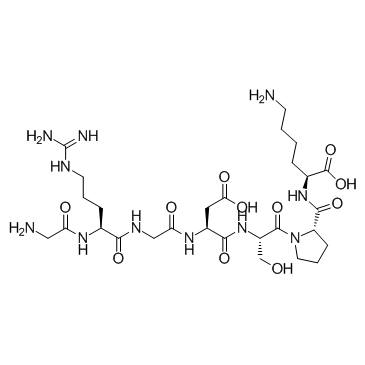
GRGDSPK (EMD 56574) (EMD 56574) ist ein Peptid, das Arg-Gly-Asp (RGD) enthÄlt.
Products are for research use only. Not for human use. We do not sell to patients.
Cas No.: 111119-28-9
Sample solution is provided at 25 µL, 10mM.
_1-3.$$$39978408@51.jpg');)
_1-9.$$$38538795@65.jpg');)
_1-9.$$$39112701@51.jpg');)
_1-7.$$$37316672@70.jpg');)
_366-372.$$$36198801@70.jpg');)
.$$$38565142@65.jpg');)
_1867-1883.$$$33248023@67.jpg');)
_eads6055.$$$39977546@45.jpg');)
_eadm9805.$$$40080571@45.jpg');)
_eadj3020.$$$39666821@45.jpg');)
_1-20.$$$39757301@28.jpg');)
_1-24.$$$38898113@28.jpg');)
_273-287.$$$36806353@46.jpg');)
_1-16.$$$37156877@44.jpg');)
_1-19.$$$37460805@44.jpg');)
_1291-1307.$$$34518654@46.jpg');)
GRGDSPK is an inhibitory peptide for RGD-mediated adhesion between integrin and extracellular matrix molecules.
GRGDSPK inhibits the adhesion of Rat PDL cells[1]. RGD-containing (GRGDSPK, 1.5 mM, 1.0 mM, and 0.5 mM) and RGD-mod-ified peptides impair the ability of sperm to fertilizebovine oocytes, illustrated by a reduction in cleavage in a dose-dependent manner[2].
[1]. Hatakeyama J, et al. Proliferation and adhesion of periodontal ligament cells on synthetic biominerals. Oral Dis. 2007 Sep;13(5):500-6. [2]. Sessions BR, et al. Effects of amino acid substitutions in and around the arginine-glycine-aspartic acid (RGD) sequence on fertilization and parthenogenetic development in mature bovine oocytes. Mol Reprod Dev. 2006 May;73(5):651-7.
Cell experiment: | Proliferation assays are carried out in 48-well cell culture dishes coated with OCP or HL. In proliferation assays, 7.25×10³ cells in 0.5 mL of culture medium are seeded in a 48-well dish. Culture medium is changed every 3 days. After 1, 6, 12, and 18 days of culture, plates are washed thrice with PBS to remove unattached cells, and attached cells are collected by trypsinization. The number of cells is counted using a hemocytometer. |
References: [1]. Hatakeyama J, et al. Proliferation and adhesion of periodontal ligament cells on synthetic biominerals. Oral Dis. 2007 Sep;13(5):500-6. | |
| Cas No. | 111119-28-9 | SDF | |
| Überlieferungen | EMD 56574 | ||
| Canonical SMILES | Gly-Arg-Gly-Asp-Ser-Pro-Lys | ||
| Formula | C28H49N11O11 | M.Wt | 715.76 |
| Löslichkeit | Soluble in Water | Storage | Store at -20°C |
| General tips | Please select the appropriate solvent to prepare the stock solution according to the
solubility of the product in different solvents; once the solution is prepared, please store it in
separate packages to avoid product failure caused by repeated freezing and thawing.Storage method
and period of the stock solution: When stored at -80°C, please use it within 6 months; when stored
at -20°C, please use it within 1 month. To increase solubility, heat the tube to 37°C and then oscillate in an ultrasonic bath for some time. |
||
| Shipping Condition | Evaluation sample solution: shipped with blue ice. All other sizes available: with RT, or with Blue Ice upon request. | ||
| Prepare stock solution | |||

|
1 mg | 5 mg | 10 mg |
| 1 mM | 1.3971 mL | 6.9856 mL | 13.9712 mL |
| 5 mM | 279.4 μL | 1.3971 mL | 2.7942 mL |
| 10 mM | 139.7 μL | 698.6 μL | 1.3971 mL |
Step 1: Enter information below (Recommended: An additional animal making an allowance for loss during the experiment)
 g
μL
g
μL
Step 2: Enter the in vivo formulation (This is only the calculator, not formulation. Please contact us first if there is no in vivo formulation at the solubility Section.)
Calculation results:
Working concentration: mg/ml;
Method for preparing DMSO master liquid: mg drug pre-dissolved in μL DMSO ( Master liquid concentration mg/mL, Please contact us first if the concentration exceeds the DMSO solubility of the batch of drug. )
Method for preparing in vivo formulation: Take μL DMSO master liquid, next addμL PEG300, mix and clarify, next addμL Tween 80, mix and clarify, next add μL saline, mix and clarify.
Method for preparing in vivo formulation: Take μL DMSO master liquid, next add μL Corn oil, mix and clarify.
Note: 1. Please make sure the liquid is clear before adding the next solvent.
2. Be sure to add the solvent(s) in order. You must ensure that the solution obtained, in the previous addition, is a clear solution before proceeding to add the next solvent. Physical methods such as vortex, ultrasound or hot water bath can be used to aid dissolving.
3. All of the above co-solvents are available for purchase on the GlpBio website.
Quality Control & SDS
- View current batch:
- Purity: >98.00% Appearance: A solid
- COA (Certificate of Analysis)
- SDS (Safety Data Sheet)
- Datasheet
Average Rating: 5 (Based on Reviews and 5 reference(s) in Google Scholar.)