

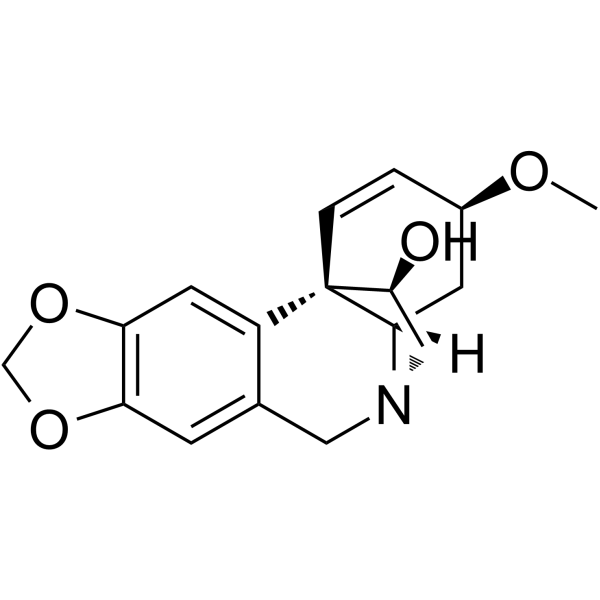
Haemanthamine |
Katalog-Nr.GC65043
 One-Click Copy Product Info
|

HÄmanthamin ist ein Alkaloid vom Crinin-Typ, das aus Amaryllidaceae-Pflanzen mit starker AntikrebsaktivitÄt isoliert wird.
Products are for research use only. Not for human use. We do not sell to patients.
Cas No.: 466-75-1
Sample solution is provided at 25 µL, 10mM.
_1-3.$$$39978408@51.jpg');)
_1-9.$$$38538795@65.jpg');)
_1-9.$$$39112701@51.jpg');)
_1-7.$$$37316672@70.jpg');)
_366-372.$$$36198801@70.jpg');)
.$$$38565142@65.jpg');)
_1867-1883.$$$33248023@67.jpg');)
_eads6055.$$$39977546@45.jpg');)
_eadm9805.$$$40080571@45.jpg');)
_eadj3020.$$$39666821@45.jpg');)
_1-20.$$$39757301@28.jpg');)
_1-24.$$$38898113@28.jpg');)
_273-287.$$$36806353@46.jpg');)
_1-16.$$$37156877@44.jpg');)
_1-19.$$$37460805@44.jpg');)
_1291-1307.$$$34518654@46.jpg');)
Haemanthamine is a crinine-type alkaloid isolated from the Amaryllidaceae plants with potent anticancer activity. Haemanthamine targets ribosomal that inhibits protein biosynthesis during the elongation stage of translation. Haemanthamine has pro-apoptotic, antioxidant, antiviral, antimalarial and anticonvulsant activities[1][2].
Haemanthamine (1-100 µM; 24-48 hours; A2780 cells) treatment shows a time- and dose-dependent decrease in cell viability[2].Haemanthamine (10 µM; 24-72 hours; A2780 cells) treatment leads to a significant inhibition of A2780 cell proliferation[2].Haemanthamine binds at the A-site cleft of the peptidyl transferase center on the large ribosomal subunit, creating unique molecular interactions with the 25S rRNA. Haemanthamine has a highly specific inhibitory effect on pre-rRNA processing, leading to the activation of a p53-dependent antitumoral surveillance pathway known as nucleolar stress[1].
A pharmacokinetic study of Haemanthamine in rats shows a rapid distribution phase of 30 min, a half-life of 70.4 min, and a major clearance through renal elimination. The high distribution volume of 13.7 L/kg suggests a high intracellular penetration, and its plasmatic concentration remains higher than 1 μM for at least 1 hr after a single 10-mg/kg administration[1].
[1]. Pellegrino S, et al. The Amaryllidaceae Alkaloid Haemanthamine Binds the Eukaryotic Ribosome to Repress Cancer Cell Growth. Structure. 2018 Mar 6;26(3):416-425.e4.
[2]. SeifrtovÁ M, et al. Haemanthamine alters sodium butyrate-induced histone acetylation, p21WAF1/Cip1 expression, Chk1 and Chk2 activation and leads to increased growth inhibition and death in A2780 ovarian cancer cells. Phytomedicine. 2017 Nov 15;35:1-10.
| Cas No. | 466-75-1 | SDF | |
| Formula | C17H19NO4 | M.Wt | 301.34 |
| Löslichkeit | DMSO : 100 mg/mL (331.85 mM; Need ultrasonic) | Storage | Store at -20°C |
| General tips | Please select the appropriate solvent to prepare the stock solution according to the
solubility of the product in different solvents; once the solution is prepared, please store it in
separate packages to avoid product failure caused by repeated freezing and thawing.Storage method
and period of the stock solution: When stored at -80°C, please use it within 6 months; when stored
at -20°C, please use it within 1 month. To increase solubility, heat the tube to 37°C and then oscillate in an ultrasonic bath for some time. |
||
| Shipping Condition | Evaluation sample solution: shipped with blue ice. All other sizes available: with RT, or with Blue Ice upon request. | ||
| Prepare stock solution | |||

|
1 mg | 5 mg | 10 mg |
| 1 mM | 3.3185 mL | 16.5926 mL | 33.1851 mL |
| 5 mM | 663.7 μL | 3.3185 mL | 6.637 mL |
| 10 mM | 331.9 μL | 1.6593 mL | 3.3185 mL |
Step 1: Enter information below (Recommended: An additional animal making an allowance for loss during the experiment)
 g
μL
g
μL
Step 2: Enter the in vivo formulation (This is only the calculator, not formulation. Please contact us first if there is no in vivo formulation at the solubility Section.)
Calculation results:
Working concentration: mg/ml;
Method for preparing DMSO master liquid: mg drug pre-dissolved in μL DMSO ( Master liquid concentration mg/mL, Please contact us first if the concentration exceeds the DMSO solubility of the batch of drug. )
Method for preparing in vivo formulation: Take μL DMSO master liquid, next addμL PEG300, mix and clarify, next addμL Tween 80, mix and clarify, next add μL saline, mix and clarify.
Method for preparing in vivo formulation: Take μL DMSO master liquid, next add μL Corn oil, mix and clarify.
Note: 1. Please make sure the liquid is clear before adding the next solvent.
2. Be sure to add the solvent(s) in order. You must ensure that the solution obtained, in the previous addition, is a clear solution before proceeding to add the next solvent. Physical methods such as vortex, ultrasound or hot water bath can be used to aid dissolving.
3. All of the above co-solvents are available for purchase on the GlpBio website.
Quality Control & SDS
- View current batch:
- Purity: >96.00% Appearance: A solid
- COA (Certificate of Analysis)
- SDS (Safety Data Sheet)
- Datasheet
Average Rating: 5 (Based on Reviews and 30 reference(s) in Google Scholar.)