

Ketoconazole (Synonyms: R 41400) |
Katalog-Nr.GC17337
 One-Click Copy Product Info
|

Ketoconazole is an orally active imidazole antifungal agent that inhibits the activities of CYP3A4 and CYP24A1.
Products are for research use only. Not for human use. We do not sell to patients.
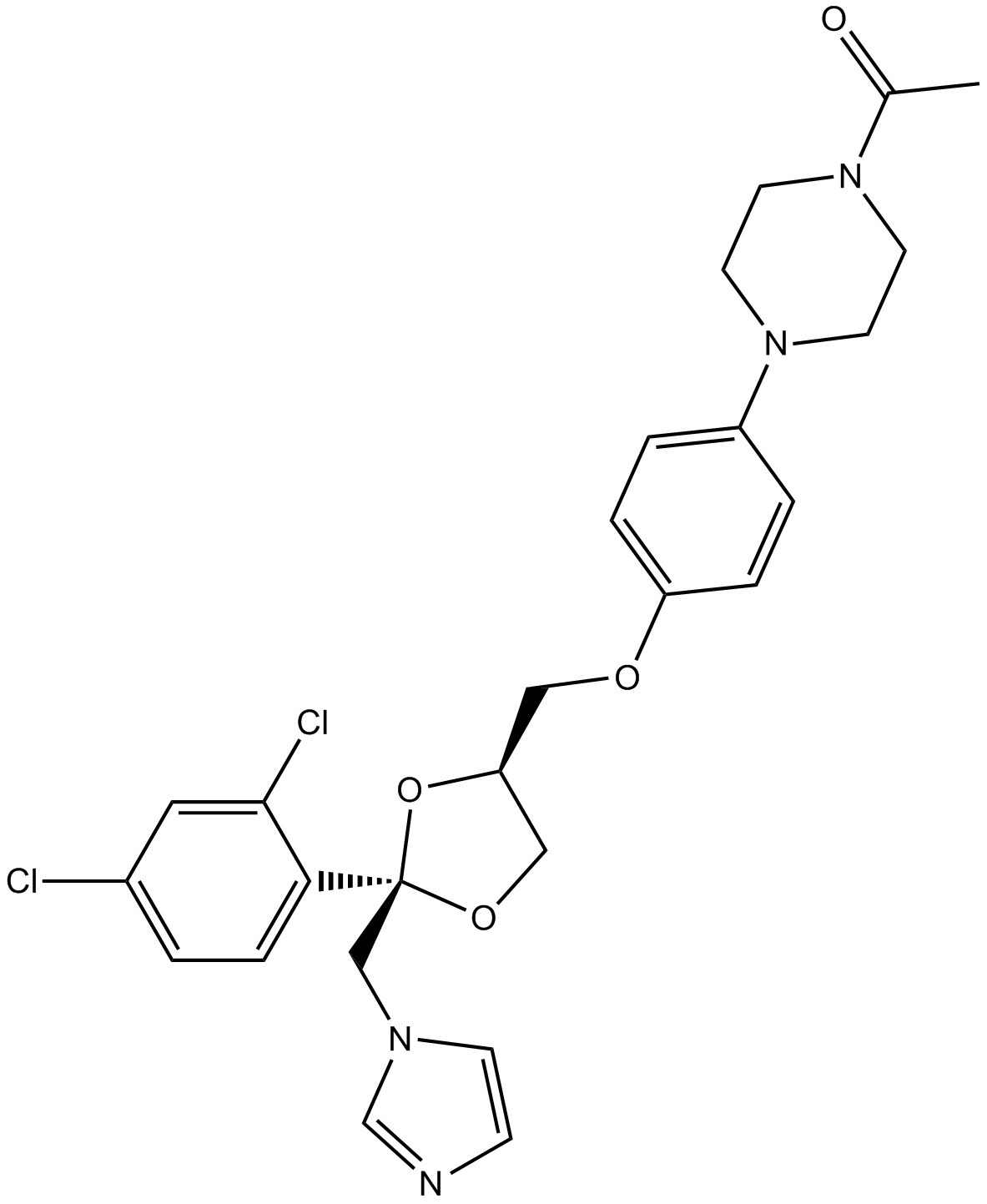
Cas No.: 65277-42-1
Sample solution is provided at 25 µL, 10mM.
_1-3.$$$39978408@51.jpg');)
_1-9.$$$38538795@65.jpg');)
_1-9.$$$39112701@51.jpg');)
_1-7.$$$37316672@70.jpg');)
_366-372.$$$36198801@70.jpg');)
.$$$38565142@65.jpg');)
_1867-1883.$$$33248023@67.jpg');)
_eads6055.$$$39977546@45.jpg');)
_eadm9805.$$$40080571@45.jpg');)
_eadj3020.$$$39666821@45.jpg');)
_1-20.$$$39757301@28.jpg');)
_1-24.$$$38898113@28.jpg');)
_273-287.$$$36806353@46.jpg');)
_1-16.$$$37156877@44.jpg');)
_1-19.$$$37460805@44.jpg');)
_1291-1307.$$$34518654@46.jpg');)
Ketoconazole is an orally active imidazole antifungal agent that inhibits the activities of CYP3A4 and CYP24A1. Ketoconazole disrupts fungal cell membrane integrity by inhibiting cytochrome P450 14α-demethylase and blocking ergosterol synthesis. Ketoconazole reduces androgen synthesis by inhibiting 17α-hydroxylase and 17,20-lyase. Ketoconazole can be used in research related to fungal infections, prostate cancer, and Cushing syndrome[1-4].
In vitro, treatment of human osteosarcoma MG63 cells with 20-200μM Ketoconazole for 24 hours reduced cell viability and induced apoptosis, elevated intracellular Ca2+ concentration, and induced ERK and JNK phosphorylation[5]. Pretreatment of J774 cells with 10μg/mL Ketoconazole for 30 minutes followed by treatment with 10μg/mL lipopolysaccharide for 24 hours decreased nitrite levels in culture supernatants and reduced i-NOS mRNA expression in cells[6]. Treatment of CEM-C7 cells with 18.8-90μM Ketoconazole for 90 hours inhibited cell growth[7].
In vivo, a single oral administration of 300mg/kg Ketoconazole to male rats decreased serum testosterone and corticosterone levels and reduced epididymal sperm motility[8]. Daily topical application of 2% Ketoconazole solution (0.1mL per application, 5 days per week) to the dorsal skin of depilated C3H/HeN mice for 3 weeks promoted hair regrowth and stimulated telogen-to-anagen transition[9]. Oral administration of 10mg/kg Ketoconazole to Schistosoma mansoni-infected CD1 Swiss albino mice on days 47, 48, and 49 post-infection, followed by a single oral dose of 400mg/kg quinine 2 hours after the last Ketoconazole dose, inhibited hepatic CYP450 and CYT b5 activities, reduced female worms, total worms, hepatic egg burden, and intestinal egg burden, shrank liver granuloma diameter, and increased the percentage of dead eggs[10].
References:
[1] Hume AL, Kerkering TM. Ketoconazole. Drug Intell Clin Pharm. 1983 Mar;17(3):169-74.
[2] Galgiani JN. Ketoconazole in the treatment of coccidioidomycosis. Drugs. 1983 Oct;26(4):355-63.
[3] Scheinfeld N. Ketoconazole: a review of a workhorse antifungal molecule with a focus on new foam and gel formulations. Drugs Today (Barc). 2008 May;44(5):369-80.
[4] Ji Y, Wang Y, Liu Y, et al. The Effect of Ketoconazole and Quinestrol Combination on Reproductive Physiology in Male Mice. Animals. 2024 Nov;14(22):3240.
[5] Lin KL, Huang CC, Cheng JS, et al. Ketoconazole-induced JNK phosphorylation and subsequent cell death via apoptosis in human osteosarcoma cells. Toxicol In Vitro. 2009 Dec;23(8):1268-1276.
[6] Baroni A, Ruocco V, De Paolis P, et al. Ketoconazole inhibits lipopolysaccharide-induced activation of the nitric oxide synthase gene in the murine macrophage cell line J774. Arch Dermatol Res. 1999;291(1):54-58.
[7] Hackney JF, Schwartz DA, et al. Ketoconazole inhibition and glucocorticoid action in the human lymphoblastic leukemia cell line CEM-C7. J Steroid Biochem. 1988;29(1):15-19.
[8] Heckman WR, Kane BR, Pakyz RE, et al. The effect of ketoconazole on endocrine and reproductive parameters in male mice and rats. J Androl. 1992 May/Jun;13(3):191-198.
[9] Jiang J, Tsuboi R, Kojima Y, et al. Topical application of ketoconazole stimulates hair growth in C3H/HeN mice. J Dermatol. 2005;32(4):243-247.
[10] Seif el-Din SH, Sabra AN, Hammam OA, et al. Effect of Ketoconazole, a Cytochrome P450 Inhibitor, on the Efficacy of Quinine and Halofantrine against Schistosoma mansoni in Mice. Korean J Parasitol. 2013 Apr;51(2):165-175.
| Cell experiment [1]: | |
|
Cell lines |
CEM-C7 cells (human lymphoblastic leukemia cell line) and a glucocorticoid-receptor-negative subline of CEM-C7 cells |
|
Preparation Method |
CEM-C7 cells were maintained in RPMI 1640 medium supplemented with 10% defined supplemented bovine calf serum at 37°C, 5% CO2. CEM-C7 cells and receptor-negative CEM-C7 cells were treated with Ketoconazole at 18.8μM for 90 hours, or with 45μM and 90μM Ketoconazole combined with triamcinolone acetonide for 90 hours; cell growth was counted and glutamine synthetase activity was assayed. |
|
Reaction Conditions |
18.8μM, 45μM, 90μM; 90h |
|
Applications |
Ketoconazole inhibited CEM-C7 cell growth and inhibited growth of glucocorticoid-receptor-negative CEM-C7 cells. Ketoconazole at 45μM and 90μM reduced triamcinolone acetonide induction of glutamine synthetase activity. |
| Animal experiment [2]: | |
|
Animal models |
CD1 Swiss albino mice infected with of Schistosoma mansoni (Egyptian strain) |
|
Preparation Method |
Mice were orally administered Ketoconazole at 10mg/kg in ultrapure water containing 0.01M hydrochloric acid on 3 days (post-infection day 47, 48, 49), 2 hours before a single oral dose of 400mg/kg quinine or 400mg/kg halofantrine. Mice were killed at day 63 post-infection (day 14 after treatment) for parasitological, histopathological and biochemical assessments. |
|
Dosage form |
10mg/kg; p.o.; 3 days |
|
Applications |
Ketoconazole plus quinine or halofantrine further inhibited hepatic CYP450 and CYT b5 activities, reduced female worms, total worms, hepatic egg burden and intestinal egg burden, shrank liver granuloma diameter, increased dead egg percentage. |
References: [1] Hackney JF, Schwartz DA. Ketoconazole inhibition and glucocorticoid action in the human lymphoblastic leukemia cell line CEM-C7. J Steroid Biochem. 1988;29(1):15-19. [2] Seif el-Din SH, Sabra AA, Hammam OA, et al. Effect of Ketoconazole, a Cytochrome P450 Inhibitor, on the Efficacy of Quinine and Halofantrine against Schistosoma mansoni in Mice. Korean J Parasitol. 2013 Apr;51(2):165-175. | |
| Cas No. | 65277-42-1 | SDF | |
| Überlieferungen | R 41400 | ||
| Chemical Name | 1-[4-[4-[[(2R,4S)-2-(2,4-dichlorophenyl)-2-(imidazol-1-ylmethyl)-1,3-dioxolan-4-yl]methoxy]phenyl]piperazin-1-yl]ethanone | ||
| Canonical SMILES | CC(=O)N1CCN(CC1)C2=CC=C(C=C2)OCC3COC(O3)(CN4C=CN=C4)C5=C(C=C(C=C5)Cl)Cl | ||
| Formula | C26H28Cl2N4O4 | M.Wt | 531.43 |
| Löslichkeit | ≥ 23.4 mg/mL in DMSO, ≥ 10 mg/mL in EtOH with ultrasonic | Storage | Store at 2-8°C |
| General tips | Please select the appropriate solvent to prepare the stock solution according to the
solubility of the product in different solvents; once the solution is prepared, please store it in
separate packages to avoid product failure caused by repeated freezing and thawing.Storage method
and period of the stock solution: When stored at -80°C, please use it within 6 months; when stored
at -20°C, please use it within 1 month. To increase solubility, heat the tube to 37°C and then oscillate in an ultrasonic bath for some time. |
||
| Shipping Condition | Evaluation sample solution: shipped with blue ice. All other sizes available: with RT, or with Blue Ice upon request. | ||
| Prepare stock solution | |||

|
1 mg | 5 mg | 10 mg |
| 1 mM | 1.8817 mL | 9.4086 mL | 18.8172 mL |
| 5 mM | 376.3 μL | 1.8817 mL | 3.7634 mL |
| 10 mM | 188.2 μL | 940.9 μL | 1.8817 mL |
Step 1: Enter information below (Recommended: An additional animal making an allowance for loss during the experiment)
 g
μL
g
μL
Step 2: Enter the in vivo formulation (This is only the calculator, not formulation. Please contact us first if there is no in vivo formulation at the solubility Section.)
Calculation results:
Working concentration: mg/ml;
Method for preparing DMSO master liquid: mg drug pre-dissolved in μL DMSO ( Master liquid concentration mg/mL, Please contact us first if the concentration exceeds the DMSO solubility of the batch of drug. )
Method for preparing in vivo formulation: Take μL DMSO master liquid, next addμL PEG300, mix and clarify, next addμL Tween 80, mix and clarify, next add μL saline, mix and clarify.
Method for preparing in vivo formulation: Take μL DMSO master liquid, next add μL Corn oil, mix and clarify.
Note: 1. Please make sure the liquid is clear before adding the next solvent.
2. Be sure to add the solvent(s) in order. You must ensure that the solution obtained, in the previous addition, is a clear solution before proceeding to add the next solvent. Physical methods such as vortex, ultrasound or hot water bath can be used to aid dissolving.
3. All of the above co-solvents are available for purchase on the GlpBio website.
Quality Control & SDS
- View current batch:
- Purity: >99.50% Appearance: A solid
- COA (Certificate of Analysis)
- SDS (Safety Data Sheet)
- Datasheet
Average Rating: 5 (Based on Reviews and 30 reference(s) in Google Scholar.)