

Luteolinidin chloride |
Katalog-Nr.GC39613
 One-Click Copy Product Info
|

Luteolinidin ist ein natÜrliches Desoxyanthocyanidin, isoliert aus Moosen und Farnen.
Products are for research use only. Not for human use. We do not sell to patients.
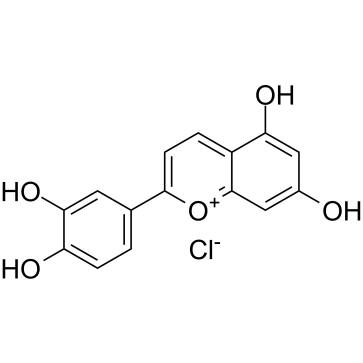
Cas No.: 1154-78-5
Sample solution is provided at 25 µL, 10mM.
_1-3.$$$39978408@51.jpg');)
_1-9.$$$38538795@65.jpg');)
_1-9.$$$39112701@51.jpg');)
_1-7.$$$37316672@70.jpg');)
_366-372.$$$36198801@70.jpg');)
.$$$38565142@65.jpg');)
_1867-1883.$$$33248023@67.jpg');)
_eads6055.$$$39977546@45.jpg');)
_eadm9805.$$$40080571@45.jpg');)
_eadj3020.$$$39666821@45.jpg');)
_1-20.$$$39757301@28.jpg');)
_1-24.$$$38898113@28.jpg');)
_273-287.$$$36806353@46.jpg');)
_1-16.$$$37156877@44.jpg');)
_1-19.$$$37460805@44.jpg');)
_1291-1307.$$$34518654@46.jpg');)
Luteolinidin chloride is an antioxidative deoxyanthocyanidin that can be isolated from the plant Sorghum bicolor[1-2]. Luteolinidin chloride is an effective CD38 inhibitor (Ki=11.4µM) and protects the heart from ischemia/reperfusion injury by preserving endothelial nitric oxide synthase function and preventing endothelial dysfunction [3-4].
In vitro, MC-65 neuronal cells were treated with Luteolinidin chloride (10–20µM) for 72 hours, followed by the induction of Aβ42 expression under tetracycline-free conditions to generate toxicity. Luteolinidin chloride protected MC-65 cells from Aβ42-induced damage, significantly increased cell survival rates, and enhanced mitochondrial function[5]. Isolated perfused rat hearts were pretreated with Luteolinidin chloride (5–50µM) for 20 minutes, followed by 30 minutes of global ischemia and 30-120 minutes of reperfusion. Luteolinidin chloride significantly improved left ventricular systolic function and coronary flow, while reducing myocardial infarction area[6].
References:
[1] Boslett J J. CD38 in the Heart: Effects of CD38 Activation on Post-Ischemic Injury[D]. The Ohio State University, 2017.
[2] Webb MR, Min K, Ebeler SE. Anthocyanin Interactions with DNA: Intercalation, Topoisomerase I Inhibition and Oxidative Reactions. J Food Biochem. 2008 Sep 23;32(5):576-596.
[3] Bianco-Gomes AC, Nogueira LDS, Bono-Lopes NVM, et al. Dry heat and pressure favor bioactive compounds preservation and peptides formation in sorghum [Sorghum bicolor (L.) Moench]. Curr Res Food Sci. 2022 Jan 4;5:117-124.
[4] Yang SY, Kim JH, Su X, et al. The Luteolinidin and Petunidin 3-O-Glucoside: A Competitive Inhibitor of Tyrosinase. Molecules. 2022 Sep 4;27(17):5703.
[5] Abdulraheem RA, Danazumi AU, Nitschke P, et al. 3-Deoxyanthocyanidins inhibit β-amyloid aggregation, toxicity, and mitochondrial dysfunction: Evidence from MC-65 cells and molecular dynamics simulations. Free Radic Biol Med. 2026 Feb 1;247:213-223.
[6] Boslett J, Hemann C, Zhao YJ, et al. Luteolinidin Protects the Postischemic Heart through CD38 Inhibition with Preservation of NAD(P)(H). J Pharmacol Exp Ther. 2017 Apr;361(1):99-108.
| Cell experiment [1]: | |
Cell lines | MC-65 neuronal cells (a human neuroblastoma cell line conditionally expressing the amyloid precursor protein C-terminal fragment) |
Preparation Method | MC-65 cells were cultured in DMEM/F-12 medium supplemented with 10% heat-inactivated fetal bovine serum (FBS), 1% penicillin/streptomycin, 5μg/mL tetracycline, and 4mg/mL G418 at 37°C under 5% CO₂. To induce Aβ42-associated toxicity, cells were incubated in Opti-MEM medium without tetracycline. Cells were treated with Luteolinidin chloride (10–20μM) under the No-Tet condition. |
Reaction Conditions | 10-20μM; 72h. |
Applications | Luteolinidin chloride (10-20μM) significantly rescued MC-65 cells from Aβ42-induced toxicity. Luteolinidin chloride also ameliorated mitochondrial dysfunction, increasing ATP levels. |
References: | |
| Cas No. | 1154-78-5 | SDF | |
| Canonical SMILES | OC1=CC2=[O+]C(C3=CC=C(O)C(O)=C3)=CC=C2C(O)=C1.[Cl-] | ||
| Formula | C15H11ClO5 | M.Wt | 306.7 |
| Löslichkeit | DMSO : 50 mg/mL (163.03 mM; Need ultrasonic) | Storage | Store at 2-8°C,protect from light |
| General tips | Please select the appropriate solvent to prepare the stock solution according to the
solubility of the product in different solvents; once the solution is prepared, please store it in
separate packages to avoid product failure caused by repeated freezing and thawing.Storage method
and period of the stock solution: When stored at -80°C, please use it within 6 months; when stored
at -20°C, please use it within 1 month. To increase solubility, heat the tube to 37°C and then oscillate in an ultrasonic bath for some time. |
||
| Shipping Condition | Evaluation sample solution: shipped with blue ice. All other sizes available: with RT, or with Blue Ice upon request. | ||
| Prepare stock solution | |||

|
1 mg | 5 mg | 10 mg |
| 1 mM | 3.2605 mL | 16.3026 mL | 32.6052 mL |
| 5 mM | 652.1 μL | 3.2605 mL | 6.521 mL |
| 10 mM | 326.1 μL | 1.6303 mL | 3.2605 mL |
Step 1: Enter information below (Recommended: An additional animal making an allowance for loss during the experiment)
 g
μL
g
μL
Step 2: Enter the in vivo formulation (This is only the calculator, not formulation. Please contact us first if there is no in vivo formulation at the solubility Section.)
Calculation results:
Working concentration: mg/ml;
Method for preparing DMSO master liquid: mg drug pre-dissolved in μL DMSO ( Master liquid concentration mg/mL, Please contact us first if the concentration exceeds the DMSO solubility of the batch of drug. )
Method for preparing in vivo formulation: Take μL DMSO master liquid, next addμL PEG300, mix and clarify, next addμL Tween 80, mix and clarify, next add μL saline, mix and clarify.
Method for preparing in vivo formulation: Take μL DMSO master liquid, next add μL Corn oil, mix and clarify.
Note: 1. Please make sure the liquid is clear before adding the next solvent.
2. Be sure to add the solvent(s) in order. You must ensure that the solution obtained, in the previous addition, is a clear solution before proceeding to add the next solvent. Physical methods such as vortex, ultrasound or hot water bath can be used to aid dissolving.
3. All of the above co-solvents are available for purchase on the GlpBio website.
Quality Control & SDS
- View current batch:
- Purity: >98.00% Appearance: A solid
- COA (Certificate of Analysis)
- SDS (Safety Data Sheet)
- Datasheet
Average Rating: 5 (Based on Reviews and 37 reference(s) in Google Scholar.)