

Minocycline HCl |
Katalog-Nr.GC11861
 One-Click Copy Product Info
|

Minocyclin-HCl ist ein oral wirksames, potent und die Blut-Hirn-Schranke durchdringendes halbsynthetisches Tetracyclin-Antibiotikum.
Products are for research use only. Not for human use. We do not sell to patients.
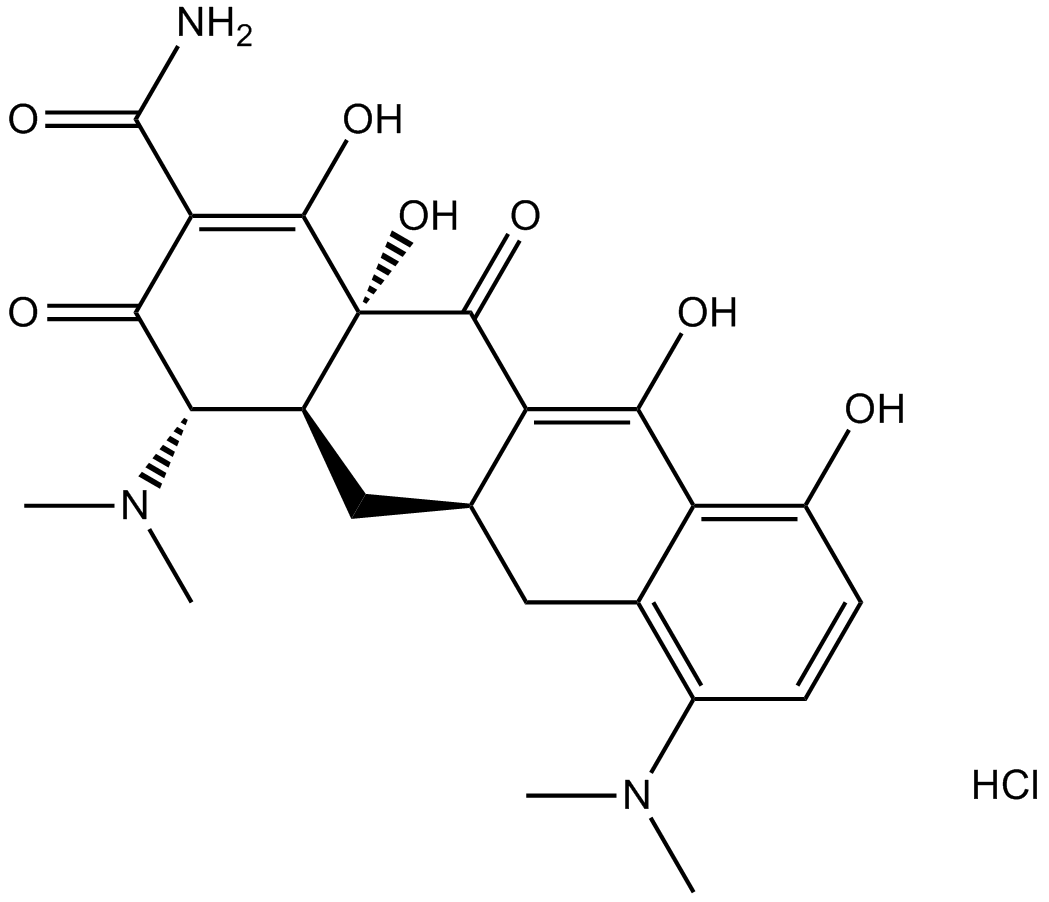
Cas No.: 13614-98-7
Sample solution is provided at 25 µL, 10mM.
Minocycline HCl is an orally effective, blood-brain barrier-permeable semisynthetic tetracycline antibiotic[1]. Minocycline HCl is a hypoxia-inducible factor (HIF-1α) inhibitor with anticancer, anti-inflammatory and glutamate antagonist effects, as well as neuroprotective and antidepressant properties[2]. Minocycline HCl inhibits bacterial protein synthesis by binding to the bacterial ribosome 30S subunit, thereby exerting an antibacterial effect[3].
In vitro, treatment of SH-SY5Y cells with Minocycline HCl (10μM) for 24 h significantly inhibited 6-hydroxydopamine (6-OHDA)-induced cell death, and inhibited cell DNA fragmentation and chromatin condensation[4]. Minocycline HCl (0-100μM) treatment of ovarian cancer cell lines (OVCAR-3, SKOV-3 and A2780 cells) for 24-72 h inhibited cell proliferation and colony formation, downregulated the expression of cyclins A, B and E, inhibited DNA synthesis, and also led to DNA laddering, caspase-3 activation and PARP-1 cleavage[5].
In vivo, Minocycline HCl (25, 50mg/kg) was treated by intraperitoneal injection in spinal cord injury model mice for 28 days, which significantly protected axonal integrity, prevented tissue loss and improved motor behavior[6]. Minocycline HCl (3, 10mg/kg) was injected into the jugular vein in rats with transient middle cerebral artery occlusion (TMCAO) model, which effectively reduced the infarct area and significantly improved neurological deficits[7].
References:
[1] Zhou J, Yang J, Dai M, et al. A combination of inhibiting microglia activity and remodeling gut microenvironment suppresses the development and progression of experimental autoimmune uveitis[J]. Biochemical Pharmacology, 2020, 180: 114108.
[2] Pajarillo E, Nyarko-Danquah I, Digman A, et al. Mechanisms of manganese-induced neurotoxicity and the pursuit of neurotherapeutic strategies[J]. Frontiers in Pharmacology, 2022, 13: 1011947.
[3] Singh S, Khanna D, Kalra S. Minocycline and doxycycline: more than antibiotics[J]. Current Molecular Pharmacology, 2021, 14(6): 1046-1065.
[4] Ossola B, Lantto T A, Puttonen K A, et al. Minocycline protects SH‐SY5Y cells from 6‐hydroxydopamine by inhibiting both caspase‐dependent and‐independent programmed cell death[J]. Journal of neuroscience research, 2012, 90(3): 682-690.
[5] Pourgholami M H, Mekkawy A H, Badar S, et al. Minocycline inhibits growth of epithelial ovarian cancer[J]. Gynecologic oncology, 2012, 125(2): 433-440.
[6] Wells J E A, Hurlbert R J, Fehlings M G, et al. Neuroprotection by minocycline facilitates significant recovery from spinal cord injury in mice[J]. Brain, 2003, 126(7): 1628-1637.
[7] Xu L, Fagan S C, Waller J L, et al. Low dose intravenous minocycline is neuroprotective after middle cerebral artery occlusion-reperfusion in rats[J]. BMC neurology, 2004, 4: 1-7.
| Cell experiment [1]: | |
|
Cell lines |
SH-SY5Y cells |
|
Preparation Method |
SH-SY5Y cells were preincubated for 24h with various concentrations of Minocycline HCl (1, 10, and 50μM) prior to the exposure to the neurotoxin for 24h and 48h. |
|
Reaction Conditions |
1, 10, 50μM; 24h |
|
Applications |
Minocycline HCl significantly prevented 6-hydroxydopamine (6-OHDA) induced cell death, and a significant protection was observed in the presence of 10μM of the drug. |
| Animal experiment [2]: | |
|
Animal models |
Male CD‐1 mice |
|
Preparation Method |
Mice were given either an intraperitoneal injection of saline or 50 mg/kg Minocycline HCl. This was followed 24 h later by a second injection of 50 mg/kg. Subsequently, treated mice were injected with a 25 mg/kg dose every 24 h for the next 5 days. All animals were killed at day 28 following Spinal cord injury (SCI). |
|
Dosage form |
25、50mg/kg; i.p. |
|
Applications |
Minocycline HCl in a mouse model of SCI significantly preserves axonal integrity, prevents tissue loss and leads to motor behavioural improvements. |
|
References: [1] Ossola B, Lantto T A, Puttonen K A, et al. Minocycline protects SH‐SY5Y cells from 6‐hydroxydopamine by inhibiting both caspase‐dependent and‐independent programmed cell death[J]. Journal of neuroscience research, 2012, 90(3): 682-690. [2]Wells J E A, Hurlbert R J, Fehlings M G, et al. Neuroprotection by minocycline facilitates significant recovery from spinal cord injury in mice[J]. Brain, 2003, 126(7): 1628-1637. |
|
| Cas No. | 13614-98-7 | SDF | |
| Chemical Name | (4S,4aS,5aR,12aR)-4,7-bis(dimethylamino)-1,10,11,12a-tetrahydroxy-3,12-dioxo-4a,5,5a,6-tetrahydro-4H-tetracene-2-carboxamide;hydrochloride | ||
| Canonical SMILES | CN(C)C1C2CC3CC4=C(C=CC(=C4C(=C3C(=O)C2(C(=C(C1=O)C(=O)N)O)O)O)O)N(C)C.Cl | ||
| Formula | C23H28ClN3O7 | M.Wt | 493.94 |
| Löslichkeit | ≥ 60.7 mg/mL in DMSO with gentle warming, ≥ 7.86 mg/mL in Water with gentle warming | Storage | Store at 2-8°C |
| General tips | Please select the appropriate solvent to prepare the stock solution according to the
solubility of the product in different solvents; once the solution is prepared, please store it in
separate packages to avoid product failure caused by repeated freezing and thawing.Storage method
and period of the stock solution: When stored at -80°C, please use it within 6 months; when stored
at -20°C, please use it within 1 month. To increase solubility, heat the tube to 37°C and then oscillate in an ultrasonic bath for some time. |
||
| Shipping Condition | Evaluation sample solution: shipped with blue ice. All other sizes available: with RT, or with Blue Ice upon request. | ||
| Prepare stock solution | |||

|
1 mg | 5 mg | 10 mg |
| 1 mM | 2.0245 mL | 10.1227 mL | 20.2454 mL |
| 5 mM | 404.9 μL | 2.0245 mL | 4.0491 mL |
| 10 mM | 202.5 μL | 1.0123 mL | 2.0245 mL |
Step 1: Enter information below (Recommended: An additional animal making an allowance for loss during the experiment)
 g
μL
g
μL
Step 2: Enter the in vivo formulation (This is only the calculator, not formulation. Please contact us first if there is no in vivo formulation at the solubility Section.)
Calculation results:
Working concentration: mg/ml;
Method for preparing DMSO master liquid: mg drug pre-dissolved in μL DMSO ( Master liquid concentration mg/mL, Please contact us first if the concentration exceeds the DMSO solubility of the batch of drug. )
Method for preparing in vivo formulation: Take μL DMSO master liquid, next addμL PEG300, mix and clarify, next addμL Tween 80, mix and clarify, next add μL saline, mix and clarify.
Method for preparing in vivo formulation: Take μL DMSO master liquid, next add μL Corn oil, mix and clarify.
Note: 1. Please make sure the liquid is clear before adding the next solvent.
2. Be sure to add the solvent(s) in order. You must ensure that the solution obtained, in the previous addition, is a clear solution before proceeding to add the next solvent. Physical methods such as vortex, ultrasound or hot water bath can be used to aid dissolving.
3. All of the above co-solvents are available for purchase on the GlpBio website.
Quality Control & SDS
- View current batch:
- Purity: >99.50% Appearance: A solid
- COA (Certificate of Analysis)
- SDS (Safety Data Sheet)
- Datasheet
-
Related Biological Data

Aucubin inhibit the inflammatory responses in microglia. BV2 cells were treated with Aucubin (25, 50, 100 µM) or minocycline (MINO; 50µM) for 12 h and were stimulated with 1 µg/mL LPS for another 24 h. (A, B, C) iNOS and COX-2 protein level were detected and quantified in microglia.
We also diluted tert-butyl hydroperoxide and minocycline (MINO; GLPBIO) in saline to stock concentrations of 100mM and 50 mM, respectively.
Int Immunopharmacol 111 (2022): 109163. PMID: 35994851 IF: 5.5999 -
Related Biological Data

Impairment of synaptic plasticity in hippocampus caused by chronic alcohol exposure were alleviated by administration of minocycline.(b) Confocal z stack and three-dimensional (3D) surface rendering showing the presence of PSD95 in microglia. Scale bar, 5 μm and 1 μm.
According to previous studies, the dose of minocycline (GLPBIO, Cat.NO. GC11861) was 30 mg/kg/day.Single daily injections of Mino (i.p.) were started 3 days prior to alcoholexposure and continued for 28 days.
Experimental Neurology (2022): 114061. PMID: 35367455 IF: 5.33 -
Related Biological Data

The NO inhibitory activity of clerodane diterpenoids from Tinospora sagittata. BV-2 cells were treated with each clerodane diterpenoid and the positive control Mino (with various concentrations) in the presence of 200 ng/mL LPS for 24 h, the supernatants were collected for measurement of NO production.
After incubation for 24 h, the normal control and LPS groups were treated with fresh medium, while the other groups were treated with compounds 2 and 12 and Mino (15 μM)(GLPBIO).
Phytochemistry, 2024, 218: 113932. PMID: 38056516 IF: 3.8001
Average Rating: 5 (Based on Reviews and 18 reference(s) in Google Scholar.)