

PPA-904 |
Katalog-Nr.GC32027
 One-Click Copy Product Info
|

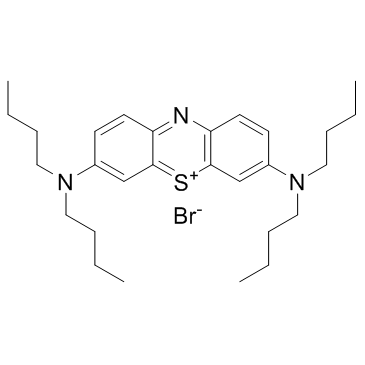
PPA-904 ist ein spezifischer Phenothiazin-Photosensibilisator in der Forschung zur photodynamischen Therapie (PDT), insbesondere bei der topischen Anwendung bei kutaner Leishmaniose in vivo.
Products are for research use only. Not for human use. We do not sell to patients.
Cas No.: 30189-85-6
Sample solution is provided at 25 µL, 10mM.
_1-3.$$$39978408@51.jpg');)
_1-9.$$$38538795@65.jpg');)
_1-9.$$$39112701@51.jpg');)
_1-7.$$$37316672@70.jpg');)
_366-372.$$$36198801@70.jpg');)
.$$$38565142@65.jpg');)
_1867-1883.$$$33248023@67.jpg');)
_eads6055.$$$39977546@45.jpg');)
_eadm9805.$$$40080571@45.jpg');)
_eadj3020.$$$39666821@45.jpg');)
_1-20.$$$39757301@28.jpg');)
_1-24.$$$38898113@28.jpg');)
_273-287.$$$36806353@46.jpg');)
_1-16.$$$37156877@44.jpg');)
_1-19.$$$37460805@44.jpg');)
_1291-1307.$$$34518654@46.jpg');)
PPA-904 is a specific phenothiazine photosensitizer used in photodynamic therapy.
Topical PPA904 photodynamic therapy is a promising treatment for cutaneous leishmaniasis. The best curative PPA904-photodynamic therapy regimen is achieved under the conditions of a longer duration of topical application time (90 minutes) and several (three) consecutive treatments with 4-day intervals between treatments[1]. PPA904-PDT can provide an immunomodulating, dose-dependent efflux on IL-12p70 production. This mechanism could be responsible for promoting a more rapid healing in PPA904-PDT treated mice[2]. Treatment of PPA904 is well tolerated with no reports of pain or other safety issues. PPA904 treated subjects show a reduction in bacterial load immediately post-treatment. After 3 months, 50% (four of eight) of subjects with actively treated chronic leg ulcer show complete healing, compared with 12% (one of eight) of subjects on placebo[3].
[1]. Akilov OE,et al. Optimization of topical photodynamic therapy with 3,7-bis(di-n-butylamino)phenothiazin-5-ium bromide for cutaneous leishmaniasis. Lasers Surg Med. 2009 Jul;41(5):358-65. [2]. Akilov OE, et al. Photodynamic therapy for cutaneous leishmaniasis: the effectiveness of topical phenothiaziniums in parasite eradication and Th1 immune response stimulation. Photochem Photobiol Sci. 2007 Oct;6(10):1067-75. [3]. Morley S, et al. Phase IIa randomized, placebo-controlled study of antimicrobial photodynamic therapy in bacterially colonized, chronic leg ulcers and diabetic foot ulcers: a new approach to antimicrobial therapy. Br J Dermatol. 2013 Mar;168(3):617-24.
Animal experiment: | Mice: 106 metacyclic parasites in 20 mL of PBS are inoculated intradermally into the ears of 6- to 8-week-old BALB/c female mice. A PPA904 cream is applied topically onto the lesion under dark conditions. The areas in the right ear are then irradiated with LC-122A, non-coherent light source equipped with a broadband optical filter, which is inserted into the light delivery system. The filter peaks at 665 nm and has a half-band width of 30 nm. A fluence of 50 J/cm2 (50 mW/cm2) is delivered to the lesion on the right ear, while the left ear (and left ears of the other mice in this group) serves as the drug only group. The ears from mice with no procedure serve as the infected nontreated group. Mice are sacrificed 5 days after photodynamic therapy. Parasite loads in the ears are determined[1]. |
References: [1]. Akilov OE,et al. Optimization of topical photodynamic therapy with 3,7-bis(di-n-butylamino)phenothiazin-5-ium bromide for cutaneous leishmaniasis. Lasers Surg Med. 2009 Jul;41(5):358-65. | |
| Cas No. | 30189-85-6 | SDF | |
| Canonical SMILES | CCCCN(C1=CC2=[S+]C3=C(C=CC(N(CCCC)CCCC)=C3)N=C2C=C1)CCCC.[Br-] | ||
| Formula | C28H42BrN3S | M.Wt | 532.62 |
| Löslichkeit | DMSO : 25 mg/mL (46.94 mM; ultrasonic and warming and heat to 60°C) | Storage | Store at -20°C |
| General tips | Please select the appropriate solvent to prepare the stock solution according to the
solubility of the product in different solvents; once the solution is prepared, please store it in
separate packages to avoid product failure caused by repeated freezing and thawing.Storage method
and period of the stock solution: When stored at -80°C, please use it within 6 months; when stored
at -20°C, please use it within 1 month. To increase solubility, heat the tube to 37°C and then oscillate in an ultrasonic bath for some time. |
||
| Shipping Condition | Evaluation sample solution: shipped with blue ice. All other sizes available: with RT, or with Blue Ice upon request. | ||
| Prepare stock solution | |||

|
1 mg | 5 mg | 10 mg |
| 1 mM | 1.8775 mL | 9.3876 mL | 18.7751 mL |
| 5 mM | 375.5 μL | 1.8775 mL | 3.755 mL |
| 10 mM | 187.8 μL | 938.8 μL | 1.8775 mL |
Step 1: Enter information below (Recommended: An additional animal making an allowance for loss during the experiment)
 g
μL
g
μL
Step 2: Enter the in vivo formulation (This is only the calculator, not formulation. Please contact us first if there is no in vivo formulation at the solubility Section.)
Calculation results:
Working concentration: mg/ml;
Method for preparing DMSO master liquid: mg drug pre-dissolved in μL DMSO ( Master liquid concentration mg/mL, Please contact us first if the concentration exceeds the DMSO solubility of the batch of drug. )
Method for preparing in vivo formulation: Take μL DMSO master liquid, next addμL PEG300, mix and clarify, next addμL Tween 80, mix and clarify, next add μL saline, mix and clarify.
Method for preparing in vivo formulation: Take μL DMSO master liquid, next add μL Corn oil, mix and clarify.
Note: 1. Please make sure the liquid is clear before adding the next solvent.
2. Be sure to add the solvent(s) in order. You must ensure that the solution obtained, in the previous addition, is a clear solution before proceeding to add the next solvent. Physical methods such as vortex, ultrasound or hot water bath can be used to aid dissolving.
3. All of the above co-solvents are available for purchase on the GlpBio website.
Quality Control & SDS
- View current batch:
- Purity: >98.00% Appearance: A solid
- COA (Certificate of Analysis)
- SDS (Safety Data Sheet)
- Datasheet
Average Rating: 5 (Based on Reviews and 19 reference(s) in Google Scholar.)