
Prolactin-Releasing Peptide (1-31) (human) (Synonyms: Human PrRP-31, PrRP(1-31)) |
| Katalog-Nr.GC18366 |
Prolactin-Releasing Peptide (1-31) (Mensch) ist ein GPR10-Ligand mit hoher Affinität, der die Freisetzung von Prolactin bewirkt.
Products are for research use only. Not for human use. We do not sell to patients.
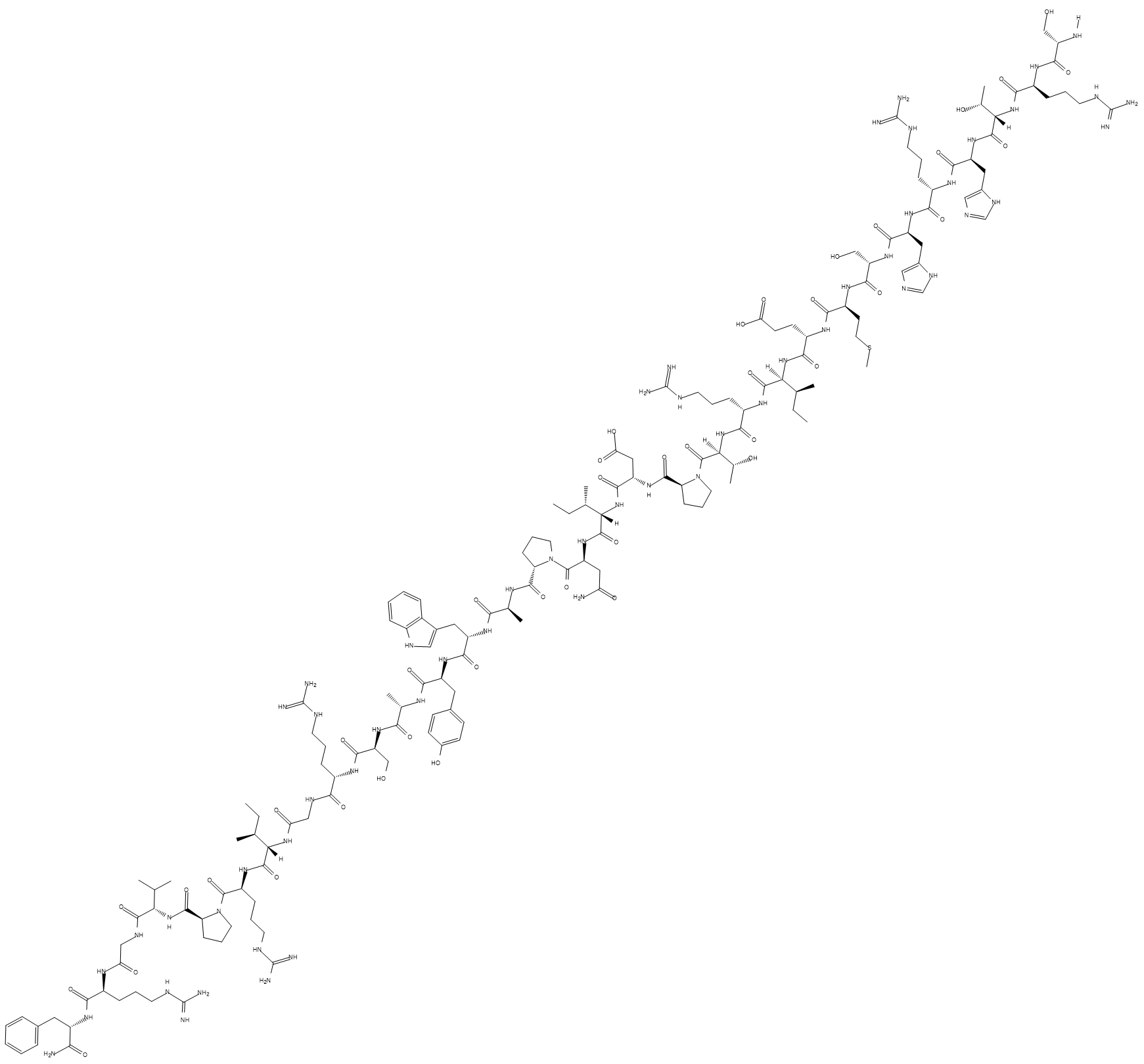
Cas No.: 215510-22-8
Sample solution is provided at 25 µL, 10mM.
Prolactin releasing peptide (PrRP) is a 31-amino acid neuropeptide involved in regulating food intake. It is found in the hypothalamus, medulla, and pituitary in rats. PrRP is an agonist of the G-protein coupled receptors GPR10/hGR3 and neuropeptide FF receptor (hNPFF2; Kis = 1 and 19 nM, respectively). It stimulates calcium mobilization in HEK293 cells expressing GPR10 (EC50 = 1.5 nM) and radiolabeled GTPγS binding to membrane homogenates from CHO cells transfected with hNPFF2 (EC50 = 240 nM). PrRP (100 nM) increases the release of gonadotropin-releasing hormone , vasoactive intestinal peptide-, and galanin from rat medial basal hypothalamic explants. It increases plasma levels of luteinizing hormone, follicle stimulating hormone, and testosterone in male rats when administered at an intracerebroventricular dose of 5 nmol. PrRP reduces food intake in fasted rats to 58.4, 53.4, and 55.4% of control levels when administered at doses of 1, 5, and 10 nmol, respectively.
References:
[1]. Seal, L.G., Small, C.J., Shillo, W.S., et al. PRL-releasing peptide inhibits food intake in male rats via the dorsomedial hypothalamic nucleus and not the paraventricular hypothalamic nucleus Endocrinology 142(10), 4236-4243 (2001).
[2].Langmead, C.J., Szekeres, P.G., Chambers, J.K., et al. Characterization of the binding of [125I]-human prolactin releasing peptide (PrRP) to GPR10, a novel G protein coupled receptor Br. J. Pharmacol. 131(4), 683-688 (2000).
[3]. Engstr?m, M., Brandt, A., Wurster, S., et al. Prolactin releasing peptide has high affinity and efficacy at neuropeptide FF2 receptors J. Pharmacol. Exp. Ther. 305(3), 825-832 (2003).
[4].Seal, L.J., Small, C.J., Kim, M.S., et al. Prolactin releasing peptide (PrRP) stimulates luteinizing hormone (LH) and follicle stimulating hormone (FSH) via a hypothalamic mechanism in male rats Endocrinology 141(5), 1909-1912 (2000).

Animal experiment: | Rats[1]Groups of rats are injected with either Prolactin Releasing Peptide (1-31) 5 nM or saline. Prolactin Releasing Peptide (1-31), human is dissolved in saline is administered in a total volume of 10 μL. Animals are habituated to the injection procedures by three ICV injections prior to the study to minimize stress in the animals. At 10, 20, 60 minutes following injection, rats are decapitated and trunk blood collected into plastic tubes[1]. |
References: [1]. Langmead CJ, et al. Characterization of the binding of [(125)I]-human prolactin releasing peptide (PrRP) to GPR10, a novel G protein coupled receptor. Characterization of the binding of [(125)I]-human prolactin releasing peptide (PrRP) to GPR10, a novel G protein coupled receptor. | |
| Cas No. | 215510-22-8 | SDF | |
| Überlieferungen | Human PrRP-31, PrRP(1-31) | ||
| Chemical Name | N/A | ||
| Canonical SMILES | N/A | ||
| Formula | C160H252N56O42S | M.Wt | 3664.2 |
| Löslichkeit | Water: 1 mg/ml | Storage | Store at -20°C |
| General tips | Please select the appropriate solvent to prepare the stock solution according to the
solubility of the product in different solvents; once the solution is prepared, please store it in
separate packages to avoid product failure caused by repeated freezing and thawing.Storage method
and period of the stock solution: When stored at -80°C, please use it within 6 months; when stored
at -20°C, please use it within 1 month. To increase solubility, heat the tube to 37°C and then oscillate in an ultrasonic bath for some time. |
||
| Shipping Condition | Evaluation sample solution: shipped with blue ice. All other sizes available: with RT, or with Blue Ice upon request. | ||
| Prepare stock solution | |||
|
1 mg | 5 mg | 10 mg |
| 1 mM | 272.9 μL | 1.3646 mL | 2.7291 mL |
| 5 mM | 54.6 μL | 272.9 μL | 545.8 μL |
| 10 mM | 27.3 μL | 136.5 μL | 272.9 μL |
Step 1: Enter information below (Recommended: An additional animal making an allowance for loss during the experiment)
Step 2: Enter the in vivo formulation (This is only the calculator, not formulation. Please contact us first if there is no in vivo formulation at the solubility Section.)
Calculation results:
Working concentration: mg/ml;
Method for preparing DMSO master liquid: mg drug pre-dissolved in μL DMSO ( Master liquid concentration mg/mL, Please contact us first if the concentration exceeds the DMSO solubility of the batch of drug. )
Method for preparing in vivo formulation: Take μL DMSO master liquid, next addμL PEG300, mix and clarify, next addμL Tween 80, mix and clarify, next add μL ddH2O, mix and clarify.
Method for preparing in vivo formulation: Take μL DMSO master liquid, next add μL Corn oil, mix and clarify.
Note: 1. Please make sure the liquid is clear before adding the next solvent.
2. Be sure to add the solvent(s) in order. You must ensure that the solution obtained, in the previous addition, is a clear solution before proceeding to add the next solvent. Physical methods such as vortex, ultrasound or hot water bath can be used to aid dissolving.
3. All of the above co-solvents are available for purchase on the GlpBio website.
Quality Control & SDS
- View current batch:
- Purity: >99.50%
- COA (Certificate Of Analysis)
- SDS (Safety Data Sheet)
- Datasheet
Average Rating: 5 (Based on Reviews and 4 reference(s) in Google Scholar.)
GLPBIO products are for RESEARCH USE ONLY. Please make sure your review or question is research based.
Required fields are marked with *


