

Pyranine (HPTS) (Synonyms: HPTS, Pyranine) |
Katalog-Nr.GC30145
 One-Click Copy Product Info
|

Pyranin (HPTS) (HPTS; Solvent Green 7) ist ein pH-empfindlicher Fluoreszenzindikator.
Products are for research use only. Not for human use. We do not sell to patients.
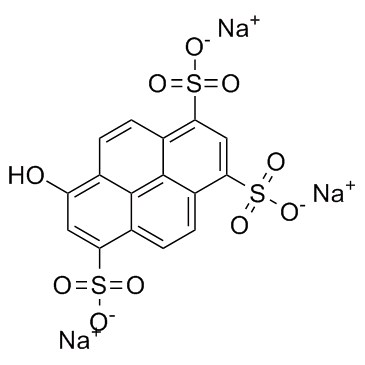
Cas No.: 6358-69-6
Sample solution is provided at 25 µL, 10mM.
Pyranine (HPTS) (8-Hydroxypyrene-1,3,6-trisulfonic acid) is a highly water-soluble, membrane-impermeable pH fluorescent indicator with a pKa of approximately 7.3 in aqueous buffer[1]. The maximum excitation wavelength of Pyranine (HPTS) is 405nm/450nm, and the maximum emission wavelength is 510nm[2]. Pyranine (HPTS) has different fluorescence spectra in the protonated and deprotonated forms[3]. The excited state of Pyranine (HPTS) is much more acidic than the ground state, and can be used as an excited state proton transfer probe in solution[4]. Pyranine (HPTS) can be used as a new type of Cu+ fluorescent chemotaxis sensor, and its sensing properties are specific only to neutral pH[5]. Pyranine (HPTS) is sensitive to the fluorescence quenching of viologen, which can be reversed in the presence of glucose or other monosaccharides, and can be used as a glucose and carbohydrate sensor[6].
References:
[1] Lemos S. Acoustic" Wall-Less" Test Tubes for Cell Biology in Type 2 Diabetes Related Research[D]. Universidade da Beira Interior (Portugal), 2008.
[2] Chowdhury R, Saha A, Mandal A K, et al. Excited state proton transfer in the lysosome of live lung cells: normal and cancer cells[J]. The Journal of Physical Chemistry B, 2015, 119(6): 2149-2156.
[3] de Nooijer L J, Toyofuku T, Oguri K, et al. Intracellular pH distribution in foraminifera determined by the fluorescent probe HPTS[J]. Limnology and Oceanography: Methods, 2008, 6(11): 610-618.
[4] Wang Y, Fang C. Femtosecond Stimulated Raman Spectroscopy (FSRS) Investigation of Excited-State Hydrogen-Bonding Dynamics and Photoacidity in Solution[M]//Hydrogen-Bonding Research in Photochemistry, Photobiology, and Optoelectronic Materials. 2019: 323-367.
[5] Saha T, Sengupta A, Hazra P, et al. In vitro sensing of Cu+ through a green fluorescence rise of pyranine[J]. Photochemical & Photobiological Sciences, 2014, 13: 1427-1433.
[6] Cappuccio F E, Suri J T, Cordes D B, et al. Evaluation of pyranine derivatives in boronic acid based saccharide sensing: Significance of charge interaction between dye and quencher in solution and hydrogel[J]. Journal of Fluorescence, 2004, 14: 521-533.
| Cas No. | 6358-69-6 | SDF | |
| Überlieferungen | HPTS, Pyranine | ||
| Canonical SMILES | O=S(C1=C(C2=C34)C=CC4=C(O)C=C(S(=O)([O-])=O)C3=CC=C2C(S(=O)([O-])=O)=C1)([O-])=O.[Na+].[Na+].[Na+] | ||
| Formula | C16H7Na3O10S3 | M.Wt | 524.39 |
| Löslichkeit | Water: 100 mg/mL (190.70 mM; Need ultrasonic); DMSO: 25 mg/mL (47.67 mM; Need ultrasonic) | Storage | Store at -20°C,protect from light |
| General tips | Please select the appropriate solvent to prepare the stock solution according to the
solubility of the product in different solvents; once the solution is prepared, please store it in
separate packages to avoid product failure caused by repeated freezing and thawing.Storage method
and period of the stock solution: When stored at -80°C, please use it within 6 months; when stored
at -20°C, please use it within 1 month. To increase solubility, heat the tube to 37°C and then oscillate in an ultrasonic bath for some time. |
||
| Shipping Condition | Evaluation sample solution: shipped with blue ice. All other sizes available: with RT, or with Blue Ice upon request. | ||
| Prepare stock solution | |||

|
1 mg | 5 mg | 10 mg |
| 1 mM | 1.907 mL | 9.5349 mL | 19.0698 mL |
| 5 mM | 381.4 μL | 1.907 mL | 3.814 mL |
| 10 mM | 190.7 μL | 953.5 μL | 1.907 mL |
Step 1: Enter information below (Recommended: An additional animal making an allowance for loss during the experiment)
 g
μL
g
μL
Step 2: Enter the in vivo formulation (This is only the calculator, not formulation. Please contact us first if there is no in vivo formulation at the solubility Section.)
Calculation results:
Working concentration: mg/ml;
Method for preparing DMSO master liquid: mg drug pre-dissolved in μL DMSO ( Master liquid concentration mg/mL, Please contact us first if the concentration exceeds the DMSO solubility of the batch of drug. )
Method for preparing in vivo formulation: Take μL DMSO master liquid, next addμL PEG300, mix and clarify, next addμL Tween 80, mix and clarify, next add μL saline, mix and clarify.
Method for preparing in vivo formulation: Take μL DMSO master liquid, next add μL Corn oil, mix and clarify.
Note: 1. Please make sure the liquid is clear before adding the next solvent.
2. Be sure to add the solvent(s) in order. You must ensure that the solution obtained, in the previous addition, is a clear solution before proceeding to add the next solvent. Physical methods such as vortex, ultrasound or hot water bath can be used to aid dissolving.
3. All of the above co-solvents are available for purchase on the GlpBio website.
Quality Control & SDS
- View current batch:
- Purity: >99.00% Appearance: A solid
- COA (Certificate of Analysis)
- SDS (Safety Data Sheet)
- Datasheet
Average Rating: 5 (Based on Reviews and 37 reference(s) in Google Scholar.)