

TMC353121 |
Katalog-Nr.GC17373
 One-Click Copy Product Info
|

TMC353121 ist ein RSV-Fusionshemmer.
Products are for research use only. Not for human use. We do not sell to patients.
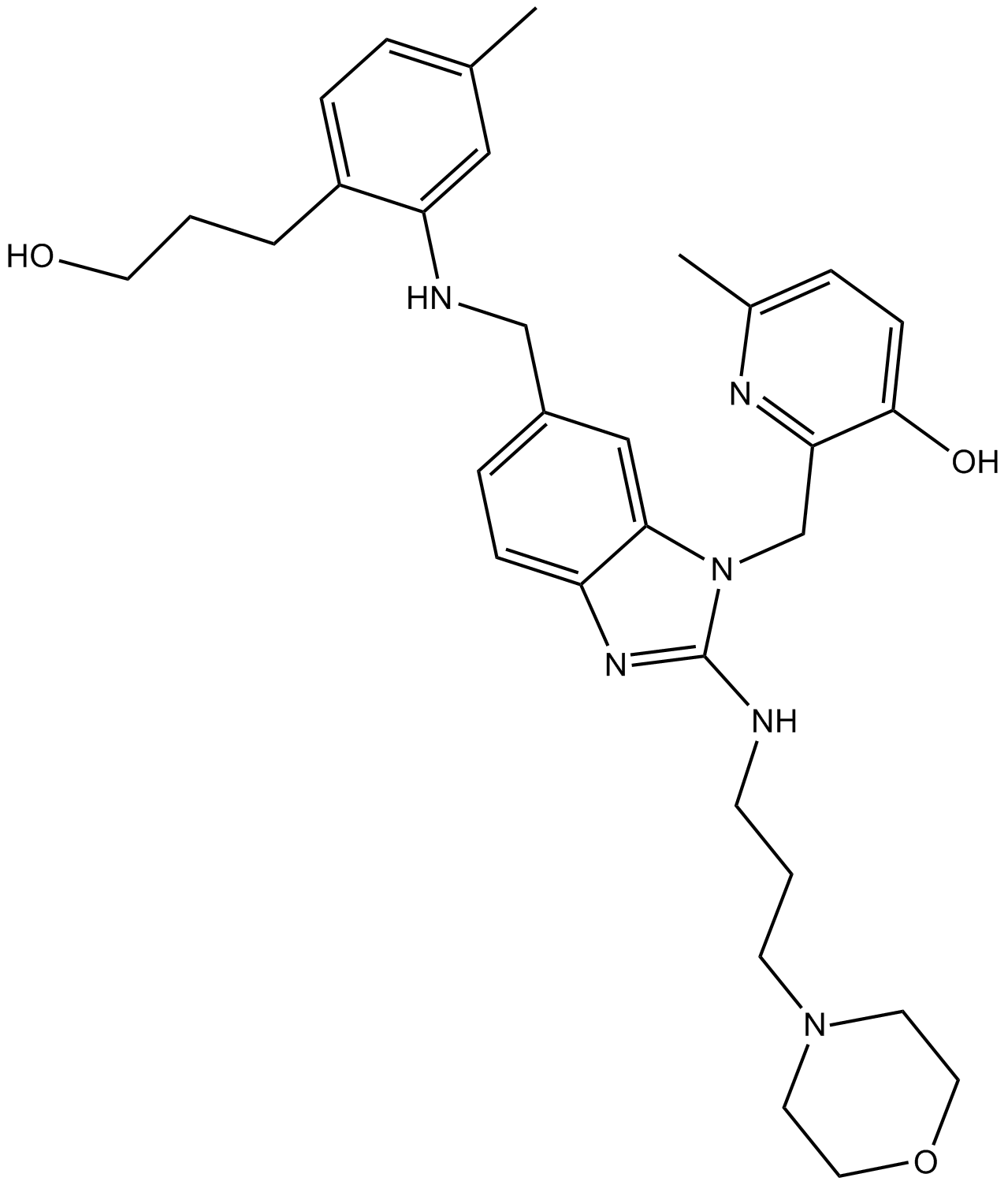
Cas No.: 857066-90-1
Sample solution is provided at 25 µL, 10mM.
_1-3.$$$39978408@51.jpg');)
_1-9.$$$38538795@65.jpg');)
_1-9.$$$39112701@51.jpg');)
_1-7.$$$37316672@70.jpg');)
_366-372.$$$36198801@70.jpg');)
.$$$38565142@65.jpg');)
_1867-1883.$$$33248023@67.jpg');)
_eads6055.$$$39977546@45.jpg');)
_eadm9805.$$$40080571@45.jpg');)
_eadj3020.$$$39666821@45.jpg');)
_1-20.$$$39757301@28.jpg');)
_1-24.$$$38898113@28.jpg');)
_273-287.$$$36806353@46.jpg');)
_1-16.$$$37156877@44.jpg');)
_1-19.$$$37460805@44.jpg');)
_1291-1307.$$$34518654@46.jpg');)
TMC353121 is a RSV fusion inhibitor. It has been developed from the precursor molecule JNJ-2408068 using a molecular modelling approach. It maintains high activity (pEC50 9.9) and low cytotoxicity, while presenting a shorter retention time in the lung (lung t1/2 25 h). [1]
TMC353121 was found to inhibit RSV by preventing both virus cell fusion and syncytia formation by causing a local disturbance of the natural six-helix bundle conformation of RSV-F protein.
TMC353121 reduces viral load in therapeutic and prophylactic administration. TMC353121 has potent antiviral properties in vivo in a BALB/c mice model and protects against lung infection and virus-induced inflammation.[2]
TMC353121 had dose-dependent antiviral activity, which varied from 1log10 reduction of
peak viral load to complete inhibition of the RSV replication. TMC353121 (0.39 μg/mL) can completely inhibit the shedding of RSV. And a dose-dependent reduction of INFγ, IL6 and MIP1α was associated. TMC353121 administered as CI for 16 days was generally well-tolerated. [3]
References:
1. Bonfanti JF, Meyer C, Doublet F et al. Selection of a respiratory syncytial virus fusion inhibitor clinical candidate. 2. Discovery of a morpholinopropylaminobenzimidazole derivative (TMC353121). J Med Chem. 2008; 51: 875–896.
2. Olszewska W1, Ispas G, Schnoeller C et al. Antiviral and lung protective activity of a novel respiratory syncytial virus fusion inhibitor in a mouse model. Eur Respir J. 2011 Aug;38(2):401-8.
3. Ispas G, Koul A, Verbeeck J et al. Antiviral Activity of TMC353121, a Respiratory Syncytial Virus (RSV) Fusion Inhibitor, in a Non-Human Primate Model. PLoS One. 2015 May 26;10(5):e0126959.
|
Animal experiment: |
Rats[2] Sprague-Dawley and cotton rats are given a single-bolus dose of 10 mg/kg TMC353121 intravenously (i.v.). Blood samples are taken from the orbital venous plexus of three Sprague-Dawley rats at 15 min and 1, 8, and 24 h postdose and from six Sprague-Dawley rats and six cotton rats at 3 h postdose. Blood samples are centrifuged at 1,500× g for 10 min, and plasma is separated and frozen until bioanalysis. After blood sampling, the rats are exsanguinated from the vena femoralis under isoflurane-oxygen anesthesia. Then they are euthanized by CO2 asphyxiation, and the lungs are subjected to lavage once via a tracheal cannula with phosphate-buffered saline (PBS) containing 2% bovine serum albumin (BSA) at room temperature at a volume of 5 mL per Sprague-Dawley rat or 2.5 mL per cotton rat. After gentle injection of the lavage fluid into the lungs, the fluid is withdrawn for collection of the bronchoalveolar lavage fluid (BALF) and the lungs are dissected. BALF is collected in order to assess TMC353121 concentrations in the lung epithelial lining fluid (ELF) after correction for the dilution with lavage fluid. A single lavage with a short dwelling time is applied as previously recommended for better accuracy of the determination of ELF dilution. BSA is added to the lavage fluid in order to prevent the adsorption of TMC353121 to syringes or other containers. The BALF is centrifuged at 300× g for 10 min, and the supernatant is separated. BALF supernatant and lung tissue samples are then frozen until bioanalysis. BALF supernatant is referred as BALF throughout this paper. Mice[3] Inbred 8- to 12-week-old female BALB/c mice are used. TMC353121 is administered intravenously in saline at doses of 0.25-10 mg/kg, and at various times in relation to the RSV infection. Mice are infected with 2×10⁶ plaque-forming unit (PFU) of plaque-purified human strain RSV A2 (100 μL intranasally). Individual body weight is used to monitor animal health and response to infection, and is recorded daily. |
|
References: [1]. Bonfanti JF, et al. Selection of a respiratory syncytial virus fusion inhibitor clinical candidate. 2. Discovery of a morpholinopropylaminobenzimidazole derivative (TMC353121). J Med Chem. 2008 Feb 28;51(4):875-96. |
|
| Cas No. | 857066-90-1 | SDF | |
| Chemical Name | 2-[[6-[[2-(3-hydroxypropyl)-5-methylanilino]methyl]-2-(3-morpholin-4-ylpropylamino)benzimidazol-1-yl]methyl]-6-methylpyridin-3-ol | ||
| Canonical SMILES | CC1=CC(=C(C=C1)CCCO)NCC2=CC3=C(C=C2)N=C(N3CC4=C(C=CC(=N4)C)O)NCCCN5CCOCC5 | ||
| Formula | C32H42N6O3 | M.Wt | 558.71 |
| Löslichkeit | DMSO : 50 mg/mL (89.49 mM; Need ultrasonic) | Storage | Store at -20°C |
| General tips | Please select the appropriate solvent to prepare the stock solution according to the
solubility of the product in different solvents; once the solution is prepared, please store it in
separate packages to avoid product failure caused by repeated freezing and thawing.Storage method
and period of the stock solution: When stored at -80°C, please use it within 6 months; when stored
at -20°C, please use it within 1 month. To increase solubility, heat the tube to 37°C and then oscillate in an ultrasonic bath for some time. |
||
| Shipping Condition | Evaluation sample solution: shipped with blue ice. All other sizes available: with RT, or with Blue Ice upon request. | ||
| Prepare stock solution | |||

|
1 mg | 5 mg | 10 mg |
| 1 mM | 1.7898 mL | 8.9492 mL | 17.8984 mL |
| 5 mM | 358 μL | 1.7898 mL | 3.5797 mL |
| 10 mM | 179 μL | 894.9 μL | 1.7898 mL |
Step 1: Enter information below (Recommended: An additional animal making an allowance for loss during the experiment)
 g
μL
g
μL
Step 2: Enter the in vivo formulation (This is only the calculator, not formulation. Please contact us first if there is no in vivo formulation at the solubility Section.)
Calculation results:
Working concentration: mg/ml;
Method for preparing DMSO master liquid: mg drug pre-dissolved in μL DMSO ( Master liquid concentration mg/mL, Please contact us first if the concentration exceeds the DMSO solubility of the batch of drug. )
Method for preparing in vivo formulation: Take μL DMSO master liquid, next addμL PEG300, mix and clarify, next addμL Tween 80, mix and clarify, next add μL saline, mix and clarify.
Method for preparing in vivo formulation: Take μL DMSO master liquid, next add μL Corn oil, mix and clarify.
Note: 1. Please make sure the liquid is clear before adding the next solvent.
2. Be sure to add the solvent(s) in order. You must ensure that the solution obtained, in the previous addition, is a clear solution before proceeding to add the next solvent. Physical methods such as vortex, ultrasound or hot water bath can be used to aid dissolving.
3. All of the above co-solvents are available for purchase on the GlpBio website.
Quality Control & SDS
- View current batch:
- Purity: >98.00% Appearance: A solid
- COA (Certificate of Analysis)
- SDS (Safety Data Sheet)
- Datasheet
Average Rating: 5 (Based on Reviews and 30 reference(s) in Google Scholar.)