

Bifenthrin (Synonyms: (±)-Bifenthrin) |
Catalog No.GC60642
 One-Click Copy Product Info
|

Bifenthrin est un insecticide pyréthrinoïde dont la cible principale de l'action neurotoxique est le canal sodique voltage-dépendant de la membrane neuronale.
Products are for research use only. Not for human use. We do not sell to patients.
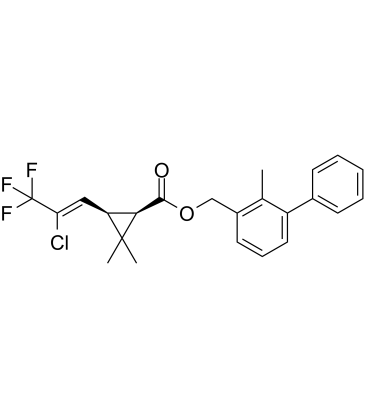
Cas No.: 82657-04-3
Sample solution is provided at 25 µL, 10mM.
_1-3.$$$39978408@51.jpg');)
_1-9.$$$38538795@65.jpg');)
_1-9.$$$39112701@51.jpg');)
_1-7.$$$37316672@70.jpg');)
_366-372.$$$36198801@70.jpg');)
.$$$38565142@65.jpg');)
_1867-1883.$$$33248023@67.jpg');)
_eads6055.$$$39977546@45.jpg');)
_eadm9805.$$$40080571@45.jpg');)
_eadj3020.$$$39666821@45.jpg');)
_1-20.$$$39757301@28.jpg');)
_1-24.$$$38898113@28.jpg');)
_273-287.$$$36806353@46.jpg');)
_1-16.$$$37156877@44.jpg');)
_1-19.$$$37460805@44.jpg');)
_1291-1307.$$$34518654@46.jpg');)
Bifenthrin est un insecticide pyréthrinoïde dont la cible principale de l'action neurotoxique est le canal sodique voltage-dépendant de la membrane neuronale[1]. Bifenthrin présente une photostabilité et une activité insecticide accrues, mais il est neurotoxique pour divers animaux, et ses signes cliniques de toxicité incluent des tremblements et des convulsions[1, 2].
Bifenthrin (20μM; 24h) a induit une augmentation marquée de la production de PGE2, NO et TNF-alpha dans les microglies primaires; Bifenthrin (20μM; 24h) a augmenté l'expression de mRNA d'IL-6 et de TNF-alpha dans les microglies primaires[3]. Bifenthrin (1, 1.5μM; 24h) a significativement diminué l'activité de la glutathion peroxydase dans les érythrocytes; Bifenthrin (1.5μM; 24h) a induit une hémolyse dans les érythrocytes[2].
Bifenthrin (30, 60ng/L; 14j) a augmenté le nombre de vaisseaux sanguins congestionnés chez les truites arc-en-ciel juvéniles[4]. Bifenthrin (8mg/kg; 7j; i.p.) a induit une pyknose nucléaire locale et une dégénérescence vacuolaire des tissus hépatiques chez certains rats BALB/c; Bifenthrin (2, 4, 8mg/kg; 7j; i.p.) a entraîné une augmentation dépendante de la concentration de ROS mitochondriale chez les rats BALB/c [5]. Bifenthrin (0.6mg/kg; 6 semaines; qod.; i.g.) a significativement augmenté le poids corporel des rats C57BL/6; Bifenthrin (0.6mg/kg; 6 semaines; qod.; i.g.) a significativement réduit la régulation de l'expression de HSL et de ATGL tout en augmentant la régulation de l'expression de LPL chez les rats C57BL/6 [6].
References:
[1] Moreira C V L, Ogbu J s, Monteiro K L C, et al. Bifenthrin under scrutiny: revisiting toxicological evidence amid regulatory gaps [J]. Journal of applied toxicology : JAT, 2026, 46(1): 61-77.
[2] Mukhtar F, Jilani K, Bibi I, et al. Stimulation of erythrocyte membrane blebbing by Bifenthrin induced oxidative stress [J]. Dose-response : a publication of International Hormesis Society, 2022, 20(1): 15593258221076710.
[3] Gargouri B, Yousif N M, Bouchard M, et al. Inflammatory and cytotoxic effects of bifenthrin in primary microglia and organotypic hippocampal slice cultures [J]. Journal of neuroinflammation, 2018, 15(1): 159.
[4] Magnuson J T, Caceres L, Sy N, et al. The use of non-targeted lipidomics and histopathology to characterize the neurotoxicity of Bifenthrin to juvenile rainbow trout (Oncorhynchus mykiss) [J]. Environmental science & technology, 2022, 56(16): 11482-11492.
[5] Zhang Y, Lu M, Zhou P, et al. Multilevel evaluations of potential liver injury of bifenthrin [J]. Pesticide biochemistry and physiology, 2015, 122: 29-37.
[6] Wei C, Wang X, Yao X, et al. Bifenthrin induces fat deposition by improving fatty acid uptake and inhibiting lipolysis in mice [J]. Journal of agricultural and food chemistry, 2019, 67(51): 14048-14055.
| Expériences cellulaires [1]: | |
Lignées cellulaires | Microglies primaires de rats Sprague Dawley |
Méthode de préparation | Les cellules microgliales ont été exposées à Bifenthrin (DMSO en tant que témoin) pendant 24h. L'expression génique de TNF-alpha et d' IL-6 a été analysée par PCR quantitative en temps réel. |
Conditions de réaction | 20μM; 24h |
Domaines d'application | Bifenthrin a augmenté l'expression de mRNA d'IL-6 et de TNF-alpha dans les microglies primaires. |
| Expériences animales [2]: | |
Modèles animaux | Rats BALB/c |
Méthode de préparation | Les animaux ont été exposés quotidiennement à Bifenthrin via injection intra-péritonéale de 0.3 mL de la concentration appropriée dans de l'huile de maïs. Après une période de traitement de 7 jours, les foies ont été prélevés pour analyse. |
Forme de dosage | 2, 4, 8mg/kg; 7j; i.p. |
Domaines d'application | Bifenthrin a entraîné une augmentation dépendante de la concentration de la génération de ROS mitochondriaux. |
References: | |
| Cas No. | 82657-04-3 | SDF | |
| Synonymes | (±)-Bifenthrin | ||
| Canonical SMILES | O=C([C@H]1C(C)(C)[C@H]1/C=C(Cl)/C(F)(F)F)OCC2=C(C)C(C3=CC=CC=C3)=CC=C2 | ||
| Formula | C23H22ClF3O2 | M.Wt | 422.87 |
| Solubility | DMSO: 100 mg/mL (236.48 mM) | Storage | 4°C, protect from light |
| General tips | Please select the appropriate solvent to prepare the stock solution according to the
solubility of the product in different solvents; once the solution is prepared, please store it in
separate packages to avoid product failure caused by repeated freezing and thawing.Storage method
and period of the stock solution: When stored at -80°C, please use it within 6 months; when stored
at -20°C, please use it within 1 month. To increase solubility, heat the tube to 37°C and then oscillate in an ultrasonic bath for some time. |
||
| Shipping Condition | Evaluation sample solution: shipped with blue ice. All other sizes available: with RT, or with Blue Ice upon request. | ||
| Prepare stock solution | |||

|
1 mg | 5 mg | 10 mg |
| 1 mM | 2.3648 mL | 11.824 mL | 23.6479 mL |
| 5 mM | 473 μL | 2.3648 mL | 4.7296 mL |
| 10 mM | 236.5 μL | 1.1824 mL | 2.3648 mL |
Step 1: Enter information below (Recommended: An additional animal making an allowance for loss during the experiment)
 g
μL
g
μL
Step 2: Enter the in vivo formulation (This is only the calculator, not formulation. Please contact us first if there is no in vivo formulation at the solubility Section.)
Calculation results:
Working concentration: mg/ml;
Method for preparing DMSO master liquid: mg drug pre-dissolved in μL DMSO ( Master liquid concentration mg/mL, Please contact us first if the concentration exceeds the DMSO solubility of the batch of drug. )
Method for preparing in vivo formulation: Take μL DMSO master liquid, next addμL PEG300, mix and clarify, next addμL Tween 80, mix and clarify, next add μL saline, mix and clarify.
Method for preparing in vivo formulation: Take μL DMSO master liquid, next add μL Corn oil, mix and clarify.
Note: 1. Please make sure the liquid is clear before adding the next solvent.
2. Be sure to add the solvent(s) in order. You must ensure that the solution obtained, in the previous addition, is a clear solution before proceeding to add the next solvent. Physical methods such as vortex, ultrasound or hot water bath can be used to aid dissolving.
3. All of the above co-solvents are available for purchase on the GlpBio website.
Quality Control & SDS
- View current batch:
- Purity: >98.00% Appearance: A solid
- COA (Certificate of Analysis)
- SDS (Safety Data Sheet)
- Datasheet
Average Rating: 5 (Based on Reviews and 15 reference(s) in Google Scholar.)