

E-64 |
Catalog No.GC13418
 One-Click Copy Product Info
|

E-64 est un inhibiteur puissant et irréversible des protéases de cystéine, et sa IC50 est 9nM pour la papaine.
Products are for research use only. Not for human use. We do not sell to patients.
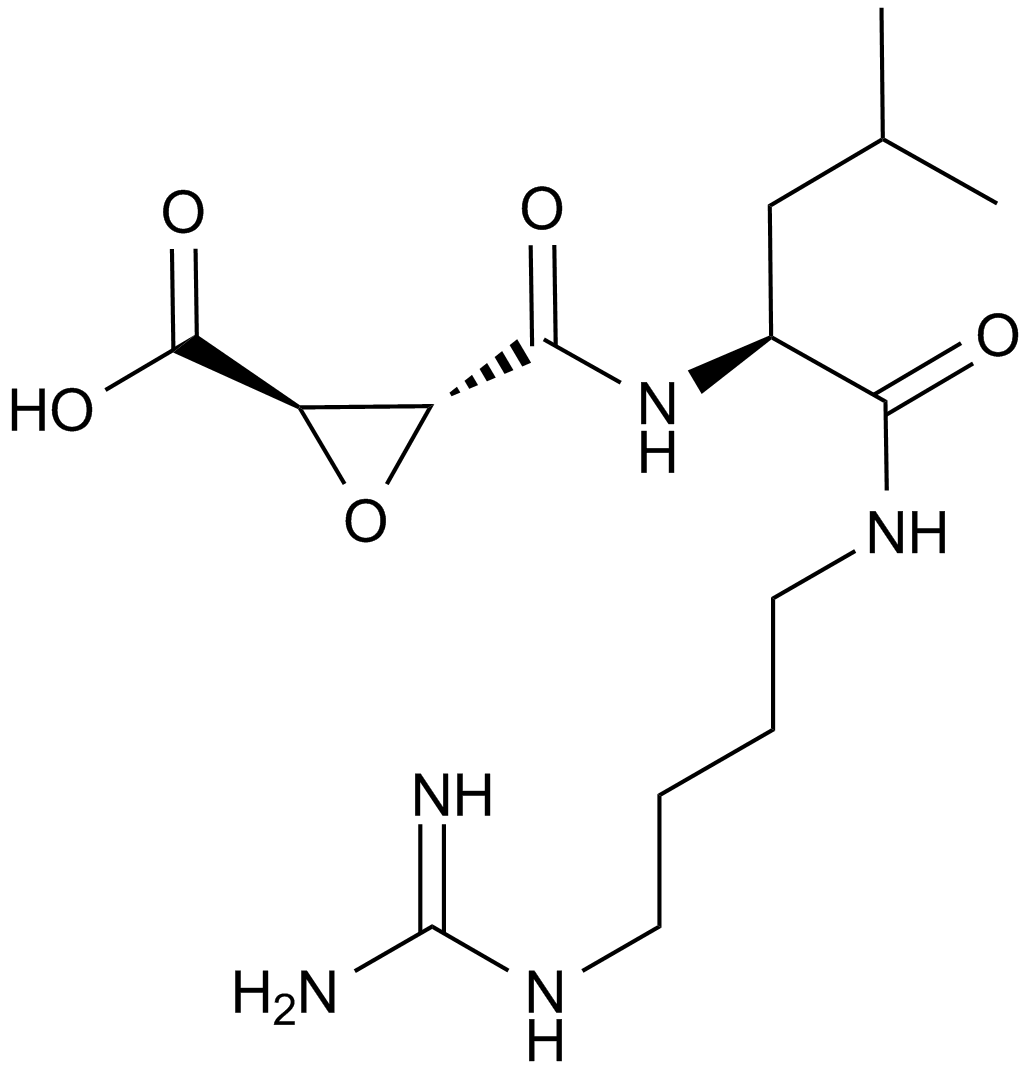
Cas No.: 66701-25-5
Sample solution is provided at 25 µL, 10mM.
E-64 est un inhibiteur puissant et irréversible des protéases de cystéine, et sa IC50 est 9nM pour la papaine[1]. E-64 peut inhiber les protéases de cystéine cathepsine B, H, et la papaine, mais n'a pas l'effet pour les protéases de sérine ou les métalloprotéinases[2]. E-64 a une activité antiparasitaire in vitro et peut induire un stress oxydatif et l'apoptose dans les parasites filariens[3]. E-64 peut accroître le développement pré-implantation des embryons issus de transfert de noyau de cellules somatiques bovines[4].
Le traitement in vitro par E-64 (0-50μM) aux cellules de cancer du sein MDA-MB-231 pendant 24 heures a augmenté la quantité de cathepsine S acctive intracellulaire et a réduit la quantité de cathepsine L de manière de la dose - dépendante[5]. Le traitement par E-64 (4mM) aux marrophages alvéolaires porcins (PAM) pendant 48 heures a augmenté le niveau de mRNA de IFNγ, IL-12 et IFN-α dans les cellules sans cytotoxicité[6].
L'infusion intraveineuse quotidienne in vivo d'E-64 (1mg) dans les rats sel-sensibles de Dahl a significativement augmenté les formes matures des protéases lysosomales Cath B et Cath L dans le cortex rénal des rats, mais n'a eu pas l'effet pour l'hypertension et les lésions rénales régime - induites , sel - riche[7].
References:
[1] Matsumoto K, Mizoue K, Kitamura K, et al. Structural basis of inhibition of cysteine proteases by E‐64 and its derivatives[J]. Peptide Science, 1999, 51(1): 99-107.
[2] Barrett A J, Kembhavi A A, Brown M A, et al. L-trans-Epoxysuccinyl-leucylamido (4-guanidino) butane (E-64) and its analogues as inhibitors of cysteine proteinases including cathepsins B, H and L[J]. Biochemical Journal, 1982, 201(1): 189-198.
[3] Wadhawan M, Singh N, Rathaur S. Inhibition of cathepsin B by E-64 induces oxidative stress and apoptosis in filarial parasite[J]. PLoS One, 2014, 9(3): e93161.
[4] Min S H, Song B S, Yeon J Y, et al. A cathepsin B inhibitor, E-64, improves the preimplantation development of bovine somatic cell nuclear transfer embryos[J]. Journal of Reproduction and Development, 2014, 60(1): 21-27.
[5] Wilder C L, Walton C, Watson V, et al. Differential cathepsin responses to inhibitor-induced feedback: E-64 and cystatin C elevate active cathepsin S and suppress active cathepsin L in breast cancer cells[J]. The international journal of biochemistry & cell biology, 2016, 79: 199-208.
[6] Liu B, Cui Y, Lu G, et al. Small molecule inhibitor E-64 exhibiting the activity against African swine fever virus pS273R[J]. Bioorganic & Medicinal Chemistry, 2021, 35: 116055.
[7] Blass G, Levchenko V, Ilatovskaya D V, et al. Chronic cathepsin inhibition by E‐64 in Dahl salt‐sensitive rats[J]. Physiological reports, 2016, 4(17): e12950.
| Expériences cellulaires [1]: | |
Lignées cellulaires | Cellules MDA-MB-231 |
Méthode de préparation | Les cellules MDA-MB-231 confluentes ont été traitées par E-64 des concentrations qui fluctuent de 0 à 50μM pendant 24h. Les cellules ont été lysées et ont été soumises à la zymographie multiplex des cathepsines pour détecter les changements dans la quantité de matière active. |
Conditions de réaction | 0-50μM; 24h |
Domaines d'application | Le traitement par E -64 a significativement augmenté la quantité de cathepsine S acctive, tout en dimiluant la quantité de cathepsine L dans les lysats cellulaires. |
| Expériences animales [2]: | |
Modèles animaux | Rats sensibles au sel de Dahl (SS/JrHsdMcwi) |
Méthode de préparation | Les rats sensibles au sel de Dahl (SS/JrHsdMcwi) ont eu leur artère et leur veine fémorales gauches cathétérisées. Les deux cathéters ont été fixés et ont été exteriorisés par l'arrière du cou, la ligne artérielle a été connectée à une pompe d'infusion de solution saline héparinée reliée à un transducteur de pression artérielle, et la ligne veineuse a été connectée à une pompe d'infusion de solution saline. Les animaux ont eu la possibilité de se mouvoir sur 360° par ce qui utilisent un système de tuteur-pivot. Une pression artérielle de base stable a été obtenu pendant 4 jours avant le changement des deux groupes pour un régime à 8.0% NaCl et ll'ajout simultané de la N-[N-(L-3-trans-carboxyox-irane-2-carbonyl)-L-leucyl]-agmatine (E-64, 1mg/jour; 280mM solutin de stock dans DMSO) ou le témoin de véicule au cathéter veineux. La pression artérielle moyenne quotidienne (MAP) a été calculée par effectuer la moyenne de la MAP prise chaque minute pendant les 3 primières heures de la période de sommeil du rat. |
Forme de dosage | 1mg/jour; i.v. |
Domaines d'application | Une augmentation significative de la forme mature de Cath B et Cath L dans les cortex rénal a été mesurée en rats traités par E - 64. |
References: | |
| Cas No. | 66701-25-5 | SDF | |
| Chemical Name | (2S,3S)-3-[[(2S)-1-[4-(diaminomethylideneamino)butylamino]-4-methyl-1-oxopentan-2-yl]carbamoyl]oxirane-2-carboxylic acid | ||
| Canonical SMILES | CC(C)CC(C(=O)NCCCCN=C(N)N)NC(=O)C1C(O1)C(=O)O | ||
| Formula | C15H27N5O5 | M.Wt | 357.41 |
| Solubility | ≥ 53.6mg/mL in DMSO | Storage | Store at 2-8°C |
| General tips | Please select the appropriate solvent to prepare the stock solution according to the
solubility of the product in different solvents; once the solution is prepared, please store it in
separate packages to avoid product failure caused by repeated freezing and thawing.Storage method
and period of the stock solution: When stored at -80°C, please use it within 6 months; when stored
at -20°C, please use it within 1 month. To increase solubility, heat the tube to 37°C and then oscillate in an ultrasonic bath for some time. |
||
| Shipping Condition | Evaluation sample solution: shipped with blue ice. All other sizes available: with RT, or with Blue Ice upon request. | ||
| Prepare stock solution | |||

|
1 mg | 5 mg | 10 mg |
| 1 mM | 2.7979 mL | 13.9895 mL | 27.9791 mL |
| 5 mM | 559.6 μL | 2.7979 mL | 5.5958 mL |
| 10 mM | 279.8 μL | 1.399 mL | 2.7979 mL |
Step 1: Enter information below (Recommended: An additional animal making an allowance for loss during the experiment)
 g
μL
g
μL
Step 2: Enter the in vivo formulation (This is only the calculator, not formulation. Please contact us first if there is no in vivo formulation at the solubility Section.)
Calculation results:
Working concentration: mg/ml;
Method for preparing DMSO master liquid: mg drug pre-dissolved in μL DMSO ( Master liquid concentration mg/mL, Please contact us first if the concentration exceeds the DMSO solubility of the batch of drug. )
Method for preparing in vivo formulation: Take μL DMSO master liquid, next addμL PEG300, mix and clarify, next addμL Tween 80, mix and clarify, next add μL saline, mix and clarify.
Method for preparing in vivo formulation: Take μL DMSO master liquid, next add μL Corn oil, mix and clarify.
Note: 1. Please make sure the liquid is clear before adding the next solvent.
2. Be sure to add the solvent(s) in order. You must ensure that the solution obtained, in the previous addition, is a clear solution before proceeding to add the next solvent. Physical methods such as vortex, ultrasound or hot water bath can be used to aid dissolving.
3. All of the above co-solvents are available for purchase on the GlpBio website.
Quality Control & SDS
- View current batch:
- Purity: >98.00% Appearance: A solid
- COA (Certificate of Analysis)
- SDS (Safety Data Sheet)
- Datasheet
Average Rating: 5 (Based on Reviews and 30 reference(s) in Google Scholar.)