

Hypotaurine |
Catalog No.GC14943
 One-Click Copy Product Info
|

Hypotaurine est un précurseur de la biosynthèse de la taurine et est un acide aminé inhibiteur endogène du récepteur de la glycine.
Products are for research use only. Not for human use. We do not sell to patients.
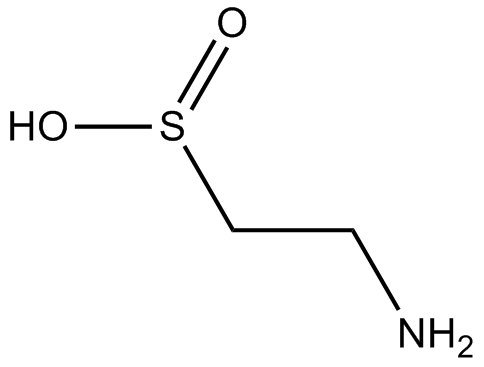
Cas No.: 300-84-5
Sample solution is provided at 25 µL, 10mM.
_1-3.$$$39978408@51.jpg');)
_1-9.$$$38538795@65.jpg');)
_1-9.$$$39112701@51.jpg');)
_1-7.$$$37316672@70.jpg');)
_366-372.$$$36198801@70.jpg');)
.$$$38565142@65.jpg');)
_1867-1883.$$$33248023@67.jpg');)
_eads6055.$$$39977546@45.jpg');)
_eadm9805.$$$40080571@45.jpg');)
_eadj3020.$$$39666821@45.jpg');)
_1-20.$$$39757301@28.jpg');)
_1-24.$$$38898113@28.jpg');)
_273-287.$$$36806353@46.jpg');)
_1-16.$$$37156877@44.jpg');)
_1-19.$$$37460805@44.jpg');)
_1291-1307.$$$34518654@46.jpg');)
Hypotaurine est un précurseur de la biosynthèse de la taurine et est un acide aminé inhibiteur endogène du récepteur de la glycine[1]. Hypotaurine inhibe les transporteurs de GABA 1 (GAT1), 2 (GAT2), 3 (GAT3), et 4 (GAT4) chez les rats (les valeurs d'IC50 sont respectivement 170, 240, 4.9, et 8.1μM) et GAT1, 2, et 3 chez le rat (les valeurs d'IC50 sont respectivement 1010, 52, et 73μM) pour la capture de GABA [2]. En tant qu'antioxydant, Hypotaurine peut éliminer efficacement les radicaux libres et les espèces réactives de l'oxygène[3].
In vitro, Hypotaurine (1mM; 24h) a significativement réduit la concentration des radicaux hydroxyles dans les cellules trophoblastiques placentaires de rat (TR-TBT 18d-1) traitées avec H2O2, et possèdait un effet protecteur contre les lésions oxydatives induites par H2O2 [4]. Dans les conditions de chlorure élevé, Hypotaurine (30-3000μM; 100s) a augmenté le courant entrant ou la déflexion ascendante du potentiel membranaire dans les neurones des cellules gliales (SG) du noyau trigéminal de la queue immature de rat (Vc) de manière concentration-dépendante, ses valeurs d'EC50 sont respectivement 663.8 et 337.6μM[5].
In vivo, chez les rats soumis à l'oscillation de la queue, à la pression de la patte et au test de formol, Hypotaurine (100, 200, 400, et 600μg/10μL; injection intrathécale) a prolongé la latence de la flexion de la queue de manière dose-dépendante, atténué l'hyperalgésie mécanique et l'hyperalgésie thermique[6]. Le traitement avec Hypotaurine (2.4mM/kg/2mL; injection intra-péritonéale) a significativement atténué l'augmentation des activités de ALT, de AST et de LDH dans le plasma de rat induite par l'acétaminophène (APAP), ainsi que la diminution des activités de GR, GST, et GCS et la consommation de GSSG dans le foie[7].
References:
[1] Green TR, Fellman JH, Eicher AL, Pratt KL. Antioxidant role and subcellular location of hypotaurine and taurine in human neutrophils. Biochim Biophys Acta. 1991;1073(1):91-97.
[2] Kragler, A., Höfner, G., and Wanner, K.T. Novel parent structures for inhibitors of the murine GABA transporters mGAT3 and mGAT4. Eur. J. Pharmacol. 519(1-2), 43-47 (2005).
[3] Aruoma O I, Halliwell B, Hoey B M, et al. The antioxidant action of taurine, hypotaurine and their metabolic precursors[J]. Biochemical Journal, 1988, 256(1): 251-255.
[4] Nishimura T, Duereh M, Sugita Y, et al. Protective effect of hypotaurine against oxidative stress-induced cytotoxicity in rat placental trophoblasts. Placenta. 2015;36(6):693-698.
[5] Oh SM, Bhattarai JP, Han SK, Park SJ. Effects of hypotaurine on substantia gelatinosa neurons of the trigeminal subnucleus caudalis in immature mice. Amino Acids. 2016;48(12):2843-2853.
[6] Hara K, Nakamura M, Haranishi Y, Terada T, Kataoka K, Sata T. Antinociceptive effect of intrathecal administration of hypotaurine in rat models of inflammatory and neuropathic pain. Amino Acids. 2012;43(1):397-404.
[7] Acharya M, Lau-Cam CA. Comparison of the protective actions of N-acetylcysteine, hypotaurine and taurine against acetaminophen-induced hepatotoxicity in the rat. J Biomed Sci. 2010;17 Suppl 1(Suppl 1):S35. Published 2010 Aug 24.
| Expériences cellulaires [1]: | |
Lignées cellulaires | Cellules TR-TBT 18d-1 |
Méthode de préparation | Les cellules TR-TBT 18d-1 ont été cultivées à 37°C pendant 2 jours, puis traitées avec le composé d'essai pendant 24 heures supplémentaires, si nécessaire. Le milieu de culture a été remplacé par un milieu frais ne contenant pas le composé d'essai, et les cellules ont été exposées à H2O2 à la concentration et au temps spécifiés. La viabilité cellulaire a été mesurée en termes d'activité oxydoréductase dépendante de NAD(P)H (test MTT) à l'aide de CellTiter 96 Non-Radioactive Cell Proliferation Assay. Les cellules TR-TBT 18d-1 ont été traitées avec une solution avec 1mM de Hypotaurine pendant 24 heures à 37°C, et les capacités antioxydantes vis-à -vis des radicaux hydroxyles et peroxyles dans les lysats cellulaires ont été également évaluées à l'aide du test HORAC ou du test ORAC, respectivement, conformément aux instructions des fabricants. |
Conditions de réaction | 1mM; 24h |
Domaines d'application | Hypotaurine a significativement réduit la concentration des radicaux hydroxyles dans les cellules trophoblastiques placentaires de rat (TR-TBT 18d-1) traitées avec H2O2, et possèdait un effet protecteur contre les lésions oxydatives induites par H2O2. |
| Expériences animales [2]: | |
Modèles animaux | Rats Sprague–Dawley |
Méthode de préparation | Pour l'administration intrathécale des médicaments, des cathéters lombaires ont été implantés chez tous les rats. Sous anesthésie au pentobarbital sodique (60mg/kg, par voie intra-péritonéale), un cathéter en polyéthylène PE-10 étiré (8,5cm) a été inséré dans l'espace intrathécal et avancé caudalement jusqu'au bord rostral de l'agrandissement lombaire par une incision dans la membrane atlanto-occipitale. Une période de récupération de sept jours a été prévue avant l'administration intrathécale de Hypotaurine et l'évaluation comportementale. La bonne localisation du cathéter a été confirmée par une paralysie des membres postérieurs après l'injection de 10µL de lidocaïne à 2% 2 jours avant l'évaluation. Pour les dosages, 10µL des médicaments ou de la solution saline ont été administrés par voie intrathécale, suivis de 10µL de Saline pour rincer le cathéter. Les effets de Hypotaurine (100, 200, 400, et 600μg) sur la nociception thermique ont été évalués de manière répétée pendant 120 minutes après l'injection. Une source de chaleur rayonnante a été concentrée sur la partie médiane de la queue du rat. L'intervalle de temps depuis le début du stimulus jusqu'à la réponse de flexion de la queue a été mesuré à l'aide d'un appareil de flexion de la queue. |
Forme de dosage | 100, 200, 400, et 600μg/10μL; injection intrathécale |
Domaines d'application | Hypotaurine a prolongé la latence de la flexion de la queue de manière dose-dépendante, atténué l'hyperalgésie mécanique et l'hyperalgésie thermique. |
References: | |
| Cas No. | 300-84-5 | SDF | |
| Chemical Name | 2-aminoethanesulfinic acid | ||
| Canonical SMILES | OS(CCN)=O | ||
| Formula | C2H7NO2S | M.Wt | 109.14 |
| Solubility | PBS (pH 7.2): 10mg/mL | Storage | Desiccate at RT |
| General tips | Please select the appropriate solvent to prepare the stock solution according to the
solubility of the product in different solvents; once the solution is prepared, please store it in
separate packages to avoid product failure caused by repeated freezing and thawing.Storage method
and period of the stock solution: When stored at -80°C, please use it within 6 months; when stored
at -20°C, please use it within 1 month. To increase solubility, heat the tube to 37°C and then oscillate in an ultrasonic bath for some time. |
||
| Shipping Condition | Evaluation sample solution: shipped with blue ice. All other sizes available: with RT, or with Blue Ice upon request. | ||
| Prepare stock solution | |||

|
1 mg | 5 mg | 10 mg |
| 1 mM | 9.1625 mL | 45.8127 mL | 91.6254 mL |
| 5 mM | 1.8325 mL | 9.1625 mL | 18.3251 mL |
| 10 mM | 916.3 μL | 4.5813 mL | 9.1625 mL |
Step 1: Enter information below (Recommended: An additional animal making an allowance for loss during the experiment)
 g
μL
g
μL
Step 2: Enter the in vivo formulation (This is only the calculator, not formulation. Please contact us first if there is no in vivo formulation at the solubility Section.)
Calculation results:
Working concentration: mg/ml;
Method for preparing DMSO master liquid: mg drug pre-dissolved in μL DMSO ( Master liquid concentration mg/mL, Please contact us first if the concentration exceeds the DMSO solubility of the batch of drug. )
Method for preparing in vivo formulation: Take μL DMSO master liquid, next addμL PEG300, mix and clarify, next addμL Tween 80, mix and clarify, next add μL saline, mix and clarify.
Method for preparing in vivo formulation: Take μL DMSO master liquid, next add μL Corn oil, mix and clarify.
Note: 1. Please make sure the liquid is clear before adding the next solvent.
2. Be sure to add the solvent(s) in order. You must ensure that the solution obtained, in the previous addition, is a clear solution before proceeding to add the next solvent. Physical methods such as vortex, ultrasound or hot water bath can be used to aid dissolving.
3. All of the above co-solvents are available for purchase on the GlpBio website.
Quality Control & SDS
- View current batch:
- Purity: >98.00% Appearance: A solid
- COA (Certificate of Analysis)
- SDS (Safety Data Sheet)
- Datasheet
Average Rating: 5 (Based on Reviews and 4 reference(s) in Google Scholar.)