

Hypotaurine |
Catalog No.GC14943
 One-Click Copy Product Info
|

Hypotaurine은 타우린 생합성의 전구물질이고 글리신 수용체의 내인성 억제 아미노산이다.
Products are for research use only. Not for human use. We do not sell to patients.
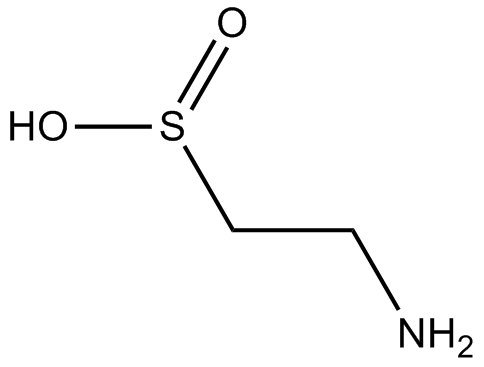
Cas No.: 300-84-5
Sample solution is provided at 25 µL, 10mM.
_1-3.$$$39978408@51.jpg');)
_1-9.$$$38538795@65.jpg');)
_1-9.$$$39112701@51.jpg');)
_1-7.$$$37316672@70.jpg');)
_366-372.$$$36198801@70.jpg');)
.$$$38565142@65.jpg');)
_1867-1883.$$$33248023@67.jpg');)
_eads6055.$$$39977546@45.jpg');)
_eadm9805.$$$40080571@45.jpg');)
_eadj3020.$$$39666821@45.jpg');)
_1-20.$$$39757301@28.jpg');)
_1-24.$$$38898113@28.jpg');)
_273-287.$$$36806353@46.jpg');)
_1-16.$$$37156877@44.jpg');)
_1-19.$$$37460805@44.jpg');)
_1291-1307.$$$34518654@46.jpg');)
Hypotaurine은 타우린 생합성의 전구물질이고 글리신 수용체의 내인성 억제 아미노산이다. Hypotaurine은 쥐에서 GABA 수송체 1(GAT1), 2(GAT2), 3(GAT3), 4(GAT4)를 억제해서 GABA의 흡수를 막은다(IC50 값은 각각 170, 240, 4.9, 8.1μM이다) 그리고 쥐에서 GAT1, 2, 3를 억제한다(IC50 값은 각각 1010, 52, 73μM이다)[2]. 항산화제로서 Hypotaurine은 자유 라디칼과 활성산소를 효과적으로 제거할 수 있다[3].
체외 실험에서 Hypotaurine(1mM; 24시간)은 H₂O₂로 처리된 쥐 태반 태반세포(TR-TBT 18d-1)에서 수산기 라디칼의 농도를 현저하게 감소시키고 H₂O₂ 유도 산화 손상을 대비한 보호 효과가 있었다[4]. 고 염소 조건에서 Hypotaurine(30-3000μM; 100초)은 미성숙 생쥐 꼬리 삼차 신경핵(Vc)의 신경교질 세포(SG) 신경세포에서 내향 전류나 막 전위의 상승을 농도 의존적으로 증가시켰는데 각각 EC50 값은 663.8과 337.6μM이었다[5].
체내 실험에서 꼬리 흔들기, 발톱 누르기 그리고 폼알데하이드 테스트를 받은 쥐에서 Hypotaurine(100, 200, 400 그리고 600μg/10μL; 경막하 주사)은 꼬리 흔들기 잠복기를 용량 의존적으로 연장시켰고 기계적 과민증과 열 과민증을 완화시켰다[6]. Hypotaurine(2.4mM/kg/2mL; 복강주사) 전처리는 아세트아미노펜(APAP)에 의해 유도된 흰쥐 혈장 중 ALT, AST 그리고 LDH 활성의 증가를 현저하게 감소시켰고 간에서 GR, GST 그리고 GCS 활성의 감소와 GSSG의 소비도 줄였다[7].
References:
[1] Green TR, Fellman JH, Eicher AL, Pratt KL. Antioxidant role and subcellular location of hypotaurine and taurine in human neutrophils. Biochim Biophys Acta. 1991;1073(1):91-97.
[2] Kragler, A., Höfner, G., and Wanner, K.T. Novel parent structures for inhibitors of the murine GABA transporters mGAT3 and mGAT4. Eur. J. Pharmacol. 519(1-2), 43-47 (2005).
[3] Aruoma O I, Halliwell B, Hoey B M, et al. The antioxidant action of taurine, hypotaurine and their metabolic precursors[J]. Biochemical Journal, 1988, 256(1): 251-255.
[4] Nishimura T, Duereh M, Sugita Y, et al. Protective effect of hypotaurine against oxidative stress-induced cytotoxicity in rat placental trophoblasts. Placenta. 2015;36(6):693-698.
[5] Oh SM, Bhattarai JP, Han SK, Park SJ. Effects of hypotaurine on substantia gelatinosa neurons of the trigeminal subnucleus caudalis in immature mice. Amino Acids. 2016;48(12):2843-2853.
[6] Hara K, Nakamura M, Haranishi Y, Terada T, Kataoka K, Sata T. Antinociceptive effect of intrathecal administration of hypotaurine in rat models of inflammatory and neuropathic pain. Amino Acids. 2012;43(1):397-404.
[7] Acharya M, Lau-Cam CA. Comparison of the protective actions of N-acetylcysteine, hypotaurine and taurine against acetaminophen-induced hepatotoxicity in the rat. J Biomed Sci. 2010;17 Suppl 1(Suppl 1):S35. Published 2010 Aug 24.
| 세포 실험 [1]: | |
세포 라인 | TR-TBT 18d-1 세포 |
제조 방법 | TR-TBT 18d-1 세포는 37°C에서 2일 동안 배양되었고 필요 시 추가로 24시간 동안 테스트 화합물로 처리하였습니다. 배양액은 테스트 화합물이 들어 있지 않은 신선한 배양액으로 교체되었고 세포는 지정된 농도와 시간 동안 H₂O₂에 노출되었습니다. 세포 생존력은 CellTiter 96 Non-Radioactive Cell Proliferation Assay를 사용해서 NAD(P)H-의존적 산화환원효소 활성(MTT 검사)으로 측정하였습니다. TR-TBT 18d-1 세포는 37°C에서 1mM 저타우린 용액으로 24시간 처리되었고 세포 추출물에서 수산기 라디칼과 과산화물 라디칼에 대한 항산화 능력도 HORAC 검사와 ORAC 검사를 각각 사용해서 제조사의 지시에 따라 평가하였습니다. |
반응 조건 | 1mM; 24시간 동안 |
응용 분야 | Hypotaurine은 H₂O₂로 처리된 흰쥐 태반 태반세포(TR-TBT 18d-1)에서 수산기 라디칼의 농도를 현저하게 감소시켜 H₂O₂ 유도 산화 손상에 대한 보호 효과를 발휘하였습니다. |
| 동물 실험 [2]: | |
동물 모형 | Sprague–Dawley 쥐 |
제조 방법 | 약물의 경막하 투여를 위해 모든 쥐에게 요추 카테터가 삽입되었습니다. 펜토바비탈 나트륨(60mg/kg, 복강주사)을 사용해서 마취한 후 8.5cm 길이의 늘인 PE-10 카테터 폴리에틸렌를 경막하 공간에 삽입해서 대서 막의 절개를 통해 요추 확대부의 앞쪽 가장자리까지 꼬리쪽으로 진행시켰습니다. Hypotaurine의 경막하 투여와 행동 평가 전에 7일간의 회복 기간을 제공하였습니다. 카테터의 적절한 위치는 평가 2일 전 2% 리도카인 10μL 투여 후 후지 하지 마비로 확인하였습니다. 시험에서 10μL의 약물이나 생리식염수를 경막하로 투여하고 카테터를 씻기 위해 생리식염수 10μL를 투여하였습니다. Hypotaurine(100, 200, 400 그리고 600μg)의 열성 통각에 대한 효과는 투여 후 120분 동안 반복적으로 평가하였습니다. 방사열원을 쥐 꼬리의 중앙 부분에 집중시켰습니다. 자극 시작부터 꼬리 흔들기 반응까지의 시간 간격은 꼬리 흔들기 장치를 사용해서 측정하였습니다. |
제형 | 100, 200, 400및 600μg/10μL;칼집 내 주사 |
응용 분야 | Hypotaurine은 꼬리 흔들기 잠복기를 용량 의존적으로 연장시켜 기계적 과민증과 열 과민증을 완화시켰습니다. |
References: | |
| Cas No. | 300-84-5 | SDF | |
| Chemical Name | 2-aminoethanesulfinic acid | ||
| Canonical SMILES | OS(CCN)=O | ||
| Formula | C2H7NO2S | M.Wt | 109.14 |
| Solubility | PBS (pH 7.2): 10mg/mL | Storage | Desiccate at RT |
| General tips | Please select the appropriate solvent to prepare the stock solution according to the
solubility of the product in different solvents; once the solution is prepared, please store it in
separate packages to avoid product failure caused by repeated freezing and thawing.Storage method
and period of the stock solution: When stored at -80°C, please use it within 6 months; when stored
at -20°C, please use it within 1 month. To increase solubility, heat the tube to 37°C and then oscillate in an ultrasonic bath for some time. |
||
| Shipping Condition | Evaluation sample solution: shipped with blue ice. All other sizes available: with RT, or with Blue Ice upon request. | ||
| Prepare stock solution | |||

|
1 mg | 5 mg | 10 mg |
| 1 mM | 9.1625 mL | 45.8127 mL | 91.6254 mL |
| 5 mM | 1.8325 mL | 9.1625 mL | 18.3251 mL |
| 10 mM | 916.3 μL | 4.5813 mL | 9.1625 mL |
Step 1: Enter information below (Recommended: An additional animal making an allowance for loss during the experiment)
 g
μL
g
μL
Step 2: Enter the in vivo formulation (This is only the calculator, not formulation. Please contact us first if there is no in vivo formulation at the solubility Section.)
Calculation results:
Working concentration: mg/ml;
Method for preparing DMSO master liquid: mg drug pre-dissolved in μL DMSO ( Master liquid concentration mg/mL, Please contact us first if the concentration exceeds the DMSO solubility of the batch of drug. )
Method for preparing in vivo formulation: Take μL DMSO master liquid, next addμL PEG300, mix and clarify, next addμL Tween 80, mix and clarify, next add μL saline, mix and clarify.
Method for preparing in vivo formulation: Take μL DMSO master liquid, next add μL Corn oil, mix and clarify.
Note: 1. Please make sure the liquid is clear before adding the next solvent.
2. Be sure to add the solvent(s) in order. You must ensure that the solution obtained, in the previous addition, is a clear solution before proceeding to add the next solvent. Physical methods such as vortex, ultrasound or hot water bath can be used to aid dissolving.
3. All of the above co-solvents are available for purchase on the GlpBio website.
Quality Control & SDS
- View current batch:
- Purity: >98.00% Appearance: A solid
- COA (Certificate of Analysis)
- SDS (Safety Data Sheet)
- Datasheet
Average Rating: 5 (Based on Reviews and 4 reference(s) in Google Scholar.)