

Napabucasin (Synonyms: BBI 608) |
Catalog No.GC11474
 One-Click Copy Product Info
|

La napabucasine (BBI608) est un inhibiteur de STAT3 qui bloque l'activité des cellules souches dans les cellules cancéreuses.
Products are for research use only. Not for human use. We do not sell to patients.
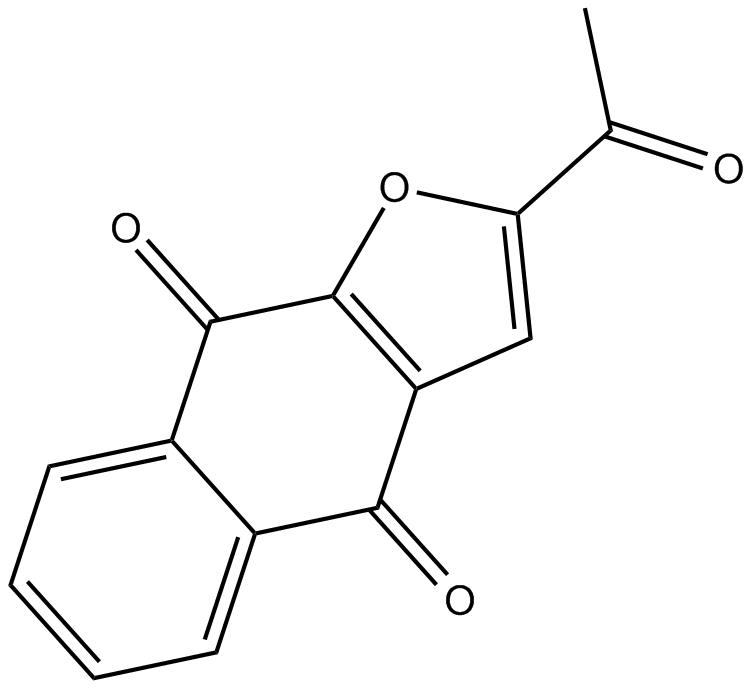
Cas No.: 83280-65-3
Sample solution is provided at 25 µL, 10mM.
_1-3.$$$39978408@51.jpg');)
_1-9.$$$38538795@65.jpg');)
_1-9.$$$39112701@51.jpg');)
_1-7.$$$37316672@70.jpg');)
_366-372.$$$36198801@70.jpg');)
.$$$38565142@65.jpg');)
_1867-1883.$$$33248023@67.jpg');)
_eads6055.$$$39977546@45.jpg');)
_eadm9805.$$$40080571@45.jpg');)
_eadj3020.$$$39666821@45.jpg');)
_1-20.$$$39757301@28.jpg');)
_1-24.$$$38898113@28.jpg');)
_273-287.$$$36806353@46.jpg');)
_1-16.$$$37156877@44.jpg');)
_1-19.$$$37460805@44.jpg');)
_1291-1307.$$$34518654@46.jpg');)
Target: Signal transducer and activator of transcription 3 (Stat3)
IC50: 0.395 μM (Bulk cells), 0.142 μM (Cancer stem cells)
Napabucasin, also named (BBI608), is an orally available small molecule by the ability to inhibit gene transcription of STAT3 and cancer stemness properties and suppresses spherogenesis or kills stemnesshigh cancer cells isolated from several kinds of cancer types [1]. Stat3 is critically important for maintaining cancer stemness.
In vitro: Napabucasin (1 μmol/L) not only decreased cell viability, migration, colony formation, and survival with cell cycle arrest, and increased cell apoptosis and sensitivity to docetaxel, but also obviously blocked PrCSCs sphere formation and killed them in vitro [1]. Napabucasin (1, and 2 μmol/L) decreased the expressions of stemness markers such as Nanog, Klf4, survivin, C-myc, and β-catenin [1].
In vivo: Napabucasin (40 mg/kg, i.p. injection) inhibited tumor growth on prostate cancer (PCa) mouse xenograft models, the PC-3 cells or 22RV1 cells were inoculated into nude mice. In addition, Napabucasin suppressed the self-renewal of stemness-high prostate cancer (PCa) cells in vivo [1]. Moreover, Napabucasin (20 mg/kg, i.p. injection) effectively blocked cancer relapse and metastasis in xenografted human cancers including PaCa-2 human pancreatic cancer and HT29 human colon cancer [2].
References:
1. Zhang Y, Jin Z, Zhou H, Ou X, Xu Y, Li H, et al. Suppression of prostate cancer progression by cancer cell stemness inhibitor napabucasin. Cancer Med. 2016;5(6):1251-8.
2. Li Y, Rogoff HA, Keates S, Gao Y, Murikipudi S, Mikule K, et al. Suppression of cancer relapse and metastasis by inhibiting cancer stemness. Proc Natl Acad Sci U S A. 2015;112(6):1839-44.
| Cell experiment [1]: | |
|
Cell lines |
PCa cell lines (22RV1and PC-3) |
|
Preparation method |
Soluble in DMSO. General tips for obtaining a higher concentration: Please warm the tube at 37 ℃ for 10 minutes and/or shake it in the ultrasonic bath for a while. Stock solution can be stored below -20℃ for several months. |
|
Reacting condition |
1 μmol/L, 48, 72, 96, and 120 h |
|
Applications |
In PCa cell lines PC-3 and 22RV1, Napabucasin (1 μM) inhibited cell proliferation, cell motility, cell survival, colony formation ability and induced cell apoptosis. Napabucasin increased the sensitivity of PCa cells to Docetaxel. Napabucasin treatment decreased the stemness-high cancer cells in PC-3 and 22RV1 cells. Napabucasin obviously inhibited both the SP cells from 22RV1 cells and CD133+/CD44+ cells from PC-3 cells as well as spheres from PC-3 and 22RV1 cells. In PC-3 stemness-high cancer cells, Napabucasin significantly decreased mRNA expression of Nanog, Klf4, survivin, and β-catenin. |
| Animal experiment [1]: | |
|
Animal models |
Immunodeficient nude mouse bearing PC-3 cells or 22RV1 cells |
|
Dosage form |
Intraperitoneal injection, 40 mg/kg, every 3 days |
|
Application |
Napabucasin significantly suppressed the tumor growth on prostate cancer (PCa) mouse xenograft models. Treatment with napabucasin resulted in inhibition of spherogenesis with numbers of spheres significantly decreased. |
|
Other notes |
Please test the solubility of all compounds indoor, and the actual solubility may slightly differ with the theoretical value. This is caused by an experimental system error and it is normal. |
|
References: [1]. Zhang Y, Jin Z, Zhou H, et al. Suppression of prostate cancer progression by cancer cell stemness inhibitor napabucasin[J]. Cancer medicine, 2016, 5(6): 1251-1258. | |
| Cas No. | 83280-65-3 | SDF | |
| Synonymes | BBI 608 | ||
| Chemical Name | 2-acetylnaphtho[2,3-b]furan-4,9-dione | ||
| Canonical SMILES | CC(C(O1)=CC2=C1C(C3=CC=CC=C3C2=O)=O)=O | ||
| Formula | C14H8O4 | M.Wt | 240.21 |
| Solubility | ≥ 8.7mg/mL in DMSO | Storage | Store at -20°C |
| General tips | Please select the appropriate solvent to prepare the stock solution according to the
solubility of the product in different solvents; once the solution is prepared, please store it in
separate packages to avoid product failure caused by repeated freezing and thawing.Storage method
and period of the stock solution: When stored at -80°C, please use it within 6 months; when stored
at -20°C, please use it within 1 month. To increase solubility, heat the tube to 37°C and then oscillate in an ultrasonic bath for some time. |
||
| Shipping Condition | Evaluation sample solution: shipped with blue ice. All other sizes available: with RT, or with Blue Ice upon request. | ||
| Prepare stock solution | |||

|
1 mg | 5 mg | 10 mg |
| 1 mM | 4.163 mL | 20.8151 mL | 41.6302 mL |
| 5 mM | 832.6 μL | 4.163 mL | 8.326 mL |
| 10 mM | 416.3 μL | 2.0815 mL | 4.163 mL |
Step 1: Enter information below (Recommended: An additional animal making an allowance for loss during the experiment)
 g
μL
g
μL
Step 2: Enter the in vivo formulation (This is only the calculator, not formulation. Please contact us first if there is no in vivo formulation at the solubility Section.)
Calculation results:
Working concentration: mg/ml;
Method for preparing DMSO master liquid: mg drug pre-dissolved in μL DMSO ( Master liquid concentration mg/mL, Please contact us first if the concentration exceeds the DMSO solubility of the batch of drug. )
Method for preparing in vivo formulation: Take μL DMSO master liquid, next addμL PEG300, mix and clarify, next addμL Tween 80, mix and clarify, next add μL saline, mix and clarify.
Method for preparing in vivo formulation: Take μL DMSO master liquid, next add μL Corn oil, mix and clarify.
Note: 1. Please make sure the liquid is clear before adding the next solvent.
2. Be sure to add the solvent(s) in order. You must ensure that the solution obtained, in the previous addition, is a clear solution before proceeding to add the next solvent. Physical methods such as vortex, ultrasound or hot water bath can be used to aid dissolving.
3. All of the above co-solvents are available for purchase on the GlpBio website.
Quality Control & SDS
- View current batch:
- Purity: >99.00% Appearance: A solid
- COA (Certificate of Analysis)
- SDS (Safety Data Sheet)
- Datasheet
Average Rating: 5 (Based on Reviews and 35 reference(s) in Google Scholar.)