

Retro-2 (Synonyms: RN 1-001) |
Catalog No.GC18485
 One-Click Copy Product Info
|

Retro-2 est un puissant inhibiteur de l'infection par l'ebolavirus (EBOV) avec une valeur d'EC50 de 12.2μM.
Products are for research use only. Not for human use. We do not sell to patients.
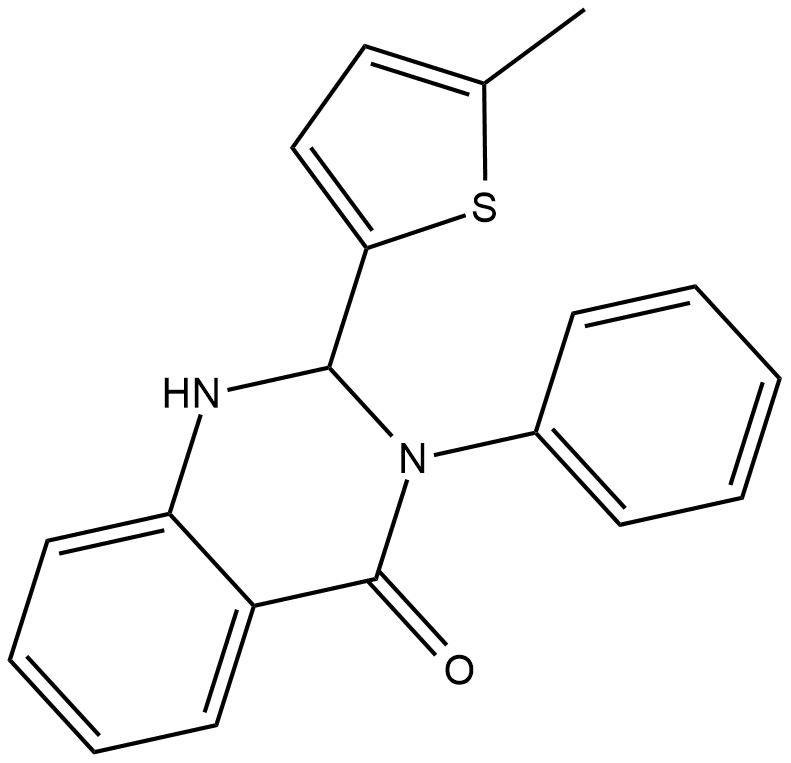
Cas No.: 1429192-00-6
Sample solution is provided at 25 µL, 10mM.
_1-3.$$$39978408@51.jpg');)
_1-9.$$$38538795@65.jpg');)
_1-9.$$$39112701@51.jpg');)
_1-7.$$$37316672@70.jpg');)
_366-372.$$$36198801@70.jpg');)
.$$$38565142@65.jpg');)
_1867-1883.$$$33248023@67.jpg');)
_eads6055.$$$39977546@45.jpg');)
_eadm9805.$$$40080571@45.jpg');)
_eadj3020.$$$39666821@45.jpg');)
_1-20.$$$39757301@28.jpg');)
_1-24.$$$38898113@28.jpg');)
_273-287.$$$36806353@46.jpg');)
_1-16.$$$37156877@44.jpg');)
_1-19.$$$37460805@44.jpg');)
_1291-1307.$$$34518654@46.jpg');)
Retro-2 est un puissant inhibiteur de l'infection par l'ebolavirus (EBOV) avec une valeur d'EC50 de 12.2μM[1]. Retro-2 protège les cellules contre la ricine et la toxine Shiga en bloquant le transport rétrograde des toxines à l'interface endosomes précoces/réseau trans-golgien (TGN)[2]. Retro-2 a été largement utilisé pour inhiber la réplication du SARS-CoV-2 et pour modifier la structure de l'appareil de Golgi[3].
In vitro, un prétraitement avec 20μM de Retro-2 pendant 4 heures a protégé les cellules RAW264.7 contre la mort induite par la toxine ricine et a restauré la fonction de synthèse protéique[4]. After 24 heures de traitement avec 10μM de Retro-2, la localisation subcellulaire de la protéine Syntaxine 5 dans les cellules HeLa a été altérée, et l'abondance de la Syntaxine 5 localisée dans l'appareil de Golgi a diminué[5]. Un traitement avec 5μM de Retro-2 pendant 4 heures a induit l'autophagie dans des cellules HeLa exprimant la GFP-LC3, accompagnée d'une augmentation significative du nombre de grosses vésicules[6].
In vivo, une injection unique de Retro-2 (2.5μl; 20μM) dans le gyrus denté de souris pendant 6 heures a augmenté l'activité de génération d'Aβ42 dans le tissu cérébral des souris[7]. Un traitement par injection intrapéritonéale avec une dose unique de 200mg/kg de Retro-2 a protégé les souris contre une intoxication par la ricine et a prolongé leur survie[8].
References:
[1] Shtanko O, Sakurai Y, Reyes A N, et al. Retro-2 and its dihydroquinazolinone derivatives inhibit filovirus infection[J]. Antiviral research, 2018, 149: 154-163.
[2] Gupta N, Pons V, Noel R, et al. (S)-N-methyldihydroquinazolinones are the active enantiomers of Retro-2 derived compounds against toxins[J]. ACS medicinal chemistry letters, 2014, 5(1): 94-97.
[3] Yue X, Gim B, Zhu L, et al. Retro-2 alters Golgi structure[J]. Scientific Reports, 2022, 12(1): 14975.
[4] Jiao Z, Ke Y, Li S, et al. Pretreatment with retro‐2 protects cells from death caused by ricin toxin by retaining the capacity of protein synthesis[J]. Journal of Applied Toxicology, 2020, 40(10): 1440-1450.
[5] Morgens D W, Chan C, Kane A J, et al. Retro-2 protects cells from ricin toxicity by inhibiting ASNA1-mediated ER targeting and insertion of tail-anchored proteins[J]. Elife, 2019, 8: e48434.
[6] Nicolas V, Lievin-Le Moal V. Small trafficking inhibitor retro-2 disrupts the microtubule-dependent trafficking of autophagic vacuoles[J]. Frontiers in Cell and Developmental Biology, 2020, 8: 464.
[7] Kanatsu K, Hori Y, Ebinuma I, et al. Retrograde transport of γ‐secretase from endosomes to the trans‐Golgi network regulates Aβ42 production[J]. Journal of neurochemistry, 2018, 147(1): 110-123.
[8] Stechmann B, Bai S K, Gobbo E, et al. Inhibition of retrograde transport protects mice from lethal ricin challenge[J]. Cell, 2010, 141(2): 231-242.
| Expériences cellulaires [1]: | |
Lignées cellulaires | Les cellules RAW264.7 |
Méthode de préparation | Les cellules RAW264.7 ont été cultivées dans du milieu DMEM contenant 10% de sérum foetal de bovin, de la pénicilline (100U/ml) et de la streptomycine (100μg/ml). Les cellules ont été cultivées dans un environnement humidifié à 37°C et sous 5% de CO2. Les cellules RAW264.7 ont été ensemencées à une densité de 1.2×10⁴ cellules par puits dans une plaque à 96 puits, et 100μl de milieu ont été ajoutés dans chaque puits. Les cellules ont été cultivées pendant 24 heures. A 37°C, différentes concentrations de Retro-2 (10, 20, 30 et 40μM) ont été appliquées pendant 4 heures. En présence continue de Retro-2, les cellules ont été traitées avec 200ng/ml de toxine ricine. Après le traitement, la viabilité cellulaire a été détectée. |
Conditions de réaction | 10, 20, 30 et 40μM; 4h |
Domaines d'application | Le traitement à Retro-2 a augmenté la viabilité des cellules RAW264.7 exposées à la toxine ricine de manière dose-dépendante. |
| Expériences animales [2]: | |
Modèles animaux | Des souris femelles Balb/c |
Méthode de préparation | Des souris femelles Balb/c, exemptes d'agents pathogènes spécifiques (SPF) et âgées de six semaines, ont été hébergées sous un cycle lumineux de 12 heures/obscurité de 12 heures et ont eu un accès libre à une alimentation standard. Une heure avant l'administration intranasale de ricine, les souris ont été réparties en groupes. Le groupe témoin a reçu une injection intrapéritonéale de 500 μl de sérum physiologique stérile (NaCl à 0.9% ), tandis que le groupe expérimental a reçu une injection intrapéritonéale d'une dose unique de 200mg/kg de Retro-2. Les taux de survie des souris ont ensuite été analysés. |
Forme de dosage | 200mg/kg en une seule administration; i.p. |
Domaines d'application | Le traitement à Retro-2 a protégé les souris contre l'intoxication par la ricine et a prolongé leur survie. |
References: | |
| Cas No. | 1429192-00-6 | SDF | |
| Synonymes | RN 1-001 | ||
| Chemical Name | 2,3-dihydro-2-(5-methyl-2-thienyl)-3-phenyl-4(1H)-quinazolinone | ||
| Canonical SMILES | O=C1C2=CC=CC=C2NC(C3=CC=C(C)S3)N1C4=CC=CC=C4 | ||
| Formula | C19H16N2OS | M.Wt | 320.4 |
| Solubility | DMSO : ≥ 125 mg/mL (390.13 mM);Water : < 0.1 mg/mL (insoluble) | Storage | Store at -20°C, protect from light |
| General tips | Please select the appropriate solvent to prepare the stock solution according to the
solubility of the product in different solvents; once the solution is prepared, please store it in
separate packages to avoid product failure caused by repeated freezing and thawing.Storage method
and period of the stock solution: When stored at -80°C, please use it within 6 months; when stored
at -20°C, please use it within 1 month. To increase solubility, heat the tube to 37°C and then oscillate in an ultrasonic bath for some time. |
||
| Shipping Condition | Evaluation sample solution: shipped with blue ice. All other sizes available: with RT, or with Blue Ice upon request. | ||
| Prepare stock solution | |||

|
1 mg | 5 mg | 10 mg |
| 1 mM | 3.1211 mL | 15.6055 mL | 31.211 mL |
| 5 mM | 624.2 μL | 3.1211 mL | 6.2422 mL |
| 10 mM | 312.1 μL | 1.5605 mL | 3.1211 mL |
Step 1: Enter information below (Recommended: An additional animal making an allowance for loss during the experiment)
 g
μL
g
μL
Step 2: Enter the in vivo formulation (This is only the calculator, not formulation. Please contact us first if there is no in vivo formulation at the solubility Section.)
Calculation results:
Working concentration: mg/ml;
Method for preparing DMSO master liquid: mg drug pre-dissolved in μL DMSO ( Master liquid concentration mg/mL, Please contact us first if the concentration exceeds the DMSO solubility of the batch of drug. )
Method for preparing in vivo formulation: Take μL DMSO master liquid, next addμL PEG300, mix and clarify, next addμL Tween 80, mix and clarify, next add μL saline, mix and clarify.
Method for preparing in vivo formulation: Take μL DMSO master liquid, next add μL Corn oil, mix and clarify.
Note: 1. Please make sure the liquid is clear before adding the next solvent.
2. Be sure to add the solvent(s) in order. You must ensure that the solution obtained, in the previous addition, is a clear solution before proceeding to add the next solvent. Physical methods such as vortex, ultrasound or hot water bath can be used to aid dissolving.
3. All of the above co-solvents are available for purchase on the GlpBio website.
Quality Control & SDS
- View current batch:
- Purity: >98.00% Appearance: A solid
- COA (Certificate of Analysis)
- SDS (Safety Data Sheet)
- Datasheet
Average Rating: 5 (Based on Reviews and 16 reference(s) in Google Scholar.)