

Retro-2 (Synonyms: RN 1-001) |
Katalog-Nr.GC18485
 One-Click Copy Product Info
|

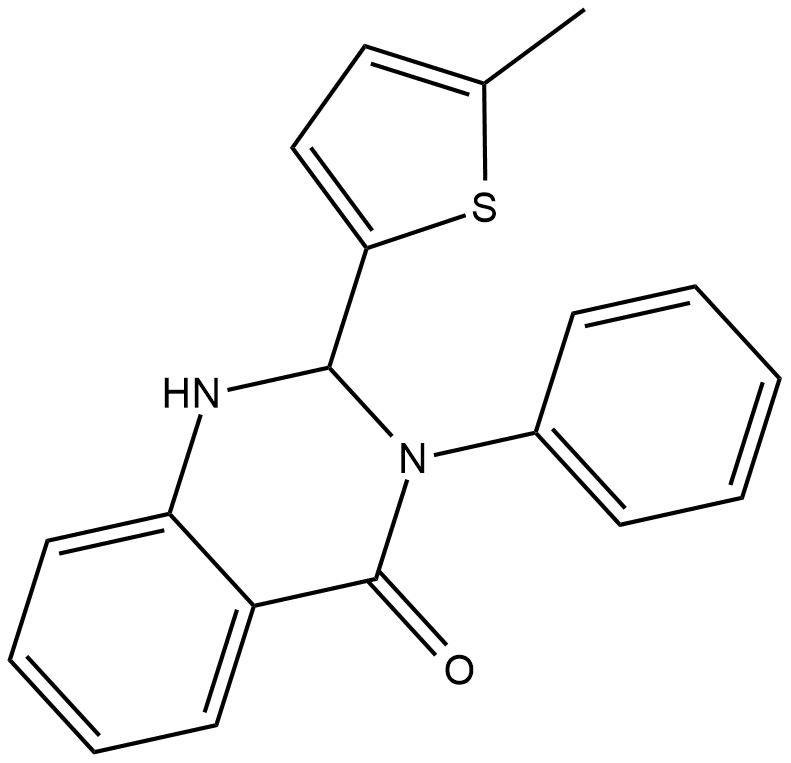
Retro-2 (RN 1-001) ist ein Dihydrochinazolinon (DHQZ)-Hemmer des retrograden Handels.
Products are for research use only. Not for human use. We do not sell to patients.
Cas No.: 1429192-00-6
Sample solution is provided at 25 µL, 10mM.
_1-3.$$$39978408@51.jpg');)
_1-9.$$$38538795@65.jpg');)
_1-9.$$$39112701@51.jpg');)
_1-7.$$$37316672@70.jpg');)
_366-372.$$$36198801@70.jpg');)
.$$$38565142@65.jpg');)
_1867-1883.$$$33248023@67.jpg');)
_eads6055.$$$39977546@45.jpg');)
_eadm9805.$$$40080571@45.jpg');)
_eadj3020.$$$39666821@45.jpg');)
_1-20.$$$39757301@28.jpg');)
_1-24.$$$38898113@28.jpg');)
_273-287.$$$36806353@46.jpg');)
_1-16.$$$37156877@44.jpg');)
_1-19.$$$37460805@44.jpg');)
_1291-1307.$$$34518654@46.jpg');)
Retro-2 is a potent ebolavirus (EBOV) infection inhibitor with an EC50 value of 12.2μM [1]. Retro-2 protects cells against ricin and Shiga toxin by blocking retrograde toxin transport at the early endosomes-TGN interface [2]. Retro-2 has been widely used to inhibit the replication of SARS-CoV-2 and to modify the Golgi structure[3].
In vitro, Retro-2 pretreatment at 20μM for 4 hours protected RAW264.7 cells from death caused by ricin toxin and restored protein synthesis function[4]. After 24 hours of treatment with 10μM Retro-2, the subcellular localization of Syntaxin 5 protein in HeLa cells was altered, and the abundance of Syntaxin 5 localized in the Golgi apparatus was decreased[5]. Treatment with 5μM Retro-2 for 4 hours induced autophagy in HeLa cells expressing GFP-LC3, accompanied by a significant increase in the number of large vesicles[6].
In vivo, Retro-2 (2.5μl; 20μM) was injected into the dentate gyrus of mice at a single dosage for 6 hours increased the generation activity of Aβ42 in the brain tissue of mice[7]. Retro-2 treatment via intraperitoneal injection at a single dose of 200mg/kg protected mice against intoxication by ricin and prolonged the survival of the mice[8].
References:
[1] Shtanko O, Sakurai Y, Reyes A N, et al. Retro-2 and its dihydroquinazolinone derivatives inhibit filovirus infection[J]. Antiviral research, 2018, 149: 154-163.
[2] Gupta N, Pons V, Noel R, et al. (S)-N-methyldihydroquinazolinones are the active enantiomers of Retro-2 derived compounds against toxins[J]. ACS medicinal chemistry letters, 2014, 5(1): 94-97.
[3] Yue X, Gim B, Zhu L, et al. Retro-2 alters Golgi structure[J]. Scientific Reports, 2022, 12(1): 14975.
[4] Jiao Z, Ke Y, Li S, et al. Pretreatment with retro‐2 protects cells from death caused by ricin toxin by retaining the capacity of protein synthesis[J]. Journal of Applied Toxicology, 2020, 40(10): 1440-1450.
[5] Morgens D W, Chan C, Kane A J, et al. Retro-2 protects cells from ricin toxicity by inhibiting ASNA1-mediated ER targeting and insertion of tail-anchored proteins[J]. Elife, 2019, 8: e48434.
[6] Nicolas V, Lievin-Le Moal V. Small trafficking inhibitor retro-2 disrupts the microtubule-dependent trafficking of autophagic vacuoles[J]. Frontiers in Cell and Developmental Biology, 2020, 8: 464.
[7] Kanatsu K, Hori Y, Ebinuma I, et al. Retrograde transport of γ‐secretase from endosomes to the trans‐Golgi network regulates Aβ42 production[J]. Journal of neurochemistry, 2018, 147(1): 110-123.
[8] Stechmann B, Bai S K, Gobbo E, et al. Inhibition of retrograde transport protects mice from lethal ricin challenge[J]. Cell, 2010, 141(2): 231-242.
| Cell experiment [1]: | |
Cell lines | RAW264.7 cells |
Preparation Method | RAW264.7 cells were cultured in DMEM medium containing 10% fetal bovine serum, penicillin (100U/ml), and streptomycin (100μg/ml). The cells were cultured in a humidified environment at 37°C and 5% CO2. RAW264.7 cells were seeded at a density of 1.2×10⁴ cells per well in a 96-well plate, and 100μl of the medium was added to each well. The cells were cultured for 24 hours. At 37°C, different concentrations of Retro-2 (10, 20, 30, and 40μM) were treated for 4h. In the presence of Retro-2 continuously, cells were treated with 200ng/ml ricin toxin. After the treatment, cell viability was detected. |
Reaction Conditions | 10, 20, 30, and 40μM; 4h |
Applications | Retro-2 treatment increased the viability of RAW264.7 cells challenged with ricin toxin in a dose-dependent manner. |
| Animal experiment [2]: | |
Animal models | Female Balb/c mice |
Preparation Method | Six-week-old specific-pathogen-free (SPF) female Balb/c mice were housed under a 12-hour light/12-hour dark cycle and were allowed to freely access standard feed. One hour before intranasal administration of ricin, the mice were grouped. The control group was intraperitoneally injected with 500μl of sterile normal saline (0.9% NaCl), while the experimental group was intraperitoneally injected with a single dose of 200mg/kg Retro-2. The survival rates of the mice were then analyzed. |
Dosage form | 200mg/kg for once; i.p. |
Applications | Retro-2 treatment protected mice against intoxication by ricin and prolonged the survival of the mice. |
References: | |
| Cas No. | 1429192-00-6 | SDF | |
| Überlieferungen | RN 1-001 | ||
| Chemical Name | 2,3-dihydro-2-(5-methyl-2-thienyl)-3-phenyl-4(1H)-quinazolinone | ||
| Canonical SMILES | O=C1C2=CC=CC=C2NC(C3=CC=C(C)S3)N1C4=CC=CC=C4 | ||
| Formula | C19H16N2OS | M.Wt | 320.4 |
| Löslichkeit | DMSO : ≥ 125 mg/mL (390.13 mM);Water : < 0.1 mg/mL (insoluble) | Storage | Store at -20°C, protect from light |
| General tips | Please select the appropriate solvent to prepare the stock solution according to the
solubility of the product in different solvents; once the solution is prepared, please store it in
separate packages to avoid product failure caused by repeated freezing and thawing.Storage method
and period of the stock solution: When stored at -80°C, please use it within 6 months; when stored
at -20°C, please use it within 1 month. To increase solubility, heat the tube to 37°C and then oscillate in an ultrasonic bath for some time. |
||
| Shipping Condition | Evaluation sample solution: shipped with blue ice. All other sizes available: with RT, or with Blue Ice upon request. | ||
| Prepare stock solution | |||

|
1 mg | 5 mg | 10 mg |
| 1 mM | 3.1211 mL | 15.6055 mL | 31.211 mL |
| 5 mM | 624.2 μL | 3.1211 mL | 6.2422 mL |
| 10 mM | 312.1 μL | 1.5605 mL | 3.1211 mL |
Step 1: Enter information below (Recommended: An additional animal making an allowance for loss during the experiment)
 g
μL
g
μL
Step 2: Enter the in vivo formulation (This is only the calculator, not formulation. Please contact us first if there is no in vivo formulation at the solubility Section.)
Calculation results:
Working concentration: mg/ml;
Method for preparing DMSO master liquid: mg drug pre-dissolved in μL DMSO ( Master liquid concentration mg/mL, Please contact us first if the concentration exceeds the DMSO solubility of the batch of drug. )
Method for preparing in vivo formulation: Take μL DMSO master liquid, next addμL PEG300, mix and clarify, next addμL Tween 80, mix and clarify, next add μL saline, mix and clarify.
Method for preparing in vivo formulation: Take μL DMSO master liquid, next add μL Corn oil, mix and clarify.
Note: 1. Please make sure the liquid is clear before adding the next solvent.
2. Be sure to add the solvent(s) in order. You must ensure that the solution obtained, in the previous addition, is a clear solution before proceeding to add the next solvent. Physical methods such as vortex, ultrasound or hot water bath can be used to aid dissolving.
3. All of the above co-solvents are available for purchase on the GlpBio website.
Quality Control & SDS
- View current batch:
- Purity: >98.00% Appearance: A solid
- COA (Certificate of Analysis)
- SDS (Safety Data Sheet)
- Datasheet
Average Rating: 5 (Based on Reviews and 16 reference(s) in Google Scholar.)