

YM155 (Synonyms: Sepantronium bromide) |
Catalog No.GC13107
 One-Click Copy Product Info
|

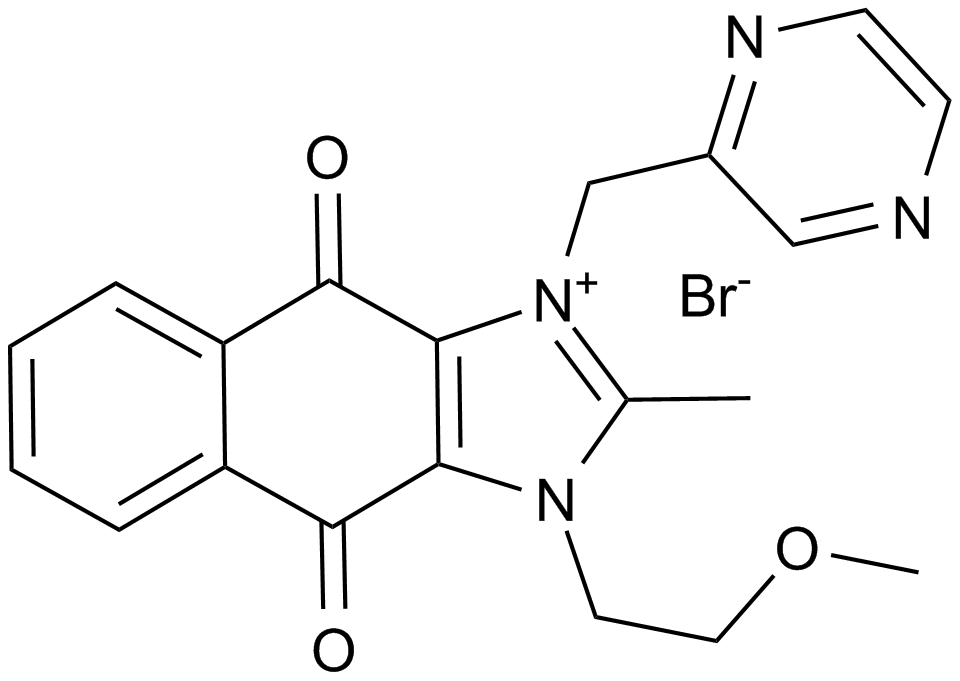
YM155, un petit composé à base d'imidazolium, inhibe fortement l'activité du promoteur de la survivine, sa valeur d'IC50 est 0,54nM.
Products are for research use only. Not for human use. We do not sell to patients.
Cas No.: 781661-94-7
Sample solution is provided at 25 µL, 10mM.
_1-3.$$$39978408@51.jpg');)
_1-9.$$$38538795@65.jpg');)
_1-9.$$$39112701@51.jpg');)
_1-7.$$$37316672@70.jpg');)
_366-372.$$$36198801@70.jpg');)
.$$$38565142@65.jpg');)
_1867-1883.$$$33248023@67.jpg');)
_eads6055.$$$39977546@45.jpg');)
_eadm9805.$$$40080571@45.jpg');)
_eadj3020.$$$39666821@45.jpg');)
_1-20.$$$39757301@28.jpg');)
_1-24.$$$38898113@28.jpg');)
_273-287.$$$36806353@46.jpg');)
_1-16.$$$37156877@44.jpg');)
_1-19.$$$37460805@44.jpg');)
_1291-1307.$$$34518654@46.jpg');)
YM155, un petit composé à base d'imidazolium, inhibe fortement l'activité du promoteur de la survivine, sa valeur d'IC50 est 0,54nM [1]. YM155 peut supprimer l'expression de la survivine en perturbant la liaison de SP1 au promoteur central de la survivine et au complexe ILF3–p54/nrb[2]. YM155 est largement utilisé pour induire l'apoptose des cellules tumorales et favoriser la régression tumorale dans diverses modèles cellulaires et animaux[3].
Le traitement in vitro avec YM155 pendant 120 heures a significativement inhibé la prolifération des cellules UKF-NB-3 et UKF-NB-6, ses valeurs d'IC50 sont respectivement 0.49 et 0.65nM[4]. Le traitement avec YM155 à 40nM aux cellules H1299 pendant 24h a significativement induit la mort cellulaire et favorisé le dysfonctionnement mitochondrial, entraînant une réduction des intermédiaires du cycle de l'acide tricarboxylique (TCA)[5]. Le traitement avec 10nM de YM155 pendant 24 heures a considérablement inhibé la viabilité des cellules PANC-1 et induit une régulation négative de PI3K, p-ERK, et p-STAT3 dans les cellules PANC-1[6].
Le traitement in vivo avec YM155 via injection sous-cutanée à la dose de 2mg/kg/jour pendant 21 jours a significativement réduit la croissance tumorale dans le modèle de xénogreffe de cellules SH-SY5Y chez les rats, sans affecter le poids corporel[7]. Une perfusion sous-cutanée continue de YM155 (5mg/kg/jour) pendant 21 jours a considérablement inhibé le développement de l'ascite chez les rats porteurs de xénogreffes de lymphone à épanchement primaire (PEL)[8].
References:
[1] Nakahara T, Takeuchi M, Kinoyama I, et al. YM155, a novel small-molecule survivin suppressant, induces regression of established human hormone-refractory prostate tumor xenografts[J]. Cancer research, 2007, 67(17): 8014-8021.
[2] Rauch A, Hennig D, Schäfer C, et al. Survivin and YM155: how faithful is the liaison?[J]. Biochimica et Biophysica Acta (BBA)-Reviews on Cancer, 2014, 1845(2): 202-220.
[3] Tolcher A W, Quinn D I, Ferrari A, et al. A phase II study of YM155, a novel small-molecule suppressor of survivin, in castration-resistant taxane-pretreated prostate cancer[J]. Annals of oncology, 2012, 23(4): 968-973.
[4] Voges Y, Michaelis M, Rothweiler F, et al. Effects of YM155 on survivin levels and viability in neuroblastoma cells with acquired drug resistance[J]. Cell death & disease, 2016, 7(10): e2410-e2410.
[5] Mondal A, Jia D, Bhatt V, et al. Ym155 localizes to the mitochondria leading to mitochondria dysfunction and activation of AMPK that inhibits BMP signaling in lung cancer cells[J]. Scientific reports, 2022, 12(1): 13135.
[6] Na Y S, Yang S J, Kim S M, et al. YM155 induces EGFR suppression in pancreatic cancer cells[J]. PloS one, 2012, 7(6): e38625.
[7] Li X, Yang F, He N, et al. YM155 inhibits neuroblastoma growth through degradation of MYCN: A new role as a USP7 inhibitor[J]. European Journal of Pharmaceutical Sciences, 2023, 181: 106343.
[8] Kojima Y, Hayakawa F, Morishita T, et al. YM155 induces apoptosis through proteasome-dependent degradation of MCL-1 in primary effusion lymphoma[J]. Pharmacological research, 2017, 120: 242-251.
| Expériences cellulaires [1]: | |
Lignées cellulaires | Cellules PC-3 |
Méthode de préparation | Les cellules PC-3 ont été cultivées dans un milieu DMEM complété par 10% de sérum bovin foetal inactivé par la chaleur, puis placées dans une incubatrice humide à 37°C avec 5% CO2. Après 48 heures de culture en présence de YM155 (1, 10, 100, et 1000nM), les cellules PC-3 ont été récoltées par digestion trypsique et centrifugation, ensuite, resuspendues dans le milieu DMEM. La suspension cellulaire a été diluée dans un volume égal de bleu trypan (solution de travail à 0,4%). Les cellules vivantes (non-colorées) et mortes (colorées) ont été comptées à l'aide d'un compteur de cellules sanguines. |
Conditions de réaction | 1, 10, 100, et 1000nM; 48h |
Domaines d'application | YM155 a considérablement inhibé la viabilité des cellules PANC-1 de manière dose-dépendante. |
| Expériences animales [2]: | |
Modèles animaux | Rats féminins BALB/c-nu |
Méthode de préparation | Les rats féminins BALB/c-nu âgés de six semaines ont été maintenus dans un environnement stérile standard. Les cellules SH-SY5Y (2×10⁶) ont été collectées, mélangées à un volume égal de Matrigel, puis injectées par voie sous-cutanée dans le flanc des rats. Après la formation de la tumeur, les rats ont été aléatoirement divisés en deux groupes : le groupe témoin (Saline) ou le groupe YM155. YM155 a été injecté en continu par voie sous-cutanée à la dose de 2mg/kg/jour pendant 21 jours à l'aide d'une pompe micro-osmotique. Le diamètre de la tumeur a été mesuré deux fois par semaine, et le volume tumoral a été calculé comme le produit de longueur × largeur2×0.5. |
Forme de dosage | 2mg/kg/jour pendant 21 jours; s.c. |
Domaines d'application | Le traitement avec YM155 a significativement réduit la croissance tumorale dans le modèle de xénogreffe de cellules SH-SY5Y chez les rats. |
References: | |
| Cas No. | 781661-94-7 | SDF | |
| Synonymes | Sepantronium bromide | ||
| Chemical Name | 1-(2-methoxyethyl)-2-methyl-3-(pyrazin-2-ylmethyl)benzo[f]benzimidazol-3-ium-4,9-dione;bromide | ||
| Canonical SMILES | CC1=[N+](C2=C(N1CCOC)C(=O)C3=CC=CC=C3C2=O)CC4=NC=CN=C4.[Br-] | ||
| Formula | C20H19BrN4O3 | M.Wt | 443.3 |
| Solubility | ≥ 22.15 mg/mL in DMSO, ≥ 13.49 mg/mL in EtOH with ultrasonic, ≥ 96.2 mg/mL in Water with ultrasonic | Storage | Store at -20°C |
| General tips | Please select the appropriate solvent to prepare the stock solution according to the
solubility of the product in different solvents; once the solution is prepared, please store it in
separate packages to avoid product failure caused by repeated freezing and thawing.Storage method
and period of the stock solution: When stored at -80°C, please use it within 6 months; when stored
at -20°C, please use it within 1 month. To increase solubility, heat the tube to 37°C and then oscillate in an ultrasonic bath for some time. |
||
| Shipping Condition | Evaluation sample solution: shipped with blue ice. All other sizes available: with RT, or with Blue Ice upon request. | ||
| Prepare stock solution | |||

|
1 mg | 5 mg | 10 mg |
| 1 mM | 2.2558 mL | 11.279 mL | 22.5581 mL |
| 5 mM | 451.2 μL | 2.2558 mL | 4.5116 mL |
| 10 mM | 225.6 μL | 1.1279 mL | 2.2558 mL |
Step 1: Enter information below (Recommended: An additional animal making an allowance for loss during the experiment)
 g
μL
g
μL
Step 2: Enter the in vivo formulation (This is only the calculator, not formulation. Please contact us first if there is no in vivo formulation at the solubility Section.)
Calculation results:
Working concentration: mg/ml;
Method for preparing DMSO master liquid: mg drug pre-dissolved in μL DMSO ( Master liquid concentration mg/mL, Please contact us first if the concentration exceeds the DMSO solubility of the batch of drug. )
Method for preparing in vivo formulation: Take μL DMSO master liquid, next addμL PEG300, mix and clarify, next addμL Tween 80, mix and clarify, next add μL saline, mix and clarify.
Method for preparing in vivo formulation: Take μL DMSO master liquid, next add μL Corn oil, mix and clarify.
Note: 1. Please make sure the liquid is clear before adding the next solvent.
2. Be sure to add the solvent(s) in order. You must ensure that the solution obtained, in the previous addition, is a clear solution before proceeding to add the next solvent. Physical methods such as vortex, ultrasound or hot water bath can be used to aid dissolving.
3. All of the above co-solvents are available for purchase on the GlpBio website.
Quality Control & SDS
- View current batch:
- Purity: >98.00% Appearance: A solid
- COA (Certificate of Analysis)
- SDS (Safety Data Sheet)
- Datasheet
Average Rating: 5 (Based on Reviews and 30 reference(s) in Google Scholar.)