

Apramycin (Nebramycin II) |
カタログ番号GC32288
 One-Click Copy Product Info
|

Apramycin (Nebramycin II)は動物のアミノグリコシド系抗生物質であり、サルモネラ、大腸菌やその他の感染症の治療に広く使われている。
Products are for research use only. Not for human use. We do not sell to patients.
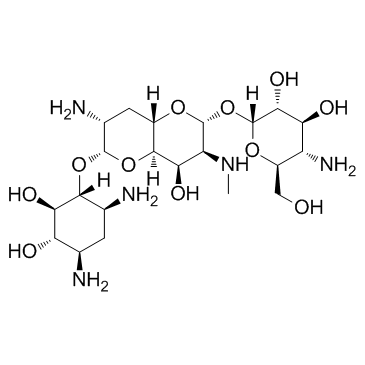
Cas No.: 37321-09-8
Sample solution is provided at 25 µL, 10mM.
_1-3.$$$39978408@51.jpg');)
_1-9.$$$38538795@65.jpg');)
_1-9.$$$39112701@51.jpg');)
_1-7.$$$37316672@70.jpg');)
_366-372.$$$36198801@70.jpg');)
.$$$38565142@65.jpg');)
_1867-1883.$$$33248023@67.jpg');)
_eads6055.$$$39977546@45.jpg');)
_eadm9805.$$$40080571@45.jpg');)
_eadj3020.$$$39666821@45.jpg');)
_1-20.$$$39757301@28.jpg');)
_1-24.$$$38898113@28.jpg');)
_273-287.$$$36806353@46.jpg');)
_1-16.$$$37156877@44.jpg');)
_1-19.$$$37460805@44.jpg');)
_1291-1307.$$$34518654@46.jpg');)
Apramycin (Nebramycin II)は動物のアミノグリコシド系抗生物質であり、サルモネラ、大腸菌やその他の感染症の治療に広く使われている[1]。Apramycinは、強毒性カルバペネム耐性K肺炎菌分離株(アミカシンまたはゲンタマイシンに耐性のあるものを含めて)に対し、強力な体外活性を示した[2]。
Apramycin (50mg/L、一晩中)を選択マーカーとして使い、機能野生型Ompk35またはOmpk36の恢復の選択的分離株を選択した[3]。
グルタミンをApramycin (20mg/kg、腹腔内)とシトルリンと併用した結果、感染されたマウスの体調が著しく改善された[1]。Apramycin (20、80または500mg/kg、皮下)は、好中球減少性マウス大腿部感染モデルで、A. baumannii株のMSRN7465、MSRN1450とFDA-CDC278に対して、劇的な治療効果を示した[4]。
References:
[1] Yong Y, Zhou Y, Liu K, et al. Exogenous citrulline and glutamine contribute to reverse the resistance of Salmonella to apramycin. Frontiers in Microbiology. 2021 Oct 14;12:759170.
[2] Melchiorri D, Rocke T, Alm RA, et al. Addressing urgent priorities in antibiotic development: insights from WHO 2023 antibacterial clinical pipeline analyses. The Lancet Microbe. 2024 Oct 22.
[3] Sun L, Li H, Wang Q, et al. Increased gene expression and copy number of mutated bla KPC lead to high-level ceftazidime/avibactam resistance in Klebsiella pneumoniae. BMC microbiology. 2021 Dec;21:1-0.
[4] Kang AD, Smith KP, Berg AH, et al. Efficacy of apramycin against multidrug-resistant Acinetobacter baumannii in the murine neutropenic thigh model. Antimicrobial agents and chemotherapy. 2018 Apr;62(4):10-128.
| 細胞実験[1]: | |
細胞株 | Klebsiella pneumoniae臨床分離株のコンピテントセル |
準備方法 | 10%のグリセリンを使い、Klebsiella pneumoniae臨床分離株のコンピテントセルを調製した。50μlのエレクトロコンピテントセルと5μlのプラスミドの混合液を、2.5kVでMicroPuler System (Bio-Rad)を使い、2mmの電気穿孔キュベットに移し、電気穿孔した。細胞を、50mg/LのApramycinを含有するLuria-Bertani (LB)寒天に播種した。プレートを37℃で一晩中培養し、PCRとシークエンシングで成功なクローンを識別した。カルバペネマーゼをコードするβ-ラクタマーゼ遺伝子、ESBL関連の遺伝子、そしてプラスミド由来のAmpCβ-ラクタマーゼの存在をPCRで検出を行った。外膜タンパク質遺伝子をPCRで増幅した。PCR増幅産物を配列決定し、BLAST検索を使い、GenBankデータベースで利用可能な配列と比較した。 |
反応条件 | 50mg/L、一晩中 |
アプリケーション | Apramycinを選択マーカーとして使い、機能野生型Ompk35またはOmpk36の恢復の選択的分離株を選択する。 |
| 動物実験 [2]: | |
動物モデル | 好中球減少症マウスアプラマイシン耐性サルモネラ菌感染モデル |
準備方法 | 90匹の健康な雌マウスを10匹ずつ、9つのグループに分けた。グループには、陰性対照群(細菌感染なし)と、陽性対照群(薬物耐性細菌で感染されたマウス、治療はなし)、そして薬物耐性細菌の感染後、それぞれApramycin、シトルリン、グルタミン、Apramycin+シトルリン、Apramycin+グルタミン、またはApramycin+シトルリン+グルタミンで処理された残り7つのグループがある。全ての動物をテストし、実験開始前、サルモネラ・チフィリウムがないことがわかった。80匹のマウスにcyclophosphamideを5日間腹腔内注射し、好中球減少症モデルを建てた。その後、107コロニー形成単位/mlの濃度で、0.1mlのApramycin誘発のSalmonella typhimurium (Apr-R-CICC21484)懸濁液を腹腔内注射した。注射の12時間後、実験グループの中のマウスをApramycinまたはシトルリンとグルタミンを腹腔内注射した。実験に使われたApramycin、シトルリンとグルタミンの用量はそれぞれ、20mg/kg体重(b.w.)、240mg/kg b.w.と200mg/kg b.wであった。処理の24時間後、全てのマウスを安楽死させた。全てのマウスの肝臓、脾臓と血液を、無菌の条件下で採取し、生理食塩水に置いた。各マウスの組織または血液を分別に均質にさせ、生理食塩水で希釈し、異なる栄養寒天プレートに接種した。最後に、各マウスの肝臓、脾臓と血液サンプルの細菌量を計算し、異なる処理スキームの効果を評価した。 |
投与形態 | 20mg/kg、腹腔内注射 |
アプリケーション | グルタミンをApramycinとシトルリンとともに併用した結果、感染されたマウスの体調を著しく改善した。 |
References: | |
| Cas No. | 37321-09-8 | SDF | |
| Canonical SMILES | O[C@H]1[C@](O[C@H](O[C@@]([C@H](C[C@H]2N)N)([H])[C@@H]([C@H]2O)O)[C@H](N)C3)([H])[C@@]3([H])O[C@H](O[C@@]([C@@H]([C@@H](O)[C@@H]4N)O)([H])O[C@@H]4CO)[C@H]1NC | ||
| Formula | C21H41N5O11 | M.Wt | 539.58 |
| 溶解度 | Soluble in DMSO | Storage | Store at -20°C |
| General tips | Please select the appropriate solvent to prepare the stock solution according to the
solubility of the product in different solvents; once the solution is prepared, please store it in
separate packages to avoid product failure caused by repeated freezing and thawing.Storage method
and period of the stock solution: When stored at -80°C, please use it within 6 months; when stored
at -20°C, please use it within 1 month. To increase solubility, heat the tube to 37°C and then oscillate in an ultrasonic bath for some time. |
||
| Shipping Condition | Evaluation sample solution: shipped with blue ice. All other sizes available: with RT, or with Blue Ice upon request. | ||
| Prepare stock solution | |||

|
1 mg | 5 mg | 10 mg |
| 1 mM | 1.8533 mL | 9.2665 mL | 18.5329 mL |
| 5 mM | 370.7 μL | 1.8533 mL | 3.7066 mL |
| 10 mM | 185.3 μL | 926.6 μL | 1.8533 mL |
Step 1: Enter information below (Recommended: An additional animal making an allowance for loss during the experiment)
 g
μL
g
μL
Step 2: Enter the in vivo formulation (This is only the calculator, not formulation. Please contact us first if there is no in vivo formulation at the solubility Section.)
Calculation results:
Working concentration: mg/ml;
Method for preparing DMSO master liquid: mg drug pre-dissolved in μL DMSO ( Master liquid concentration mg/mL, Please contact us first if the concentration exceeds the DMSO solubility of the batch of drug. )
Method for preparing in vivo formulation: Take μL DMSO master liquid, next addμL PEG300, mix and clarify, next addμL Tween 80, mix and clarify, next add μL saline, mix and clarify.
Method for preparing in vivo formulation: Take μL DMSO master liquid, next add μL Corn oil, mix and clarify.
Note: 1. Please make sure the liquid is clear before adding the next solvent.
2. Be sure to add the solvent(s) in order. You must ensure that the solution obtained, in the previous addition, is a clear solution before proceeding to add the next solvent. Physical methods such as vortex, ultrasound or hot water bath can be used to aid dissolving.
3. All of the above co-solvents are available for purchase on the GlpBio website.
Quality Control & SDS
- View current batch:
- Purity: >95.00% Appearance: A solid
- COA (Certificate of Analysis)
- SDS (Safety Data Sheet)
- Datasheet
Average Rating: 5 (Based on Reviews and 24 reference(s) in Google Scholar.)