

Apramycin (Nebramycin II) |
Catalog No.GC32288
 One-Click Copy Product Info
|

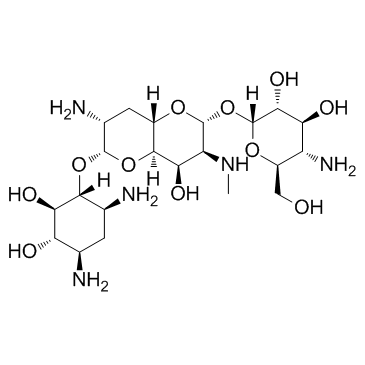
Apramycin (Nebramycin II), an aminoglycoside antibiotic for animals, is widely used to treat Salmonella, Escherichia coli, and other infections.
Products are for research use only. Not for human use. We do not sell to patients.
Cas No.: 37321-09-8
Sample solution is provided at 25 µL, 10mM.
_1-3.$$$39978408@51.jpg');)
_1-9.$$$38538795@65.jpg');)
_1-9.$$$39112701@51.jpg');)
_1-7.$$$37316672@70.jpg');)
_366-372.$$$36198801@70.jpg');)
.$$$38565142@65.jpg');)
_1867-1883.$$$33248023@67.jpg');)
_eads6055.$$$39977546@45.jpg');)
_eadm9805.$$$40080571@45.jpg');)
_eadj3020.$$$39666821@45.jpg');)
_1-20.$$$39757301@28.jpg');)
_1-24.$$$38898113@28.jpg');)
_273-287.$$$36806353@46.jpg');)
_1-16.$$$37156877@44.jpg');)
_1-19.$$$37460805@44.jpg');)
_1291-1307.$$$34518654@46.jpg');)
Apramycin (Nebramycin II), an aminoglycoside antibiotic for animals, is widely used to treat Salmonella, Escherichia coli, and other infections[1]. Apramycin showed potent in-vitro activity against hypervirulent carbapenem-resistant K pneumoniae isolates, including those resistant to amikacin or gentamicin[2].
Apramycin (50mg/L, overnight) was used as a selection marker to successfully select isolates with the restoration of functional wild type Ompk35 or Ompk36[3].
Apramycin (20mg/kg, i.p.) and citrulline combined with glutamine significantly improved the body condition of the infected mice[1]. Apramycin (20, 80, or 500mg/kg, s.c.) demonstrated a dramatic therapeutic effect against A. baumannii strains MSRN7465, MSRN1450 and FDA-CDC278 in neutropenic murine thigh infection model[4].
References:
[1] Yong Y, Zhou Y, Liu K, et al. Exogenous citrulline and glutamine contribute to reverse the resistance of Salmonella to apramycin. Frontiers in Microbiology. 2021 Oct 14;12:759170.
[2] Melchiorri D, Rocke T, Alm RA, et al. Addressing urgent priorities in antibiotic development: insights from WHO 2023 antibacterial clinical pipeline analyses. The Lancet Microbe. 2024 Oct 22.
[3] Sun L, Li H, Wang Q, et al. Increased gene expression and copy number of mutated bla KPC lead to high-level ceftazidime/avibactam resistance in Klebsiella pneumoniae. BMC microbiology. 2021 Dec;21:1-0.
[4] Kang AD, Smith KP, Berg AH, et al. Efficacy of apramycin against multidrug-resistant Acinetobacter baumannii in the murine neutropenic thigh model. Antimicrobial agents and chemotherapy. 2018 Apr;62(4):10-128.
| Cell experiment [1]: | |
Cell lines | The competent cells of Klebsiella pneumoniae clinical isolates |
Preparation Method | The competent cells of Klebsiella pneumoniae clinical isolates were prepared using 10% glycerol. The mixture of 50μl electrocompetent cells and 5μl plasmid was transferred into a 2mm electroporation cuvette and electroporated using MicroPuler System (Bio-Rad) at 2.5kV. The cells were plated onto Luria-Bertani (LB) agar containing Apramycin at 50mg/L. The plates were incubated at 37°C overnight, and the successful clone was identified using PCR and sequencing. PCR detection for the presence of beta-lactamase genes encoding carbapenemases, ESBL associated genes, and plasmid-borne AmpC beta-lactamases were performed. Outer membrane protein genes were amplified by PCR. PCR amplicons were sequenced and compared with sequences available in the GenBank database using BLAST searches. |
Reaction Conditions | 50mg/L, overnight |
Applications | Apramycin was used as a selection marker to successfully select isolates with the restoration of functional wild type Ompk35 or Ompk36. |
| Animal experiment [2]: | |
Animal models | Neutropenia mouse Apramycin-resistant Salmonella strains infection model |
Preparation Method | Ninety healthy female mice were divided into nine groups, with 10 mice in each group. The groups comprised the negative control group without bacterial infection, the positive control group (mice infected with drug-resistant bacteria but without any treatment), and the other seven groups were treated with Apramycin, citrulline, glutamine, Apramycin plus citrulline, Apramycin plus glutamine, or Apramycin plus citrulline plus glutamine, respectively, after infection with drug-resistant bacteria. All animals were tested and found to be Salmonella typhimurium-free before the start of experiments. Eighty mice were intraperitoneally injected with cyclophosphamide for 5 days to establish a neutropenia model. After the establishment of the model, 0.1ml Apramycin-induced Salmonella typhimurium (Apr-R-CICC21484) suspension was injected intraperitoneally at a concentration of 107 colony-forming units/ml. At 12h after infection, the mice in the experimental group were injected intraperitoneally with Apramycin or citrulline and glutamine. The doses of Apramycin, citrulline, and glutamine used in the experiment were 20mg/kg body weight (b.w.), 240mg/kg b.w., and 200mg/kg b.w., respectively. At 24h after treatment, all mice were euthanized. The liver, spleen, and blood of all mice were collected under sterile conditions and placed in saline. The tissue or blood of each mouse was homogenized separately, diluted with saline, and inoculated on different nutrient agar plates. Finally, the bacterial load of each mouse liver, spleen, and a blood sample was calculated to evaluate the effect of different treatment schemes. |
Dosage form | 20mg/kg, i.p. |
Applications | Apramycin and citrulline combined with glutamine significantly improved the body condition of the infected mice. |
References: | |
| Cas No. | 37321-09-8 | SDF | |
| Canonical SMILES | O[C@H]1[C@](O[C@H](O[C@@]([C@H](C[C@H]2N)N)([H])[C@@H]([C@H]2O)O)[C@H](N)C3)([H])[C@@]3([H])O[C@H](O[C@@]([C@@H]([C@@H](O)[C@@H]4N)O)([H])O[C@@H]4CO)[C@H]1NC | ||
| Formula | C21H41N5O11 | M.Wt | 539.58 |
| Solubility | Soluble in DMSO | Storage | Store at -20°C |
| General tips | Please select the appropriate solvent to prepare the stock solution according to the
solubility of the product in different solvents; once the solution is prepared, please store it in
separate packages to avoid product failure caused by repeated freezing and thawing.Storage method
and period of the stock solution: When stored at -80°C, please use it within 6 months; when stored
at -20°C, please use it within 1 month. To increase solubility, heat the tube to 37°C and then oscillate in an ultrasonic bath for some time. |
||
| Shipping Condition | Evaluation sample solution: shipped with blue ice. All other sizes available: with RT, or with Blue Ice upon request. | ||
| Prepare stock solution | |||

|
1 mg | 5 mg | 10 mg |
| 1 mM | 1.8533 mL | 9.2665 mL | 18.5329 mL |
| 5 mM | 370.7 μL | 1.8533 mL | 3.7066 mL |
| 10 mM | 185.3 μL | 926.6 μL | 1.8533 mL |
Step 1: Enter information below (Recommended: An additional animal making an allowance for loss during the experiment)
 g
μL
g
μL
Step 2: Enter the in vivo formulation (This is only the calculator, not formulation. Please contact us first if there is no in vivo formulation at the solubility Section.)
Calculation results:
Working concentration: mg/ml;
Method for preparing DMSO master liquid: mg drug pre-dissolved in μL DMSO ( Master liquid concentration mg/mL, Please contact us first if the concentration exceeds the DMSO solubility of the batch of drug. )
Method for preparing in vivo formulation: Take μL DMSO master liquid, next addμL PEG300, mix and clarify, next addμL Tween 80, mix and clarify, next add μL saline, mix and clarify.
Method for preparing in vivo formulation: Take μL DMSO master liquid, next add μL Corn oil, mix and clarify.
Note: 1. Please make sure the liquid is clear before adding the next solvent.
2. Be sure to add the solvent(s) in order. You must ensure that the solution obtained, in the previous addition, is a clear solution before proceeding to add the next solvent. Physical methods such as vortex, ultrasound or hot water bath can be used to aid dissolving.
3. All of the above co-solvents are available for purchase on the GlpBio website.
Quality Control & SDS
- View current batch:
- Purity: >95.00% Appearance: A solid
- COA (Certificate of Analysis)
- SDS (Safety Data Sheet)
- Datasheet
Average Rating: 5 (Based on Reviews and 24 reference(s) in Google Scholar.)