

ARS-1620 |
カタログ番号GC34055
 One-Click Copy Product Info
|

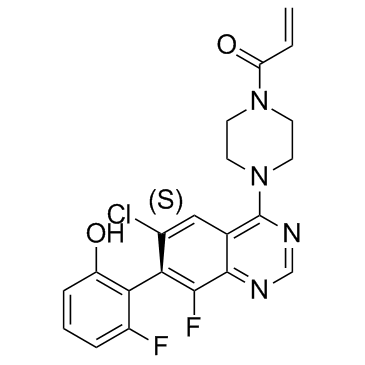
ARS-1620はKRAS p.G12C変異タンパク質の高選択的で、経口活性の阻害剤である。
Products are for research use only. Not for human use. We do not sell to patients.
Cas No.: 1698055-85-4
Sample solution is provided at 25 µL, 10mM.
_1-3.$$$39978408@51.jpg');)
_1-9.$$$38538795@65.jpg');)
_1-9.$$$39112701@51.jpg');)
_1-7.$$$37316672@70.jpg');)
_366-372.$$$36198801@70.jpg');)
.$$$38565142@65.jpg');)
_1867-1883.$$$33248023@67.jpg');)
_eads6055.$$$39977546@45.jpg');)
_eadm9805.$$$40080571@45.jpg');)
_eadj3020.$$$39666821@45.jpg');)
_1-20.$$$39757301@28.jpg');)
_1-24.$$$38898113@28.jpg');)
_273-287.$$$36806353@46.jpg');)
_1-16.$$$37156877@44.jpg');)
_1-19.$$$37460805@44.jpg');)
_1291-1307.$$$34518654@46.jpg');)
ARS-1620はKRAS p.G12C変異タンパク質の高選択的で、経口活性の阻害剤である[1-2]。Switch-IIポケットで、ARS-1620はKRAS G12Cタンパク質のGDP結合型に不可逆的に共有結合し、不活性状態にKRASを固定し、よって下流のシグナル伝達伝導を遮断する。ARS-1620は、KRAS p.G12C変異を持つ非小細胞肺癌、大腸癌、膵臓癌やその他の固形腫瘍の研究に適している[3-4]。
In vitro(体外)実験で、KRAS G12C変異を持ち、様々な薬物感受性を持つ三種類の非小細胞肺癌細胞株(H358、Calu1、H1792)をARS-1620(1µM)で6と24時間処理した。ARS-1620はMAPKとAKTシグナル伝達経路の活性を著しく阻害し、ERBB2/3シグナル伝達経路を活性化した[5]。ARS-1620(0-1µM)で三種類のKRAS G12C変異肺癌細胞株(H23、HOP-62、Calu-1)をも14日間処理した。ARS-1620は、コロニー形成と細胞の増殖を著しく阻害し、mTOR遺伝子mRNAの発現の著しい上方制御を誘発した[6]。
In vivo(体内)実験で、KRAS p.G12C変異を持つヒト非小細胞肺癌細胞(MIA-PaCa2、H358、H2030、H1373、HCC44、LU99A)に由来する皮下異種移植腫瘍を持つマウスに、また、KRAS p.G12C変異を持つ患者由来の異種移植(PDX)モデルのマウスに、ARS-1620(50-400mg/kg;経口投与;毎日一回)を2-3週間投与した。ARS-1620は、腫瘍の成長を著しく阻害し、腫瘍の退縮を促進した[7]。KRAS p.G12C変異を持つPDXモデルのマウスに、ARS-1620(100-200mg/kg;経口投与;3週間、週に5回)は著しい腫瘍成長の阻害と退縮を誘発し、同時に高度のKRAS G12C標的占有率、下流シグナル伝達経路(RAS-GTP、p-ERK、 p-S6)の阻害を起こした[8]。
References:
[1] Li L, Zhao H, Peng X, et al. Discovery of novel Quinazoline-based KRAS G12C inhibitors as potential anticancer agents. Bioorg Med Chem. 2022 Oct 1;71:116962.
[2] Lin X, Ma Q, Chen L, et al. Identifying genes associated with resistance to KRAS G12C inhibitors via machine learning methods. Biochim Biophys Acta Gen Subj. 2023 Dec;1867(12):130484.
[3] Hansen R, Peters U, Babbar A, et al. The reactivity-driven biochemical mechanism of covalent KRASG12C inhibitors. Nat Struct Mol Biol. 2018 Jun;25(6):454-462.
[4] Shankar S, Tien JC, Siebenaler RF, et al. An essential role for Argonaute 2 in EGFR-KRAS signaling in pancreatic cancer development. Nat Commun. 2020 Jun 4;11(1):2817.
[5] Solanki HS, Welsh EA, Fang B, et al. Cell Type-specific Adaptive Signaling Responses to KRASG12C Inhibition. Clin Cancer Res. 2021 May 1;27(9):2533-2548.
[6] Ito M, Miyata Y, Hirano S, et al. Dual inhibition of GTP-bound KRAS and mTOR in lung adenocarcinoma and squamous cell carcinoma harboring KRAS G12C. Cell Commun Signal. 2025 May 11;23(1):220.
[7] Janes MR, Zhang J, Li LS, et al. Targeting KRAS Mutant Cancers with a Covalent G12C-Specific Inhibitor. Cell. 2018 Jan 25;172(3):578-589.e17.
[8] Molina-Arcas M, Moore C, Rana S, et al. Development of combination therapies to maximize the impact of KRAS-G12C inhibitors in lung cancer. Sci Transl Med. 2019 Sep 18;11(510):eaaw7999.
| 細胞実験[1]: | |
細胞株 | H358、H1792とCalu1細胞(KRAS G12C変異を持つヒト非小細胞肺癌細胞株) |
準備方法 | リン酸化プロテオミクス解析のために、H358、H1792とCalu1細胞を1μMのARS-1620で6時間と24時間処理した。遊離のKRAS G12Cペプチドシグナルの著しい減少が示したLC-MRM定量により、標的との結合は確認された。 |
反応条件 | 1μM;6時間と24時間 |
アプリケーション | ARS-1620の処理は、KRAS下流のシグナル伝達を著しく阻害し、その証拠に、MAPK/ERK(p-ERK)のリン酸化が減少し、また一部の株では、AKT(p-AKT)が減少した。 |
| 動物実験 [2]: | |
動物モデル | 無胸腺の雌ヌードマウス(NCr nu/nu)とCD-1マウス |
準備方法 | KRAS p.G12Cを持つヒト癌細胞株(例:MIA-PaCa2、H358、H2030、HCC44、H1373、LU99A)の作製された皮下異種移植片または患者由来の異種移植片(PDX)を持つマウスには、ARS-1620(50-400mg/kg;毎日一回(q.d.))を経口投与した。 |
投与形態 | 50-400mg/kg;経口投与;2-3週間、毎日一回 |
アプリケーション | KRAS p.G12C異種移植モデル(例:MIA-PaCa2、H358)で、ARS-1620は腫瘍の成長を著しく阻害し、著しい腫瘍の退縮を誘発した。それと対照的に、KRAS p.G12Vに効果はなかった。KRAS p.G12C患者に由来する異種移植(PDX)モデルで、3週間の処理後、ARS-1620は著しい腫瘍成長の阻害と退縮を誘発し、G12C変異のないPDXモデルでは、反応がなかった。 |
References: | |
| Cas No. | 1698055-85-4 | SDF | |
| Canonical SMILES | C=CC(N1CCN(C2=C3C=C(Cl)[C@@]([C@@]4=C(O)C=CC=C4F)=C(F)C3=NC=N2)CC1)=O.[S] | ||
| Formula | C21H17ClF2N4O2 | M.Wt | 430.84 |
| 溶解度 | DMSO : ≥ 53 mg/mL (123.02 mM) | Storage | Store at -20°C |
| General tips | Please select the appropriate solvent to prepare the stock solution according to the
solubility of the product in different solvents; once the solution is prepared, please store it in
separate packages to avoid product failure caused by repeated freezing and thawing.Storage method
and period of the stock solution: When stored at -80°C, please use it within 6 months; when stored
at -20°C, please use it within 1 month. To increase solubility, heat the tube to 37°C and then oscillate in an ultrasonic bath for some time. |
||
| Shipping Condition | Evaluation sample solution: shipped with blue ice. All other sizes available: with RT, or with Blue Ice upon request. | ||
| Prepare stock solution | |||

|
1 mg | 5 mg | 10 mg |
| 1 mM | 2.321 mL | 11.6052 mL | 23.2105 mL |
| 5 mM | 464.2 μL | 2.321 mL | 4.6421 mL |
| 10 mM | 232.1 μL | 1.1605 mL | 2.321 mL |
Step 1: Enter information below (Recommended: An additional animal making an allowance for loss during the experiment)
 g
μL
g
μL
Step 2: Enter the in vivo formulation (This is only the calculator, not formulation. Please contact us first if there is no in vivo formulation at the solubility Section.)
Calculation results:
Working concentration: mg/ml;
Method for preparing DMSO master liquid: mg drug pre-dissolved in μL DMSO ( Master liquid concentration mg/mL, Please contact us first if the concentration exceeds the DMSO solubility of the batch of drug. )
Method for preparing in vivo formulation: Take μL DMSO master liquid, next addμL PEG300, mix and clarify, next addμL Tween 80, mix and clarify, next add μL saline, mix and clarify.
Method for preparing in vivo formulation: Take μL DMSO master liquid, next add μL Corn oil, mix and clarify.
Note: 1. Please make sure the liquid is clear before adding the next solvent.
2. Be sure to add the solvent(s) in order. You must ensure that the solution obtained, in the previous addition, is a clear solution before proceeding to add the next solvent. Physical methods such as vortex, ultrasound or hot water bath can be used to aid dissolving.
3. All of the above co-solvents are available for purchase on the GlpBio website.
Quality Control & SDS
- View current batch:
- Purity: >98.00% Appearance: A solid
- COA (Certificate of Analysis)
- SDS (Safety Data Sheet)
- Datasheet
Average Rating: 5 (Based on Reviews and 22 reference(s) in Google Scholar.)