

Batefenterol (GSK961081) (Synonyms: GSK961081, TD-5959) |
カタログ番号GC31690
 One-Click Copy Product Info
|

バテフェンテロール (GSK961081) (GSK961081;TD-5959) は、新規のムスカリン受容体拮抗薬であり、β2-アドレナリン受容体作動薬です。 hM2、hM3 ムスカリンおよび hβ2-アドレナリン受容体に対する高い親和性を示し、Ki 値はそれぞれ 1.4、1.3、および 3.7 nM です。
Products are for research use only. Not for human use. We do not sell to patients.
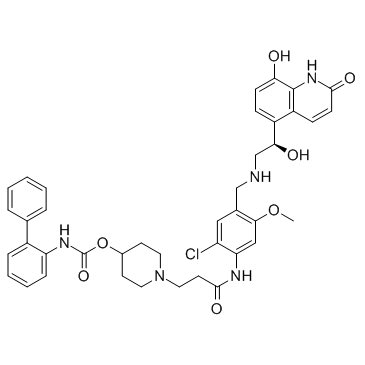
Cas No.: 743461-65-6
Sample solution is provided at 25 µL, 10mM.
_1-3.$$$39978408@51.jpg');)
_1-9.$$$38538795@65.jpg');)
_1-9.$$$39112701@51.jpg');)
_1-7.$$$37316672@70.jpg');)
_366-372.$$$36198801@70.jpg');)
.$$$38565142@65.jpg');)
_1867-1883.$$$33248023@67.jpg');)
_eads6055.$$$39977546@45.jpg');)
_eadm9805.$$$40080571@45.jpg');)
_eadj3020.$$$39666821@45.jpg');)
_1-20.$$$39757301@28.jpg');)
_1-24.$$$38898113@28.jpg');)
_273-287.$$$36806353@46.jpg');)
_1-16.$$$37156877@44.jpg');)
_1-19.$$$37460805@44.jpg');)
_1291-1307.$$$34518654@46.jpg');)
Batefenterol (GSK961081;TD-5959) is a novel muscarinic receptor antagonist and β2-adrenoceptor agonist; displays high affinity for hM2, hM3 muscarinic and hβ2-adrenoceptor with Ki values of 1.4, 1.3 and 3.7 nM, respectively.
Batefenterol is a novel first-in-class inhaled bifunctional compound possessing both muscarinic antagonist (MA) and β2-adrenoceptor agonist (BA) properties (MABA). In competition radioligand binding studies at human recombinant receptors, batefenterol displays high affinity for hM2 (Ki=1.4 nM), hM3 muscarinic receptors (Ki=1.3 nM) and hβ2-adrenoceptors (Ki=3.7 nM). Batefenterol behaves as a potent hβ2-adrenoceptor agonist (EC50=0.29 nM for stimulation of cAMP levels) with 440- and 320-fold functional selectivity over hβ1- and hβ3-adrenoceptors, respectively[1].
In the guinea pig bronchoprotection assay, inhaled Batefenterol produces potent, dose-dependent inhibition of bronchoconstrictor responses via MA (ED50=33.9 µg/mL), BA (ED50=14.1 µg/mL), and MABA (ED50=6.4 µg/mL) mechanisms. Significant bronchoprotective effects of Batefenterol are evident in guinea pigs via MA, BA, and MABA mechanisms for up to 7 days after dosing[1]. In guinea pig isolated trachea expressing native muscarinic M3 and β2, batefenterol produces smooth muscle relaxation through a dual mechanism involving competitive antagonism of the M3 receptor (EC50=50 nM) and agonism of the β2 receptor (EC50=25 nM). The combined effect on both muscarinic receptors and β2 receptors is more potent than either function working alone (EC50=10 nM). Batefenterol exhibits a rapid rate of clearance and short half-life[2].
[1]. Hegde SS, et al. Pharmacologic characterization of GSK-961081 (TD-5959), a first-in-class inhaled bifunctional bronchodilator possessing muscarinic receptor antagonist and β2-adrenoceptor agonist properties. J Pharmacol Exp Ther. 2014 Oct;351(1):190-9. [2]. Hughes AD, et al. Discovery of (R)-1-(3-((2-chloro-4-(((2-hydroxy-2-(8-hydroxy-2-oxo-1,2-dihydroquinolin-5-yl)ethyl)amino)methyl)-5-methoxyphenyl)amino)-3-oxopropyl)piperidin-4-yl [1,1'-biphenyl]-2-ylcarbamate (TD-5959, GSK961081, batefenterol): first-in-class dual pharmacology multivalent muscarinic antagonist and β? agonist (MABA) for the treatment of chronic obstructive pulmonary disease (COPD). J Med Chem. 2015 Mar 26;58(6):2609-22.
|
Cell experiment: |
CHO-K1 cells stably transfected with each receptor subtype are incubated with increasing concentrations of batefenterol for 20 minutes at 37°C. The cells are stimulated with an EC90 concentration of the muscarinic agonist oxotremorine. Oxotremorine elicits a Gq-mediated calcium-release event, which in turn caused the calcium-sensitive dye to bind to calcium and fluoresce upon stimulation with a 488 nm laser light source. The change in fluorescence is measured by the FLIPR for 3 minutes, and the peak height in fluorescence is taken as the maximal response to generate the concentration-response curve for batefenterol[1]. |
|
Animal experiment: |
Guinea pigs: Batefenterol is dissolved in water. Guinea pig trachea is dissected and isolated. The tracheal rings are initially tensioned to 1 g and allowed to equilibrate for 1 hour before evoking contraction with a submaximal concentration of either methylcholine (MCh; 10 µM), in the presence of propranolol (10 µM), or histamine (HIS; 30 µM) to assess relaxant effects via MA and BA mechanisms, respectively. Relaxation through the MABA mechanism is evaluated in tissues precontracted with MCh in the absence of propranolol. After the contractile tone attained a plateau, the batefenterol (0.1 nM to 100 µM) is added cumulatively in half log increments, with each concentration being added after achieving a steady-state relaxation response to the previous concentration. After the last concentration of test compound, theophylline (2.2 mM) is added to establish maximum relaxation[1]. |
|
References: [1]. Hegde SS, et al. Pharmacologic characterization of GSK-961081 (TD-5959), a first-in-class inhaled bifunctional bronchodilator possessing muscarinic receptor antagonist and β2-adrenoceptor agonist properties. J Pharmacol Exp Ther. 2014 Oct;351(1):190-9. |
|
| Cas No. | 743461-65-6 | SDF | |
| 同義語 | GSK961081, TD-5959 | ||
| Canonical SMILES | O=C(OC1CCN(CCC(NC2=CC(OC)=C(CNC[C@H](O)C3=CC=C(O)C4=C3C=CC(N4)=O)C=C2Cl)=O)CC1)NC5=CC=CC=C5C6=CC=CC=C6 | ||
| Formula | C40H42ClN5O7 | M.Wt | 740.24 |
| 溶解度 | DMSO : ≥ 100 mg/mL (135.09 mM);Water : < 0.1 mg/mL (insoluble) | Storage | Store at -20°C |
| General tips | Please select the appropriate solvent to prepare the stock solution according to the
solubility of the product in different solvents; once the solution is prepared, please store it in
separate packages to avoid product failure caused by repeated freezing and thawing.Storage method
and period of the stock solution: When stored at -80°C, please use it within 6 months; when stored
at -20°C, please use it within 1 month. To increase solubility, heat the tube to 37°C and then oscillate in an ultrasonic bath for some time. |
||
| Shipping Condition | Evaluation sample solution: shipped with blue ice. All other sizes available: with RT, or with Blue Ice upon request. | ||
| Prepare stock solution | |||

|
1 mg | 5 mg | 10 mg |
| 1 mM | 1.3509 mL | 6.7546 mL | 13.5091 mL |
| 5 mM | 270.2 μL | 1.3509 mL | 2.7018 mL |
| 10 mM | 135.1 μL | 675.5 μL | 1.3509 mL |
Step 1: Enter information below (Recommended: An additional animal making an allowance for loss during the experiment)
 g
μL
g
μL
Step 2: Enter the in vivo formulation (This is only the calculator, not formulation. Please contact us first if there is no in vivo formulation at the solubility Section.)
Calculation results:
Working concentration: mg/ml;
Method for preparing DMSO master liquid: mg drug pre-dissolved in μL DMSO ( Master liquid concentration mg/mL, Please contact us first if the concentration exceeds the DMSO solubility of the batch of drug. )
Method for preparing in vivo formulation: Take μL DMSO master liquid, next addμL PEG300, mix and clarify, next addμL Tween 80, mix and clarify, next add μL saline, mix and clarify.
Method for preparing in vivo formulation: Take μL DMSO master liquid, next add μL Corn oil, mix and clarify.
Note: 1. Please make sure the liquid is clear before adding the next solvent.
2. Be sure to add the solvent(s) in order. You must ensure that the solution obtained, in the previous addition, is a clear solution before proceeding to add the next solvent. Physical methods such as vortex, ultrasound or hot water bath can be used to aid dissolving.
3. All of the above co-solvents are available for purchase on the GlpBio website.
Quality Control & SDS
- View current batch:
- Purity: >99.00% Appearance: A solid
- COA (Certificate of Analysis)
- SDS (Safety Data Sheet)
- Datasheet
Average Rating: 5 (Based on Reviews and 17 reference(s) in Google Scholar.)