
Bazedoxifene HCl |
| カタログ番号GC10245 |
バゼドキシフェン HCl (TSE-424 塩酸塩) は、経口で有効な BBB 浸透性の非ステロイド性選択的エストロゲン受容体モジュレーター (SERM) であり、ERα の IC50 は 23 nM および 99 nM です。および ERβ、それぞれ。バゼドキシフェン HCl は、骨粗鬆症の研究に使用できます。バゼドキシフェン HCl は、IL-6/GP130 タンパク質間相互作用の阻害剤として作用します。バゼドキシフェン HCl は、膵臓癌の研究に使用できます。
Products are for research use only. Not for human use. We do not sell to patients.
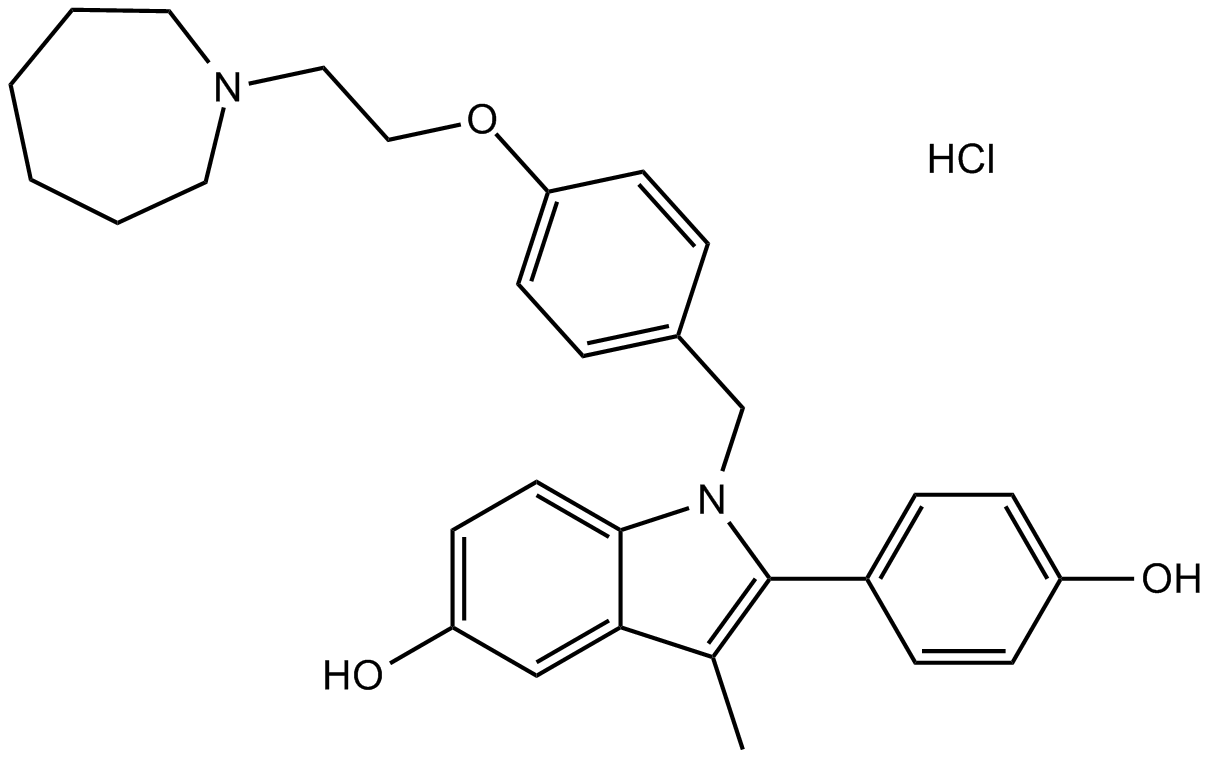
Cas No.: 198480-56-7
Sample solution is provided at 25 µL, 10mM.
Bazedoxifene HCl is a novel, non-steroidal and indole-based estrogen receptor modulator (SERM). The IC50 value of bazedoxifene against ERα and ERβ is 23 nM and 89 nM, respectively [1,2].
The estrogen receptor (ER) contains two subtypes, ERα and ERβ. ERs are widely expressed in different tissue types such as kidney, brain, bone, heart, prostate, and endothelial cells. Estrogen and the ERs have been involved in most cancers such as breast cancer,ovarian cancer,colon cancer,prostate cancer, and endometrial cancer [3].
In vitro: Bazedoxifene is a selective SERM currently in development for osteoporosis prevention and treatment. Bazedoxifene was the third generation SERM. In cultured breast cancer (bMCF-7) cells, bazedoxifenedidn’t stimulate ERα mediated transcriptional activity and acted as an antagonist to estradiol. Similar results were also seen in other cell lines including CHO (ovarian), HepG2 (hepatic) or GTI-7 (neuronal) with bazedoxifene having no ERα agonist activity and acting as an antagonist to estradiol action [2].Bazedoxifene didn’t stimulate proliferation of MCF-7 cells but inhibited 17β-estradiol-induced proliferation with an IC50 value of 0.19 nM [4].
In vivo:In an immature rat model, bazedoxifene increased uterine wet weight 35% at a dose of 0.5 mg/kg compared to an 85% increase with raloxifene at the same dose and a 300% increase in uterine weight with ethinyl estradiol at a dose of 10 μg/kg. Ovarectomized rats treated with 0.3 mg/d bazedoxifene displayed maintenance of bone mass and bone strength similar to effects seen with 2 μg/d ethinyl estradiol, 3 mg/d raloxifene, or sham operated animals. In an immature rat uterine model, bazedoxifene (0.5 and 5.0 mg/kg) was associated with less increase in uterine wet weight than either ethinyl estradiol (10 μg/kg) or raloxifene (0.5 and 5.0 mg/kg) [4].
References:
[1]. Miller C P, Collini M D, Tran B D, et al. Design, synthesis, and preclinical characterization of novel, highly selective indole estrogens[J]. Journal of medicinal chemistry, 2001, 44(11): 1654-1657.
[2]. Biskobing D M. Update on bazedoxifene: A novel selective estrogen receptor modulator[J]. Clinical interventions in aging, 2007, 2(3): 299.
[3]. Harris H A, Albert L M, Leathurby Y, et al. Evaluation of an estrogen receptor-β agonist in animal models of human disease[J]. Endocrinology, 2003, 144(10): 4241-4249.
[4]. Komm B S, Kharode Y P, Bodine P V N, et al. Bazedoxifene acetate: a selective estrogen receptor modulator with improved selectivity[J]. Endocrinology, 2005, 146(9): 3999-4008.

| Cell experiment [1]: | |
|
Cell lines |
CHO cells, HepG2 cells, GT1–7 cells, MCF-7 cells |
|
Preparation method |
The solubility of this compound in DMSO is >25.4mg/mL. General tips for obtaining a higher concentration: Please warm the tube at 37℃ for 10 minutes and/or shake it in the ultrasonic bath for a while. Stock solution can be stored below -20℃ for several months. |
|
Reacting condition |
0.1 pM-10 nM |
|
Applications |
Co-treatment with 1.0 nM 17β-estradiol and bazedoxifene had an IC50 of 22.0 nM in CHO cells, 4.97 nM in HepG2 cells, and 10.0 nM in GT1–7 cells. In HepG2 cells transfected with hepatic lipase promoter luciferase construct, bazedoxifene functioned as an agonist with an EC50 of 100.0 nM. In MCF-7 cell, co-treatment with 17β-estradiol and bazedoxifene dose-dependently inhibited cell proliferation with an IC50 of 0.19 nM. |
| Animal experiment [1]: | |
|
Animal models |
An immature rat uterine model |
|
Dosage form |
0.5 and 5.0 mg/kg; once daily for 3 d; administered orally |
|
Application |
In an immature rat uterine model, bazedoxifene (BZA) increased uterine wet weight by 35% at 0.5 mg/kg andno significant difference at 5 mg/kg. Histological examination of the entire uterus revealed BZA does not affect luminal epithelial cell hypertrophy or hyperplasia, myometrial hypertrophy, or luminal distention. BZA resulted in only a slight, insignificant increase in luminal cell height. |
|
Other notes |
Please test the solubility of all compounds indoor, and the actual solubility may slightly differ with the theoretical value. This is caused by an experimental system error and it is normal. |
|
References: [1] Komm B S, Kharode Y P, Bodine P V N, et al. Bazedoxifene acetate: a selective estrogen receptor modulator with improved selectivity[J]. Endocrinology, 2005, 146(9): 3999-4008. | |
| Cas No. | 198480-56-7 | SDF | |
| Chemical Name | 1-[[4-[2-(azepan-1-yl)ethoxy]phenyl]methyl]-2-(4-hydroxyphenyl)-3-methylindol-5-ol;hydrochloride | ||
| Canonical SMILES | CC1=C(N(C2=C1C=C(C=C2)O)CC3=CC=C(C=C3)OCCN4CCCCCC4)C5=CC=C(C=C5)O.Cl | ||
| Formula | C30H34N2O3.HCl | M.Wt | 507.06 |
| 溶解度 | ≥ 25.35mg/mL in DMSO | Storage | Store at -20°C |
| General tips | Please select the appropriate solvent to prepare the stock solution according to the
solubility of the product in different solvents; once the solution is prepared, please store it in
separate packages to avoid product failure caused by repeated freezing and thawing.Storage method
and period of the stock solution: When stored at -80°C, please use it within 6 months; when stored
at -20°C, please use it within 1 month. To increase solubility, heat the tube to 37°C and then oscillate in an ultrasonic bath for some time. |
||
| Shipping Condition | Evaluation sample solution: shipped with blue ice. All other sizes available: with RT, or with Blue Ice upon request. | ||
| Prepare stock solution | |||
|
1 mg | 5 mg | 10 mg |
| 1 mM | 1.9722 mL | 9.8608 mL | 19.7215 mL |
| 5 mM | 394.4 μL | 1.9722 mL | 3.9443 mL |
| 10 mM | 197.2 μL | 986.1 μL | 1.9722 mL |
Step 1: Enter information below (Recommended: An additional animal making an allowance for loss during the experiment)
Step 2: Enter the in vivo formulation (This is only the calculator, not formulation. Please contact us first if there is no in vivo formulation at the solubility Section.)
Calculation results:
Working concentration: mg/ml;
Method for preparing DMSO master liquid: mg drug pre-dissolved in μL DMSO ( Master liquid concentration mg/mL, Please contact us first if the concentration exceeds the DMSO solubility of the batch of drug. )
Method for preparing in vivo formulation: Take μL DMSO master liquid, next addμL PEG300, mix and clarify, next addμL Tween 80, mix and clarify, next add μL ddH2O, mix and clarify.
Method for preparing in vivo formulation: Take μL DMSO master liquid, next add μL Corn oil, mix and clarify.
Note: 1. Please make sure the liquid is clear before adding the next solvent.
2. Be sure to add the solvent(s) in order. You must ensure that the solution obtained, in the previous addition, is a clear solution before proceeding to add the next solvent. Physical methods such as vortex, ultrasound or hot water bath can be used to aid dissolving.
3. All of the above co-solvents are available for purchase on the GlpBio website.
Quality Control & SDS
- View current batch:
- Purity: >98.00%
- COA (Certificate Of Analysis)
- SDS (Safety Data Sheet)
- Datasheet
Average Rating: 5 (Based on Reviews and 31 reference(s) in Google Scholar.)
GLPBIO products are for RESEARCH USE ONLY. Please make sure your review or question is research based.
Required fields are marked with *


