

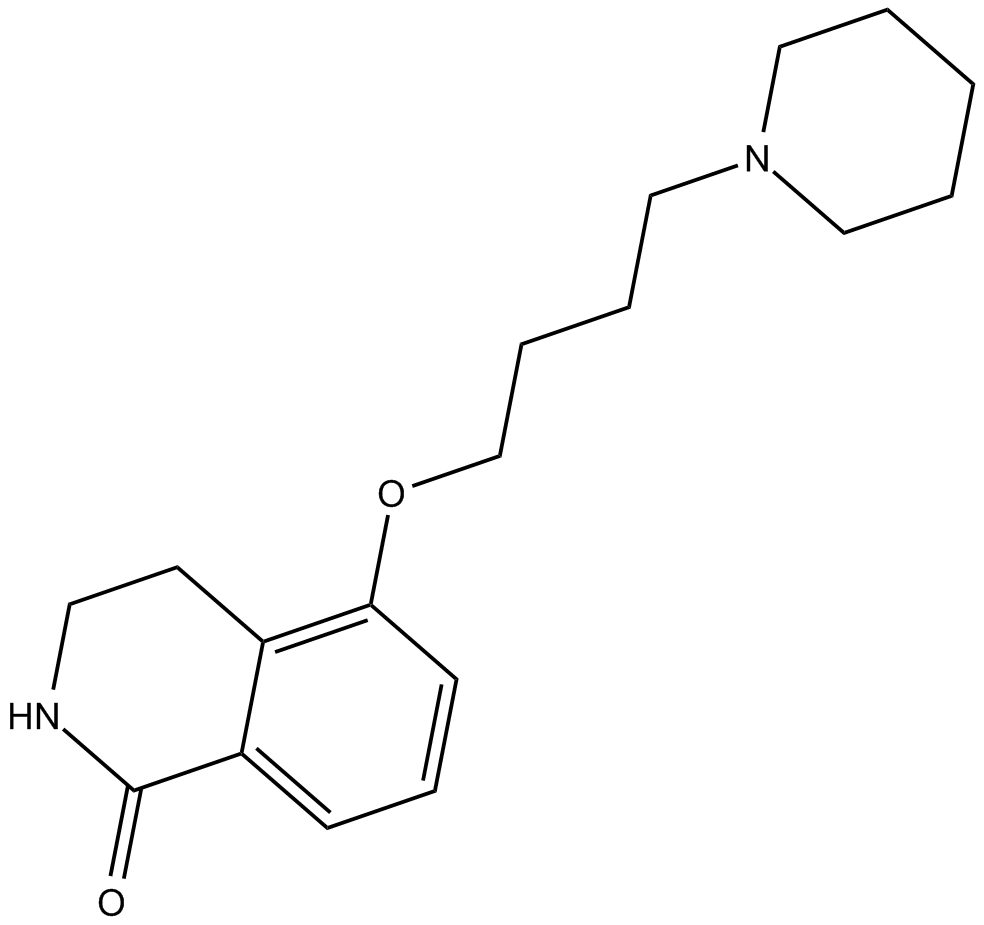
DPQ (Synonyms: PARP Inhibitor III) |
カタログ番号GC15294
 One-Click Copy Product Info
|

DPQは有力で、血液脳関門を通過できるポリ(ADP-リボース)ポリメラーゼ-1 (PARP-1)選択的阻害剤であり、DNA損傷の修復や関連の細胞プロセスの研究に使われる。
Products are for research use only. Not for human use. We do not sell to patients.
Cas No.: 129075-73-6
Sample solution is provided at 25 µL, 10mM.
DPQは有力で、血液脳関門を通過できるポリ(ADP-リボース)ポリメラーゼ-1 (PARP-1)選択的阻害剤であり、DNA損傷の修復や関連の細胞プロセスの研究に使われる[1-2]。DPQは、急性肺損傷、心筋虚血再潅流損傷と神経変性疾患で、炎症反応と細胞死のメカニズムの調査に使われ、神経保護と心臓保護の作用を示す[3-4]。
体外で、DPQ (1μM)で非小細胞肺癌細胞(A549とH1299)を4時間事前処理し、続いて炭素イオン照射(0.5–2Gy)を24時間行った結果、細胞の遊離、創傷治癒能力、マトリックスメタロプロテアーゼ(MMP-2とMMP-9)の活性と発見を著しく阻害した[5]。HeLa細胞をDPQ (20–150μM)で1時間事前処理し、続いてPMA(50nM)で3時間刺激した結果、ヒスタミンH1受容体(H1R)遺伝子の発見の上方制御を著しく抑制し、H1Rプロモーターの活性を減らした[6]。
体内で、DPQ (15mg/kg)でC57BL/6マウスを24時間事前処理し、その後は45分間腎虚血、6時間再潅流した結果、PARP-1の過剰活性化を阻害することで、虚血再潅流関連の病理学的な損傷(例えば急性尿細管の壊死(ATN)、尿細管細胞の空胞化や刷子縁消失)を減らし、尿細管上皮細胞の脱落と円柱の形成をも改善した[7]。C57BL/6マウスをLPS (7.5mg/kg)で30分間事前処理し、続いてDPQ (10μg/kg)を6時間腹腔内注射した結果、肺組織における好中球の浸潤とミエロペルオキシダーゼ(MPO)の活性を著しく阻害し、同時に炎症促進因子(例えばTNF-α、IL-1βやIL-6など)のmRNA発見レベルを減らした[8]。
References:
[1] Meli E, Pangallo M, Picca R, et al. Differential role of poly(ADP-ribose) polymerase-1in apoptotic and necrotic neuronal death induced by mild or intense NMDA exposure in vitro. Mol Cell Neurosci. 2004 Jan;25(1):172-80.
[2] Wang J, Hao L, Wang Y, et al. Inhibition of poly (ADP-ribose) polymerase and inducible nitric oxide synthase protects against ischemic myocardial damage by reduction of apoptosis. Mol Med Rep. 2015 Mar;11(3):1768-76.
[3] Czapski GA, Cakala M, Kopczuk D, et al. Effect of poly(ADP-ribose) polymerase inhibitors on oxidative stress evoked hydroxyl radical level and macromolecules oxidation in cell free system of rat brain cortex. Neurosci Lett. 2004 Feb 6;356(1):45-8.
[4] Suh SW, Aoyama K, Alano CC, et al. Zinc inhibits astrocyte glutamate uptake by activation of poly(ADP-ribose) polymerase-1. Mol Med. 2007 Jul-Aug;13(7-8):344-9.
[5] Chowdhury P, Dey P, Ghosh S, et al. Reduction of metastatic potential by inhibiting EGFR/Akt/p38/ERK signaling pathway and epithelial-mesenchymal transition after carbon ion exposure is potentiated by PARP-1 inhibition in non-small-cell lung cancer. BMC Cancer. 2019 Aug 22;19(1):829.
[6] Mizuguchi H, Terao T, Kitai M, et al. Involvement of protein kinase Cdelta/extracellular signal-regulated kinase/poly(ADP-ribose) polymerase-1 (PARP-1) signaling pathway in histamine-induced up-regulation of histamine H1 receptor gene expression in HeLa cells. J Biol Chem. 2011 Sep 2;286(35):30542-30551.
[7] del Moral RM, Gómez-Morales M, Hernández-Cortés P, et al. PARP inhibition attenuates histopathological lesion in ischemia/reperfusion renal mouse model after cold prolonged ischemia. ScientificWorldJournal. 2013 Nov 11;2013:486574.
[8] Wang G, Huang X, Li Y, et al. PARP-1 inhibitor, DPQ, attenuates LPS-induced acute lung injury through inhibiting NF-κB-mediated inflammatory response. PLoS One. 2013 Nov 21;8(11):e79757.
| 細胞実験[1]: | |
細胞株 | A549とH1299(ヒト非小細胞肺癌細胞)、HeLa(ヒト子宮頸癌細胞)、MCF7(ヒト乳腺癌細胞) |
準備方法 | 37°C、5% CO₂で、10%のウシ胎児血清(FBS)を添加したDMEMで細胞を培養した。炭素イオン(¹²C)照射の4時間前、細胞をDPQ (1μM)で処理し、照射後にDPQの存在下で培養した。 |
反応条件 | 1μM;¹²C照射(0.5–2Gy)後に4時間の事前処理 |
アプリケーション | DPQは、EGFR、Akt、p38とERKのリン酸化を阻害することで、A549とH1299細胞における細胞の遊離と創傷の治癒を著しく抑制し、NF-κBの不活性化を招いた。DPQは、MMP-2とMMP-9の発見を減らした。DPQは、N-cadherin、vimentinとanillinを下方制御し、同時にclaudin-1とclaudin-2を上方制御することで、上皮間葉転換(EMT)をも阻害した。 |
| 動物実験 [2]: | |
動物モデル | C57BL/6マウス(8-10週齢、雄) |
準備方法 | マウスにはLPS (7.5mg/kg)を腹腔内注射し、急性肺損傷を誘発した。LPSチャレンジの30分後、DPQ (1または10μg/kg)を腹腔内注射した。肺組織分析のために、LPS暴露の6時間後に、マウスを殺処分した。 |
投与形態 | 10μg/kg;腹腔内注射;単回注射 |
アプリケーション | DPQは、好中球の浸潤を減らし、血管の透過性を阻害することで、LPS誘発の急性肺損傷を著しく軽減した。DPQは、肺組織で炎症促進メディエーター(TNF-α、IL-1β、IL-6、MIP-2、iNOSとCXCL-1)のmRNA発見を抑制し、アポトーシス細胞死を減らした。 |
References: | |
| Cas No. | 129075-73-6 | SDF | |
| 同義語 | PARP Inhibitor III | ||
| Chemical Name | 5-(4-(piperidin-1-yl)butoxy)-3,4-dihydroisoquinolin-1(2H)-one | ||
| Canonical SMILES | O=C1NCCC2=C(C=CC=C21)OCCCCN3CCCCC3 | ||
| Formula | C18H26N2O2 | M.Wt | 302.41 |
| 溶解度 | Soluble in DMSO | Storage | Store at -20°C |
| General tips | Please select the appropriate solvent to prepare the stock solution according to the
solubility of the product in different solvents; once the solution is prepared, please store it in
separate packages to avoid product failure caused by repeated freezing and thawing.Storage method
and period of the stock solution: When stored at -80°C, please use it within 6 months; when stored
at -20°C, please use it within 1 month. To increase solubility, heat the tube to 37°C and then oscillate in an ultrasonic bath for some time. |
||
| Shipping Condition | Evaluation sample solution: shipped with blue ice. All other sizes available: with RT, or with Blue Ice upon request. | ||
| Prepare stock solution | |||

|
1 mg | 5 mg | 10 mg |
| 1 mM | 3.3068 mL | 16.5338 mL | 33.0677 mL |
| 5 mM | 661.4 μL | 3.3068 mL | 6.6135 mL |
| 10 mM | 330.7 μL | 1.6534 mL | 3.3068 mL |
Step 1: Enter information below (Recommended: An additional animal making an allowance for loss during the experiment)
 g
μL
g
μL
Step 2: Enter the in vivo formulation (This is only the calculator, not formulation. Please contact us first if there is no in vivo formulation at the solubility Section.)
Calculation results:
Working concentration: mg/ml;
Method for preparing DMSO master liquid: mg drug pre-dissolved in μL DMSO ( Master liquid concentration mg/mL, Please contact us first if the concentration exceeds the DMSO solubility of the batch of drug. )
Method for preparing in vivo formulation: Take μL DMSO master liquid, next addμL PEG300, mix and clarify, next addμL Tween 80, mix and clarify, next add μL saline, mix and clarify.
Method for preparing in vivo formulation: Take μL DMSO master liquid, next add μL Corn oil, mix and clarify.
Note: 1. Please make sure the liquid is clear before adding the next solvent.
2. Be sure to add the solvent(s) in order. You must ensure that the solution obtained, in the previous addition, is a clear solution before proceeding to add the next solvent. Physical methods such as vortex, ultrasound or hot water bath can be used to aid dissolving.
3. All of the above co-solvents are available for purchase on the GlpBio website.
Quality Control & SDS
- View current batch:
- Purity: >99.00% Appearance: A solid
- COA (Certificate of Analysis)
- SDS (Safety Data Sheet)
- Datasheet
Average Rating: 5 (Based on Reviews and 28 reference(s) in Google Scholar.)