

PLX5622 |
カタログ番号GC36940
 One-Click Copy Product Info
|

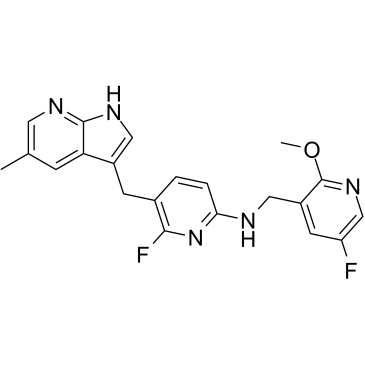
PLX5622はコロニー刺激因子1受容体(CSFR1)の選択的阻害剤であり、IC50値は0.016μMである。
Products are for research use only. Not for human use. We do not sell to patients.
Cas No.: 1303420-67-8
Sample solution is provided at 25 µL, 10mM.
_1-3.$$$39978408@51.jpg');)
_1-9.$$$38538795@65.jpg');)
_1-9.$$$39112701@51.jpg');)
_1-7.$$$37316672@70.jpg');)
_366-372.$$$36198801@70.jpg');)
.$$$38565142@65.jpg');)
_1867-1883.$$$33248023@67.jpg');)
_eads6055.$$$39977546@45.jpg');)
_eadm9805.$$$40080571@45.jpg');)
_eadj3020.$$$39666821@45.jpg');)
_1-20.$$$39757301@28.jpg');)
_1-24.$$$38898113@28.jpg');)
_273-287.$$$36806353@46.jpg');)
_1-16.$$$37156877@44.jpg');)
_1-19.$$$37460805@44.jpg');)
_1291-1307.$$$34518654@46.jpg');)
PLX5622はコロニー刺激因子1受容体(CSFR1)の選択的阻害剤であり、IC50値は0.016μMである。PLX5622は主に中枢神経系におけるミクログリアに作用する。CSFR1を阻害することにより、PLX5662は他の種類の骨髄系細胞に影響を与えることなく、ミクログリアを選択的に枯渇させる。PLX5662は、神経変性疾患におけるミクログリアの役割を研究するためのツールとして検討されている。
In vitroでは、一次混合マウスアストロサイトおよびミクログリア細胞を抽出した。細胞を10 μM PLX5622(20mM DMSOストック溶液で希釈する)で処理した。対照群の細胞にはDMSOのみを添加した。ミクログリア細胞を10μM PLX5622で処理した後、細胞抽出直後の細胞数は対照群の8%に減少した。4週間処理後、ミクログリア細胞数は2%に減少し、6週間後には0.5%未満に低下した。PLX5622はミクログリアの増殖を著しく抑制した。
In vivoでは、C57BL/6NCrlマウスに1200 mg/kgのPLX5622を含む飼料を投与した一方、対照群には同濃度のAIN76を含む飼料を投与した。5ヶ月後、マウスにおいてミクログリア細胞数が95%減少したことが観察された。複数の臓器における常在マクロファージが枯渇しており、その内訳は結腸(92.4%);脂肪組織(58.2%);肺(26.3%)および腹腔(90.2%)など複数の臓器で常在マクロファージが枯渇した。しかし、PLX5622の除去後にはミクログリアの回復が認められた。同様の再増殖は骨髄および脾臓でも示され、免疫細胞がPLX5622の中止後に回復し得ることを示唆している。
References:
[1]Guenoun D, Blaise N, Sellam A, Roupret‐Serzec J, Jacquens A, Steenwinckel JV, Gressens P, Bokobza C. Microglial Depletion, a New Tool in Neuroinflammatory Disorders: Comparison of Pharmacological Inhibitors of the CSF‐1R. Glia. 2024 Dec 24.
[2]Spangenberg E, Severson PL, Hohsfield LA, Crapser J, Zhang J, Burton EA, Zhang Y, Spevak W, Lin J, Phan NY, Habets G. Sustained microglial depletion with CSF1R inhibitor impairs parenchymal plaque development in an Alzheimer’s disease model. Nature communications. 2019 Aug 21;10(1):3758.
[3]Hupp S, Iliev AI. CSF-1 receptor inhibition as a highly effective tool for depletion of microglia in mixed glial cultures. Journal of neuroscience methods. 2020 Feb 15;332:108537.
[4]Bosch AJ, Keller L, Steiger L, Rohm TV, Wiedemann SJ, Low AJ, Stawiski M, Rachid L, Roux J, Konrad D, Wueest S. CSF1R inhibition with PLX5622 affects multiple immune cell compartments and induces tissue-specific metabolic effects in lean mice. Diabetologia. 2023 Dec;66(12):2292-306.
| 細胞実験[1]: | |
細胞株 | 一次混合マウスアストロサイトおよびミクログリア細胞 |
準備方法 | 新生C57BL/6マウスから単離したマウスアストロサイト・ミクログリア混合初代培養細胞を用いた。細胞をPLX5622群と対照群に分け、DMEM培地で培養した。10mgのPLX5622を1.25mlのDMSOに溶解し、20mMのストック溶液を調製した。その後、PLX5622群には10μMを投与し、対照群にはDMSOのみを投与した。PLX5622またはDMSOを含む培地は3日ごとに交換した。6日目、12日目、28日目、42日目に細胞を固定し、増殖解析を行った。 |
反応条件 | PLX5622: 10μM; 6日目、12日目、28日目、42日目 |
アプリケーション | 細胞抽出直後から10μM PLX5622を添加すると、ミクログリア細胞数は対照群の8%に減少した。また、培養12日目から添加を開始した場合、細胞数は対照群の25%に減少した。4週間の処理後、ミクログリア数は2%に減少、6週間後には0.5%未満に低下した。ミクログリアの除去は緩慢で、半減期は6日間であった。 |
| 動物実験 [2]: | |
動物モデル | C57BL/6Nctrlマウス |
準備方法 | PLX5622群マウスには1200mg/kgのPLX5622を含む飼料を、対照群マウスには1200mg/kgのAIN76を含む飼料を5ヶ月間投与した。PLX5622群マウスには抗マウスCD115抗体1mg/マウスを、対照群マウスにはラットIgG2aアイソタイプ対照抗体を3週間毎週投与し、マクロファージ枯渇を評価した。回復試験は、PLX5622投与4週間後、続いて3~4週間の対照飼料投与により実施した。安楽死後、免疫細胞を分離しフローサイトメトリーを実施した。 |
投与形態 | PLX5622:1200mg/kg;5ヶ月間;AIN76:1200mg/kg;5ヶ月間 |
アプリケーション | 5ヶ月間の食事投与後、PLX5622投与群マウスではミクログリアが95%減少した。複数の臓器における常在マクロファージが枯渇し、大腸(92.4%)、脂肪組織(58.2%)、肺(26.3%)、腹腔(90.2%)での減少が認められた。しかし、PLX5622の除去後にはミクログリアの回復が認められた。同様の再増殖は骨髄および脾臓でも示され、免疫細胞がPLX5622の中止後に回復し得ることを示唆している。 |
References: | |
| Cas No. | 1303420-67-8 | SDF | |
| Canonical SMILES | COC1=NC=C(F)C=C1CNC2=NC(F)=C(CC3=CNC4=NC=C(C)C=C43)C=C2 | ||
| Formula | C21H19F2N5O | M.Wt | 395.41 |
| 溶解度 | DMSO: 83.33 mg/mL (210.74 mM); Water: < 0.1 mg/mL (insoluble) | Storage | Store at -20°C |
| General tips | Please select the appropriate solvent to prepare the stock solution according to the
solubility of the product in different solvents; once the solution is prepared, please store it in
separate packages to avoid product failure caused by repeated freezing and thawing.Storage method
and period of the stock solution: When stored at -80°C, please use it within 6 months; when stored
at -20°C, please use it within 1 month. To increase solubility, heat the tube to 37°C and then oscillate in an ultrasonic bath for some time. |
||
| Shipping Condition | Evaluation sample solution: shipped with blue ice. All other sizes available: with RT, or with Blue Ice upon request. | ||
| Prepare stock solution | |||

|
1 mg | 5 mg | 10 mg |
| 1 mM | 2.529 mL | 12.6451 mL | 25.2902 mL |
| 5 mM | 505.8 μL | 2.529 mL | 5.058 mL |
| 10 mM | 252.9 μL | 1.2645 mL | 2.529 mL |
Step 1: Enter information below (Recommended: An additional animal making an allowance for loss during the experiment)
 g
μL
g
μL
Step 2: Enter the in vivo formulation (This is only the calculator, not formulation. Please contact us first if there is no in vivo formulation at the solubility Section.)
Calculation results:
Working concentration: mg/ml;
Method for preparing DMSO master liquid: mg drug pre-dissolved in μL DMSO ( Master liquid concentration mg/mL, Please contact us first if the concentration exceeds the DMSO solubility of the batch of drug. )
Method for preparing in vivo formulation: Take μL DMSO master liquid, next addμL PEG300, mix and clarify, next addμL Tween 80, mix and clarify, next add μL saline, mix and clarify.
Method for preparing in vivo formulation: Take μL DMSO master liquid, next add μL Corn oil, mix and clarify.
Note: 1. Please make sure the liquid is clear before adding the next solvent.
2. Be sure to add the solvent(s) in order. You must ensure that the solution obtained, in the previous addition, is a clear solution before proceeding to add the next solvent. Physical methods such as vortex, ultrasound or hot water bath can be used to aid dissolving.
3. All of the above co-solvents are available for purchase on the GlpBio website.
Quality Control & SDS
- View current batch:
- Purity: >98.00% Appearance: A solid
- COA (Certificate of Analysis)
- SDS (Safety Data Sheet)
- Datasheet
Average Rating: 5 (Based on Reviews and 2 reference(s) in Google Scholar.)