

Melphalan (Synonyms: Alanine Nitrogen Mustard, Alkeran, NSC 8806, NSC 241286, L-Phenylalanine Mustard) |
カタログ番号GC12393
 One-Click Copy Product Info
|

DNAアルキル化剤
Products are for research use only. Not for human use. We do not sell to patients.
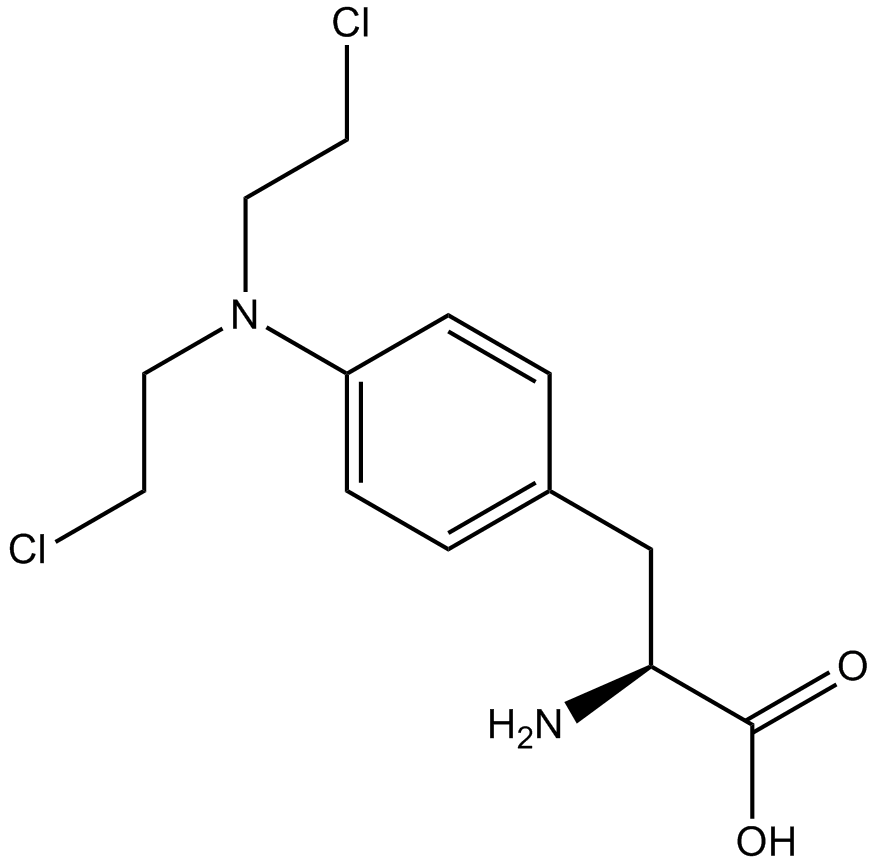
Cas No.: 148-82-3
Sample solution is provided at 25 µL, 10mM.
_1-3.$$$39978408@51.jpg');)
_1-9.$$$38538795@65.jpg');)
_1-9.$$$39112701@51.jpg');)
_1-7.$$$37316672@70.jpg');)
_366-372.$$$36198801@70.jpg');)
.$$$38565142@65.jpg');)
_1867-1883.$$$33248023@67.jpg');)
_eads6055.$$$39977546@45.jpg');)
_eadm9805.$$$40080571@45.jpg');)
_eadj3020.$$$39666821@45.jpg');)
_1-20.$$$39757301@28.jpg');)
_1-24.$$$38898113@28.jpg');)
_273-287.$$$36806353@46.jpg');)
_1-16.$$$37156877@44.jpg');)
_1-19.$$$37460805@44.jpg');)
_1291-1307.$$$34518654@46.jpg');)
Melphalan is an alkylating drug that binds guanosine and forms monoadducts and interstrand cross-links[1]. The intracellular cytotoxic effect of Melphalan is based on the inter- or intra-structural crosslinking of DNA structures as well as crosslinking between DNA and proteins, mediated by the two chloroethyl groups on the molecule, which lead to the loss of nitrogenous bases in DNA molecules, strand breaks, and the formation of open rings, thereby disrupting DNA replication and transcription processes[2]. Melphalan has been widely used in immunological research to induce immunogenic cell death and regulate the formation of the immunogenic microenvironment[3].
In vitro, Melphalan treatment for 48 hours significantly inhibited the viability of THP1, HL60 and RPMI8226 cells, with IC50 values of 6.26μM, 3.78μM and 8.9μM, respectively[4]. Treatment with 100μM Melphalan for 72 hours markedly induced cell cycle arrest and promoted massive cell death in IGROV1 cells[5]. Incubation of A375 cells with 300μM Melphalan for 24 hours elicited endoplasmic reticulum stress and ROS-dependent apoptosis, accompanied by a significant increase in IL8 and CCL2 levels[6].
In vivo, Melphalan treatment via intraperitoneal injection at a dose of 50μg, three times a week for 85 days, prolonged the survival period of 5T33MM xenograft tumor mouse models[7]. Subconjunctival injection of Melphalan (10μg), twice a week for 3 weeks, significantly reduced the tumor burden in transgenic retinoblastoma mice, alleviated hypoxia and improved vascular distribution[8].
References:
[1] Gourzones C, Bellanger C, Lamure S, et al. Antioxidant defenses confer resistance to high dose melphalan in multiple myeloma cells[J]. Cancers, 2019, 11(4): 439.
[2] Poczta A, Rogalska A, Marczak A. Treatment of multiple myeloma and the role of melphalan in the era of modern therapies—Current research and clinical approaches[J]. Journal of Clinical Medicine, 2021, 10(9): 1841.
[3] Kuczma M, Ding Z C, Zhou G. Immunostimulatory effects of melphalan and usefulness in adoptive cell therapy with antitumor CD4+ T cells[J]. Critical Reviews™ in Immunology, 2016, 36(2).
[4] Poczta A, Krzeczyński P, Tobiasz J, et al. Synthesis and in vitro activity of novel melphalan analogs in hematological malignancy cells[J]. International Journal of Molecular Sciences, 2022, 23(3): 1760.
[5] Lupi M, Cappella P, Matera G, et al. Interpreting cell cycle effects of drugs: the case of melphalan[J]. Cancer chemotherapy and pharmacology, 2006, 57(4): 443-457.
[6] Dudek-Perić A M, Ferreira G B, Muchowicz A, et al. Antitumor immunity triggered by melphalan is potentiated by melanoma cell surface–associated calreticulin[J]. Cancer research, 2015, 75(8): 1603-1614.
[7] Hayun M, Saida H, Albeck M, et al. Induction therapy in a multiple myeloma mouse model using a combination of AS101 and melphalan, and the activity of AS101 in a tumor microenvironment model[J]. Experimental hematology, 2009, 37(5): 593-603.
[8] Shah N V, Pham D G, Murray T G, et al. Intravitreal and subconjunctival melphalan for retinoblastoma in transgenic mice[J]. Journal of Ophthalmology, 2014, 2014(1): 829879.
| Cell experiment [1]: | |
|
Cell lines |
A375 cells |
|
Preparation Method |
A375 cells were cultured in DMEM medium supplemented with 100μg/ml streptomycin, 100μg/ml penicillin, 10% fetal bovine serum, and 2mM glutamine at 37°C in an incubator with 5% CO2. A375 cells (2×10⁴/well) were seeded in the 96-well plates and cultured overnight followed by treatment with 300μM Melphalan for different periods (16, 24, and 48h). Cell viability was measured. |
|
Reaction Conditions |
300μM; 16, 24, and 48h |
|
Applications |
Melphalan reduced cell viability in A375 cells in a time-dependent manner. |
| Animal experiment [2]: | |
|
Animal models |
LHBETATAG transgenic mice |
|
Preparation Method |
LHBETATAG transgenic mice were housed individually in specific cages and placed in a ventilated cabinet, temperature was kept relatively constant at 22-25°C and humidity between 50 and 70%, and the lighting was controlled to be 12h light and 12h dark. Melphalan for injection was prepared by rapidly injecting 10ml of the diluent (sodium citrate 0.2g, propylene glycol 6.0ml, ethanol (96%) 0.52ml, and water) directly into 50mg of Melphalan and vigorously shaken. 1ml of the 5mg/ml solution was diluted to 0.5μg/ml using 0.9% normal saline solution to prepare a 10μg/20μl solution. Mice were treated with 10μg per 20μl subconjunctival Melphalan 2 times a week for 3 weeks. Subconjunctival injections were delivered with a 33-gauge needle inserted into the nasal and superior subconjunctival space. Mice were euthanized with CO2 fumes and eyes were enucleated. Tumor sections were analyzed for tumor burden, hypoxia, and vasculature. |
|
Dosage form |
10μg; twice a week; 3 weeks; subconjunctival injection |
|
Applications |
Melphalan treatment reduced the tumor burden of retinoblastoma, alleviated hypoxia and improved vascular distribution in LHBETATAG transgenic mice. |
References: [1] Dudek-Perić A M, Ferreira G B, Muchowicz A, et al. Antitumor immunity triggered by melphalan is potentiated by melanoma cell surface–associated calreticulin[J]. Cancer research, 2015, 75(8): 1603-1614. [2] Shah N V, Pham D G, Murray T G, et al. Intravitreal and subconjunctival melphalan for retinoblastoma in transgenic mice[J]. Journal of Ophthalmology, 2014, 2014(1): 829879. | |
| Cas No. | 148-82-3 | SDF | |
| 同義語 | Alanine Nitrogen Mustard, Alkeran, NSC 8806, NSC 241286, L-Phenylalanine Mustard | ||
| Chemical Name | (2S)-2-amino-3-[4-[bis(2-chloroethyl)amino]phenyl]propanoic acid | ||
| Canonical SMILES | C1=CC(=CC=C1CC(C(=O)O)N)N(CCCl)CCCl | ||
| Formula | C13H18Cl2N2O2 | M.Wt | 305.2 |
| 溶解度 | ≥ 6.85mg/mL in DMSO, <2.62 mg/mL in EtOH, <2.24 mg/mL in Water | Storage | 4°C, protect from light |
| General tips | Please select the appropriate solvent to prepare the stock solution according to the
solubility of the product in different solvents; once the solution is prepared, please store it in
separate packages to avoid product failure caused by repeated freezing and thawing.Storage method
and period of the stock solution: When stored at -80°C, please use it within 6 months; when stored
at -20°C, please use it within 1 month. To increase solubility, heat the tube to 37°C and then oscillate in an ultrasonic bath for some time. |
||
| Shipping Condition | Evaluation sample solution: shipped with blue ice. All other sizes available: with RT, or with Blue Ice upon request. | ||
| Prepare stock solution | |||

|
1 mg | 5 mg | 10 mg |
| 1 mM | 3.2765 mL | 16.3827 mL | 32.7654 mL |
| 5 mM | 655.3 μL | 3.2765 mL | 6.5531 mL |
| 10 mM | 327.7 μL | 1.6383 mL | 3.2765 mL |
Step 1: Enter information below (Recommended: An additional animal making an allowance for loss during the experiment)
 g
μL
g
μL
Step 2: Enter the in vivo formulation (This is only the calculator, not formulation. Please contact us first if there is no in vivo formulation at the solubility Section.)
Calculation results:
Working concentration: mg/ml;
Method for preparing DMSO master liquid: mg drug pre-dissolved in μL DMSO ( Master liquid concentration mg/mL, Please contact us first if the concentration exceeds the DMSO solubility of the batch of drug. )
Method for preparing in vivo formulation: Take μL DMSO master liquid, next addμL PEG300, mix and clarify, next addμL Tween 80, mix and clarify, next add μL saline, mix and clarify.
Method for preparing in vivo formulation: Take μL DMSO master liquid, next add μL Corn oil, mix and clarify.
Note: 1. Please make sure the liquid is clear before adding the next solvent.
2. Be sure to add the solvent(s) in order. You must ensure that the solution obtained, in the previous addition, is a clear solution before proceeding to add the next solvent. Physical methods such as vortex, ultrasound or hot water bath can be used to aid dissolving.
3. All of the above co-solvents are available for purchase on the GlpBio website.
Quality Control & SDS
- View current batch:
- Purity: >90.00% Appearance: A solid
- COA (Certificate of Analysis)
- SDS (Safety Data Sheet)
- Datasheet
Average Rating: 5 (Based on Reviews and 30 reference(s) in Google Scholar.)