


N-3-oxo-dodecanoyl-L-Homoserine lactone (Synonyms: 3-oxo-C12-HSL) |
| カタログ番号GC17279 |
NF-κBとAP-2の活性化剤
Products are for research use only. Not for human use. We do not sell to patients.
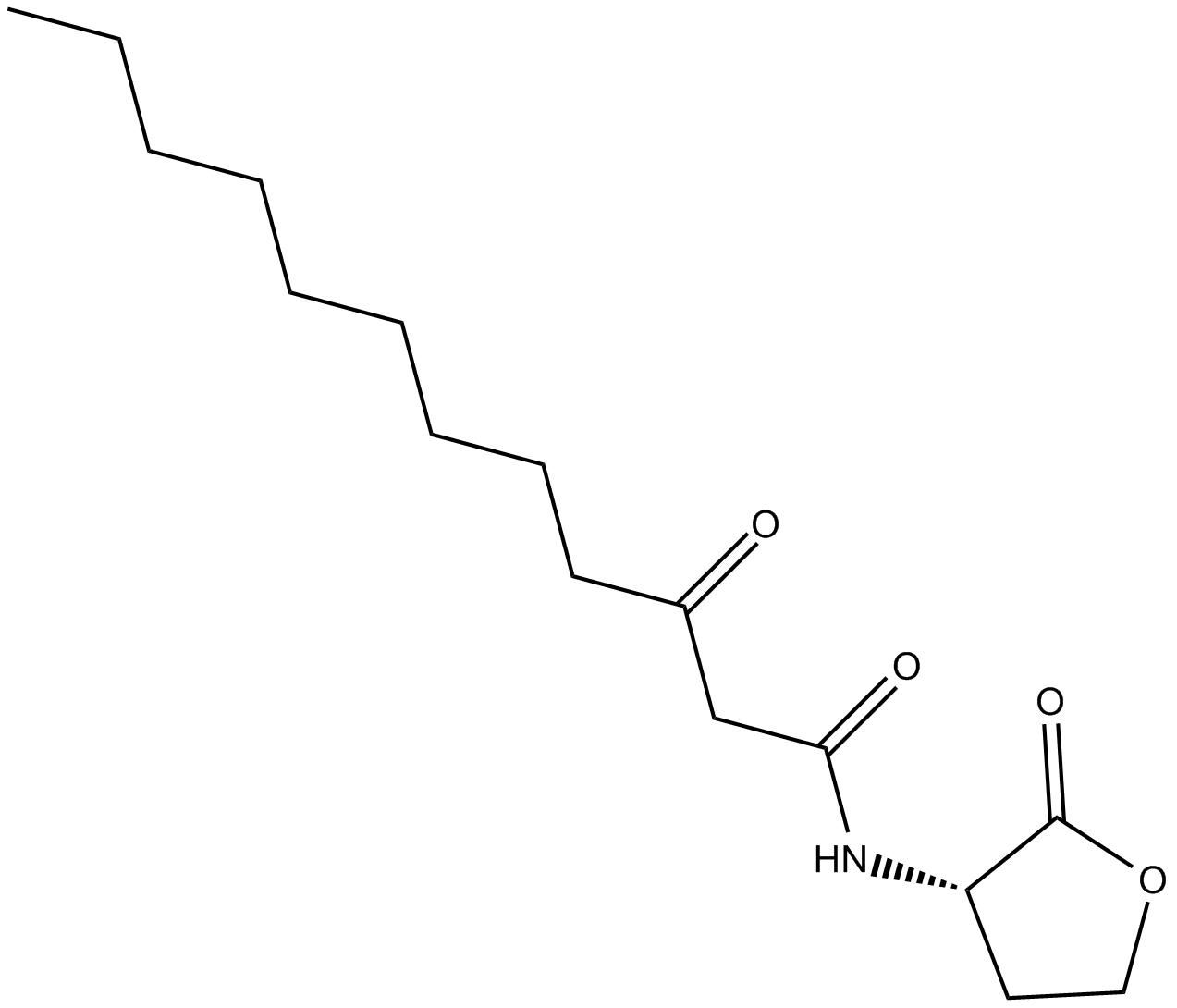
Cas No.: 168982-69-2
Sample solution is provided at 25 µL, 10mM.
;)
,-1-7$$$37316672.jpg');)
;)
;)
$$$36806353.jpg');)
;33(7)%EF%BC%9A546-561$$$37156877.jpg');)
;)
;)
;)
%201124-1138.$$$35908550.jpg');)
%20766-780.$$$37100057.jpg');)
%20418-432.$$$36893736.jpg');)
%EF%BC%9A-240-255.$$$35108512.jpg');)
533-545$$$36543525.jpg');)
%201-13.$$$36600053.jpg');)
;)
N-3-oxo-dodecanoyl-L-Homoserine lactone (3-oxo-C12-HSL), as a quorum-sensing (QS) molecule produced by Gram-negative bacteria in the gastrointestinal tract, is a major inducer of oxidative stress indicated by a high level of intracellular reactive oxygen species (ROS)[1].
In vitro, 100μM 3-oxo-C12 HSL elevates intracellular free calcium in platelet, and 3-oxo-C12 HSL induces intracellular calcium-dependent ROS generation[2]. In vitro, 3-oxo-12-HSL also significantly inhibited LPS (lipopolysaccharides) induced IL-6 release at 10 μM, while 100 μM reduced IL-6 release by almost 75%[3]. In vitro, treatment of fibroblasts with 50 μM 3O-C12-HSL for 1 or 3 h (in contrast to 10 μM and the control) resulted in a rapid fragmentation of mitochondrial network, as evidenced by decreased mitochondrial length and area and an elevated number of small mitochondria[4]. In addition, 50 μM 3O-C12-HSL increases the cell area and protrusive activity of macrophages[5].
In vivo, Passively sensitized mice that had been treated with 3-oxo-12-HSL (3 mg/kg) 1 h prior to antigen exposure showed a significant (60%) decrease in PCA (passive cutaneous anaphylaxis) response[3].
References:
[1] Tao S, et al. Caspase-1-dependent mechanism mediating the harmful impacts of the quorum-sensing molecule N-(3-oxo-dodecanoyl)-l-homoserine lactone on the intestinal cells. J Cell Physiol. 2019 Apr;234(4):3621-3633.
[2] Yadav VK, et al. Pseudomonas aeruginosa quorum sensing molecule N-3-oxo-dodecanoyl-l-homoserine lactone activates human platelets through intracellular calcium-mediated ROS generation. Int J Med Microbiol. 2018 Oct;308(7):858-864.
[3] Khambati I, et al. The bacterial quorum-sensing molecule, N-3-oxo-dodecanoyl-L-homoserine lactone, inhibits mediator release and chemotaxis of murine mast cells. Inflamm Res. 2017 Mar;66(3):259-268.
[4] Josephson H, et al. Pseudomonas aeruginosa N-3-Oxo-Dodecanoyl-Homoserine Lactone Impacts Mitochondrial Networks Morphology, Energetics, and Proteome in Host Cells. Front Microbiol. 2020 May 25;11:1069.
[5]Holm A, et al. Pseudomonas aeruginosa N-3-oxo-dodecanoyl-homoserine Lactone Elicits Changes in Cell Volume, Morphology, and AQP9 Characteristics in Macrophages. Front Cell Infect Microbiol. 2016 Mar 24;6:32.


Average Rating: 5 (Based on Reviews and 7 reference(s) in Google Scholar.)
GLPBIO products are for RESEARCH USE ONLY. Please make sure your review or question is research based.
Required fields are marked with *